

A lot of D8 carts on the market are genuinely bad. We’re talking cutting agents, mystery oil, hardware that clogs on day two, and COAs that only test for potency (which is the bare minimum, not the bar). This guide is how you avoid all of that. It covers what a Delta 8 cart actually is, how to read the difference between distillate and live resin, how to match a strain to what you’re actually trying to do, which battery works best with which cart, what a proper COA looks like, and how to fix a clogged cart when it happens. 4.87/5 from 551 cart-specific reviews.
🧪 Lab Tested | 👩💼 Woman-Owned | 🏆 Est. 2017
IN THIS GUIDE
Delta 8 Carts at a Glance
| What it is | 510-thread oil cartridge filled with Delta 8 THC concentrate; hemp-derived, hemp-derived |
| Two oil types | Distillate (refined, potent, clean) and live resin (full terpene profile, richer flavor) |
| Standard size | 1 gram (700-950mg active Delta 8 THC) |
| Thread type | 510-thread; works with any 510-compatible battery |
| Onset | 5-10 minutes |
| Duration | 2-4 hours |
| Quality signal | Full-panel third-party COA (potency + heavy metals + pesticides + residual solvents + microbials) |
| Drug test risk | High. Delta 8 carts will produce a positive result on a standard drug test. |
| TribeTokes cart rating | 4.87/5 from 551 Delta 8 cart reviews |
What Is a Delta 8 Cart?
A Delta 8 cart is a pre-filled oil cartridge containing Delta 8 THC concentrate. It screws onto a 510-thread battery (sold separately), which heats the oil to vaporization temperature. You inhale the vapor. The cannabinoids absorb through lung tissue directly into the bloodstream, bypassing the digestive system. That’s why you feel it in minutes rather than an hour.
The “510” in 510-thread refers to the connection standard: 10 threads at a 5mm pitch. It’s the universal size across the vaping industry. Any 510 cart works with any 510 battery. (This is genuinely useful information the first time you accidentally buy the wrong battery: it doesn’t exist. They all fit.)
Delta 8 THC is a naturally occurring cannabinoid in hemp, though only in trace amounts. The Delta 8 in commercial carts is produced by isomerizing hemp-derived CBD, a chemical process that rearranges the molecular structure. Responsible sourcing and production at every stage matters for what ends up in the final product. Third-party lab testing is the only way to verify it.
Delta 8 THC is within the federal hemp definition when derived from hemp. It is psychoactive. The effects are generally described as clearer and less anxious than Delta 9 THC at comparable doses. But it still gets you high, and standard drug tests cannot tell the difference between Delta 8 and Delta 9 metabolites. Plan accordingly.
Cart Anatomy: What You’re Actually Buying
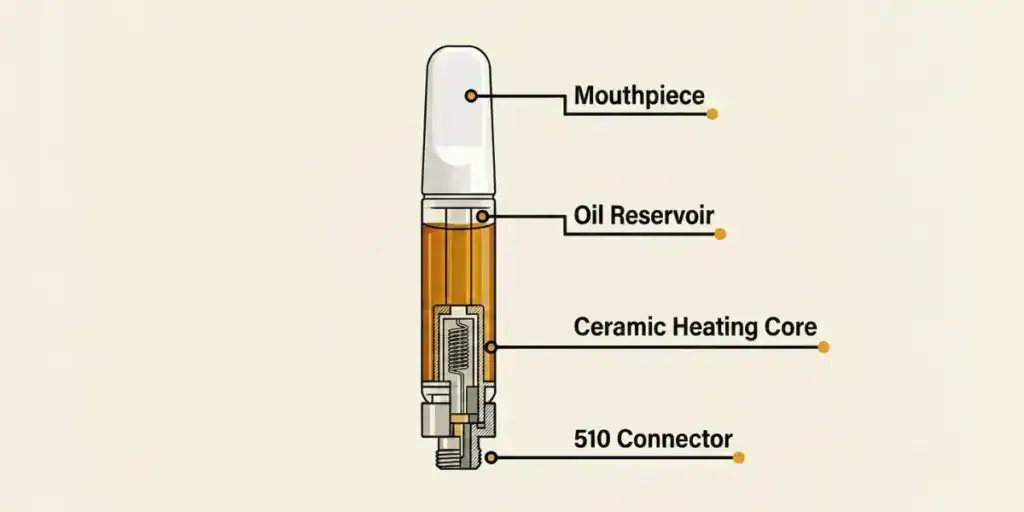
Most Delta 8 carts look similar from the outside. The differences that matter are inside.
Mouthpiece. Plastic or ceramic. Ceramic mouthpieces don’t impart flavor; plastic ones occasionally do, especially as they warm up. If flavor is your priority, ceramic is the right call.
Oil reservoir. Usually borosilicate glass or PCTG plastic. Glass is inert and won’t react with the oil; quality plastic is fine too. The reservoir is what holds the concentrate. 1 gram is the standard, though 0.5g half-gram carts exist. At 1 gram, you’re getting roughly 700-950mg of active Delta 8 THC depending on the formulation.
Heating element (coil/core). This is where quality matters most. Ceramic core heating elements are the standard in quality carts: they produce cleaner vapor, preserve terpene character better than metal coils, and are less likely to burn oil at high temperatures. Metal coils (usually nichrome or kanthal wire) are more common in cheap carts. Burnt-tasting hits on low quality hardware often come from metal coil burnoff, not the oil itself.
510 connector. The threaded metal base that screws into your battery. All 510s are compatible. The connection should be snug but not cranked down. Overtightening can damage the contact pin, which is the most common hardware failure mode outside of clogs.
What you don’t want in any of these components: cutting agents in the oil. Vitamin E acetate, MCT oil, and propylene glycol are red flags: these were behind the EVALI lung injury outbreak in 2019. Quality Delta 8 oil is just oil and terpenes. If an ingredient list goes further than that, ask why.
Distillate vs. Live Resin
This is the most meaningful choice you’ll make in the Delta 8 cart category, and most brands don’t explain it clearly.
| Distillate Carts | Live Resin Carts | |
| Starting material | Dried/cured hemp extract, highly refined | Fresh-frozen hemp, preserved at harvest |
| Delta 8 concentration | Higher (80-95%) | Lower by percentage, but with supporting cannabinoids |
| Terpene profile | Mild to moderate; added back post-distillation | Full, preserved from the plant before degradation |
| Flavor | Clean, mild, strain-forward | Complex, rich, sometimes fruity or dank depending on strain |
| Effect character | Clean Delta 8 high, predictable | Broader, more layered; entourage effect in play |
| Price | Lower | Higher (more complex extraction process) |
| Best for | Consistent daily use, potency-first users | Flavor-first users, those who want full-plant complexity |
Distillate
Distillate is refined Delta 8 oil with most other plant compounds removed. The result is highly concentrated, clean, and predictable. TribeTokes full-spectrum distillate carts add cannabis-derived terpenes back after distillation, which gives them actual flavor rather than the bland, almost artificial character of plain distillate. Kathryn M. tried the live resin London Poundcake and said it “actually tastes like buttery vanilla, so smooth.” That’s a live resin experience. Distillate carts are more like a clean, direct hit with strain character from the reblended terpenes.
Live Resin
Live resin starts with hemp that’s flash-frozen immediately after harvest, before any drying or curing can degrade the terpenes and minor cannabinoids. The full plant profile is preserved in the extract. More terpenes means more flavor complexity and what researchers call the entourage effect: the observed phenomenon where cannabinoids and terpenes appear to work better in combination than any single compound alone. Live resin carts cost more because the process is more involved, but for flavor-first users, there’s no comparison. “My Piña Colada and Slurricane vapes complement one another nicely for day and night time use. Immensely flavorful and effective,” wrote Ian S.
Which Should You Buy?
Neither is objectively better. Distillate delivers reliable, potent Delta 8. Live resin delivers the full plant experience. Plenty of regular users keep both in rotation for different situations: distillate for the workweek, live resin for when the weekend actually starts. If you’re new to Delta 8 carts, start with distillate to establish your baseline. Once you know where you land dosing-wise, live resin is worth exploring.
Strain Guide: Matching Effects to Your Day
Strain selection is the other major variable in the cart-buying decision. Indica, sativa, and hybrid signal the terpene profile and the general direction of the experience. Individual response varies. The indica/sativa framework is a useful map, not a guarantee.
| Strain | Type | Character | Best for |
| Northern Lights | Indica | Deep, heavy-body relaxation; earthy, piney | Evening, sleep support, unwinding after a long day |
| Granddaddy Purp | Indica | Relaxed, slightly sedating, grape and berry notes | Nighttime; Debbie M. called it better than Northern Lights for her specifically |
| Zkittlez | Indica | Calm, happy, fruity candy profile | Relaxed evening use; Phillip M. calls it “only 2 ingredients, cannabis and terps” |
| Remedy | Indica | Mellow, low-key; Lori J.: “only takes a hit or two to do the job” | Microdosers, sensitivity-first users |
| Maui Wowie | Sativa | Uplifting, tropical, energizing without edge | Daytime, creative work, social settings |
| NYC Diesel | Sativa | Heady, focused, citrus-forward | Active daytime use; work-week sativa |
| Mango Haze | Sativa | Light, sweet mango profile; clear-headed | Daytime, lower-tolerance users wanting sativa effects |
| Green Crack | Sativa | Sharp, energizing, citrus and sweet earth | Functional daytime use; not a sleep strain |
| Birthday Cake | Hybrid | Sweet, vanilla-forward; relaxed but present | Anytime; alexis g. says “I never let birthday cake run out, it’s always in rotation” |
| Blue Dream | Hybrid | Balanced body and head; berry, herbal | Flexible daytime to early evening |
| Pineapple Express | Hybrid | Bright, tropical, mild and accessible | Good entry point for sativa-curious indica users |
| Gelato | Hybrid | Sweet, dessert-forward; Bayyenah A.: “might be low-key obsessed” | Evening hybrid; social or solo |
| Lemon Haze | Sativa | Bright citrus, uplifting, clean | Daytime, mood elevation |
“The sativa knocks the work day edge off. The indica allows you to leave the work day behind,” wrote James B. Buy one of each. Rotate. Most regular users figure this out within a few orders.
The You Pick 2 and You Pick 3 bundles exist specifically for this: mix and match strains at a discount rather than committing to a full gram of a single strain before you know where it lands for you personally. Solid way to try three strains for roughly the price of two.
Choosing Your Battery
All 510 carts work with all 510 batteries. Compatibility is universal. What varies between batteries is form factor, voltage range, and whether you want adjustable settings or a set-and-forget experience.
| Battery | Form factor | Voltage | Best for |
| Saber | Folding; cart tucks inside the battery body | Adjustable (3 settings) | Regular users who want protection for the cart and adjustable voltage. Long battery life. “Looks so sleek, holds a charge for more than a week,” wrote Robert C. |
| Wand | Slim pen style | Adjustable (3 settings) | Versatile, easy to carry, voltage control. Tim Y.: “Looks and feels like it’s made out of high end materials. My go to vape.” |
| Mini | Compact, pocket-sized | Fixed | Discretion and portability above everything. Levester J.: “Fits perfectly in my pocket discreetly. I am in my zone everywhere and nobody knows.” |
For new buyers, the Saber starter kit is the strongest default. The folding design protects the cart from snapping when it’s in a bag or pocket (a real failure mode), the battery lasts days between charges, and the adjustable voltage lets you tune flavor vs. intensity. The Wand is the sleeker daily-carry option. The Mini is for maximum portability and discretion. Smaller tank, but it does the job.
On voltage: lower settings (around 2.6V) produce cooler, more flavorful vapor. Higher settings (3.2V+) produce denser, more intense hits with more terpene burnoff. For live resin carts, start low to actually taste what you paid for. For distillate, the difference is less pronounced. Go with whatever hit density you prefer.
How to Use and Dose
Screw the cart onto your charged battery. Don’t overtighten. Snug is enough. If the cart has a rubber seal covering the 510 connector, remove it before threading on. (More commonly the source of “it’s not working” than any actual hardware problem.)
If your battery has voltage settings, start at the lowest setting and move up from there over a few sessions. You can always take more. You cannot un-take more.
New to Delta 8 carts: 1-2 puffs, then wait 15-20 minutes. Delta 8 from vaping kicks in fast but doesn’t peak immediately. The number of new users who take five puffs because they felt nothing after two minutes and then feel very much something fifteen minutes later is… significant. Don’t be that person.
Occasional users: 2-4 puffs is a typical session. Strain matters here: an indica at 4 puffs and a sativa at 4 puffs are different experiences, even from the same brand.
Regular users: You already know where you land. If your tolerance has crept up to the point where a 1g cart disappears unreasonably fast, even a few days of abstinence typically resets sensitivity more than you’d expect.
“It only takes a hit or two to do the job,” wrote Lori J. about the Maui Wowie and Remedy carts. Two puffs. Wait. That’s the protocol. Simple, boring, effective.
How to Spot a Quality Delta 8 Cart
The Delta 8 market has a real quality gap, and most of what signals quality is verifiable before you buy. You just have to know what to look for.
The COA Is the Minimum, Not the Whole Picture
A Certificate of Analysis from a third-party ISO 17025-accredited lab is non-negotiable. But a potency-only COA (which confirms how much Delta 8 is in the oil) tells you nothing about safety. A complete COA covers potency, heavy metals (lead, mercury, arsenic, cadmium), pesticides, residual solvents, and microbials. All five panels. If a brand publishes potency only, they’re either cutting corners on testing or hiding something they don’t want you to see. Neither is fine.
TribeTokes publishes full-panel, batch-specific COAs at tribetokes.com/certificates-of-analysis before products ship. Batch-specific means you can verify the actual production run you received, not just a representative sample. That’s how it should work.
Oil Color
Quality distillate Delta 8 oil runs clear to light amber. Quality live resin is amber to golden. Dark, brown, or muddy oil indicates degradation, oxidation, or low-quality starting material. If you hold your cart up to light and the oil looks like motor oil, that’s informative.
No Cutting Agents
The ingredient list for a quality Delta 8 cart is short: Delta 8 THC concentrate and terpenes. That’s it. Vitamin E acetate, MCT oil, propylene glycol, and polyethylene glycol (PEG) are cutting agents associated with lung irritation and were central to the EVALI outbreak in 2019. Any brand adding these has a cost reason for doing so. The cost is yours.
Hardware Red Flags
Cheap carts clog, leak, and burn. The ceramic core hardware in quality carts runs cleaner and longer than metal coil alternatives. Emma S. put the reliability question simply: “I’ve tried different brands of D8 cartridges and always come back to TribeTokes. Cartridges never clog, my favorite brand.” Cart reliability sounds boring until you’ve had three carts from a bargain brand clog on you in a month.
How to Fix a Clogged Cart
Clogs happen even with quality carts, especially in cold weather or after extended storage. The mechanism is simple: oil thickens and solidifies in the mouthpiece or around the airway. Most clear quickly with one of these steps:
Warm it up first. Hold the cart in your palm for 60-90 seconds. Body heat is often enough to thin the oil back to a workable viscosity. Cold oil plus a cold cart is the most common cause of a clog that isn’t actually a hardware problem.
Try a no-fire draw. Cover the airhole (if there is one) with your finger and draw without activating the battery. This creates suction through the cart that can sometimes clear a soft clog without introducing heat.
Low-voltage preheat. Most adjustable batteries have a preheat function: double-click to activate it. This pulses low heat through the coil without burning, which gently warms the oil around the clog. Do this two or three times, then try drawing normally.
Thin needle or pin. If the clog is in the mouthpiece itself (you can see or feel hardened oil at the tip), a thin needle or toothpick can clear it mechanically. Go slow. You’re moving oil, not drilling.
Storage position. Store carts upright, not on their side. On their side, oil migrates toward the mouthpiece and can create a residue clog over time. Upright keeps the oil near the heating element where it belongs.
What not to do: Do not use a hair dryer or heat gun. The oil expands faster than the glass/plastic reservoir can accommodate and the cart can crack or burst. Body heat and low-voltage preheat are the safe options. If a cart remains clogged after all of the above, contact the brand. A good brand will replace it. TribeTokes does.
Delta 8 Carts and Drug Testing
Delta 8 carts will produce a positive result on a standard drug test. This is not negotiable and it doesn’t matter that Delta 8 is within the federal hemp definition, hemp-derived, or labeled differently from Delta 9. Standard immunoassay tests detect THC-COOH, a metabolite that Delta 8 and Delta 9 both produce through the same metabolic pathway. The test cannot distinguish the source.
For urine testing (the most common workplace format): occasional users typically clear the 50 ng/mL detection threshold within 3-7 days. Regular daily users can test positive for 30 days or longer. THC-COOH is fat-soluble and accumulates with repeated use. Frequency matters far more than the size of any individual dose.
If you are subject to any drug testing, do not use Delta 8 products. If you want cannabinoid products without the testing risk, CBD-only products with COAs confirming non-detectable Delta-9 THC are the right move. TribeTokes CBD products are verified THC-free by batch.
TribeTokes Delta 8 Carts
TribeTokes has been making Delta 8 carts since 2017. The lineup covers 13+ strain-specific options across distillate and live resin, from evergreen indicas like Northern Lights and Granddaddy Purp to live resin sativas like Piña Colada and Strawberry Cough. Every cart is third-party tested at ISO 17025-accredited labs with full-panel COAs published by batch. Full-spectrum distillate carts use cannabis-derived terpenes (not botanical substitutes), which is why the strain character actually comes through.
“All that I have ordered have been superb. Great quality. Great vibes. Great taste. I can recommend them without reservation,” wrote Carl C. after multiple orders across strains. 4.87/5 from 551 cart reviews. Woman-owned since 2017.
Shop: all Delta 8 carts | full-spectrum distillate carts | Delta 8 live resin carts | You Pick 2 | You Pick 3 | batteries and starter kits
Frequently Asked Questions
A 510-thread Delta 8 cart is a pre-filled oil cartridge containing Delta 8 THC concentrate. The “510” refers to the connection standard (10 threads at 5mm pitch), which is universal across the vaping industry. Any 510 cart attaches to any 510 battery. The cart contains a ceramic heating element and an oil reservoir, typically 1 gram, containing 700-950mg of active Delta 8 THC. You need a separate battery to use it.
Distillate carts use highly refined Delta 8 oil with most other plant compounds removed. The result is potent, clean, and predictable, with mild to moderate flavor. Live resin carts start with fresh-frozen hemp; the flash-freeze preserves the full terpene and cannabinoid profile before any degradation. The result is richer flavor and what most users describe as a more layered effect (the entourage effect in action). Live resin costs more due to the more complex extraction process. Neither is objectively better: distillate for consistency, live resin for depth.
Indica strains are generally body-forward and relaxing, suited for evening use. Sativas lean energizing and head-forward, better for daytime. Hybrids land somewhere in between. The framework is a useful starting point, not a guarantee. Individual response varies based on terpene sensitivity and tolerance. For most new users, a hybrid is the lowest-risk starting point. Once you know where you land with a hybrid, you can go fuller indica or sativa from there.
Yes. 510 is a universal industry standard. Any 510-thread cart screws onto any 510-thread battery. The one exception: some proprietary pod systems (JUUL, certain brand-specific ecosystems) use non-510 connections and are not compatible. If the battery says 510, the cart fits.
It depends heavily on draw length and battery voltage, but a rough estimate for a 1-gram cart is 200-300 puffs at moderate draw length and voltage. Heavy users pulling long, high-voltage hits will go through a cart faster; light users taking short 2-second draws will get more out of it. At 1-2 puffs per session, a 1-gram cart typically lasts most users 2-4 weeks of regular use.
Clogging is almost always caused by thickened oil blocking the airpath, usually from cold temperatures or extended storage on its side. To fix: warm the cart in your palm for 60-90 seconds, then try drawing without activating the battery to create suction. If that doesn’t work, use your battery’s preheat function (usually a double-click) to pulse low heat through the coil. Store carts upright between uses to prevent future clogs. Do not use a hair dryer: the rapid heat expansion can crack the reservoir.
A complete COA from a third-party ISO 17025-accredited lab should cover five panels: Delta 8 THC potency, heavy metals (lead, mercury, arsenic, cadmium), pesticides, residual solvents, and microbials. Potency-only COAs are insufficient: they confirm what’s in the oil but say nothing about contaminants. Look for batch-specific COAs (tied to the production batch you received) rather than one-time tests from product launch. TribeTokes publishes batch-specific full-panel COAs at tribetokes.com/certificates-of-analysis.
Yes. Delta 8 and Delta 9 THC produce the same primary urinary metabolite (THC-COOH), which standard drug screens detect. The product’s federal legal status under federal hemp law has no effect on test results. For a standard urine screen, occasional users typically test positive for 3-7 days; regular daily users can test positive for 30 days or longer. If you face any drug testing, do not use Delta 8 products.
Check the ingredient list: it should say Delta 8 THC (or hemp-derived Delta 8 distillate or live resin) and terpenes. Nothing else is required or acceptable. Vitamin E acetate, MCT oil, propylene glycol, and polyethylene glycol (PEG) are cutting agents associated with lung irritation and the 2019 EVALI outbreak. If a brand doesn’t publish a full ingredient list, that’s informative on its own. A complete COA with a passing residual solvents panel also provides some confirmation that problematic additives aren’t present.
For live resin carts, start at the lowest voltage setting (around 2.6V) to preserve the terpene profile. You’re paying for that complexity, so actually taste it. For distillate carts, the difference between low and mid voltage (2.6-3.2V) is less pronounced, and it comes down to whether you prefer more flavor at lower temp or more vapor density at higher. Avoid maximum voltage settings for regular use: high heat degrades terpenes and can introduce coil burnoff taste in metal-coil hardware. Most adjustable batteries (Saber, Wand) give you 3 settings; start low and move up.
Shop TribeTokes Delta 8 Carts
4.87/5 from 551 cart reviews. 13+ strains, distillate and live resin, batch COAs before every shipment. Woman-owned since 2017.