If you take a 25mg CBD gummy and your friend inhales a 25mg CBD vape, you are not taking the same dose. Not even close. Only about 1 to 5mg of the CBD in your gummy reaches your bloodstream. Your friend may absorb 8 to 14mg from the same label weight. That gap is bioavailability, and it is the single most important concept for understanding why different CBD products produce such different experiences. This guide walks through what bioavailability actually means, the specific percentage ranges for every major delivery method, how fast each one kicks in, how long it lasts, and how to think about dose equivalence when you move between formats.
🧪 Lab Tested | 👩💼 Woman-Owned | 🏆 Est. 2017
CBD Bioavailability at a Glance
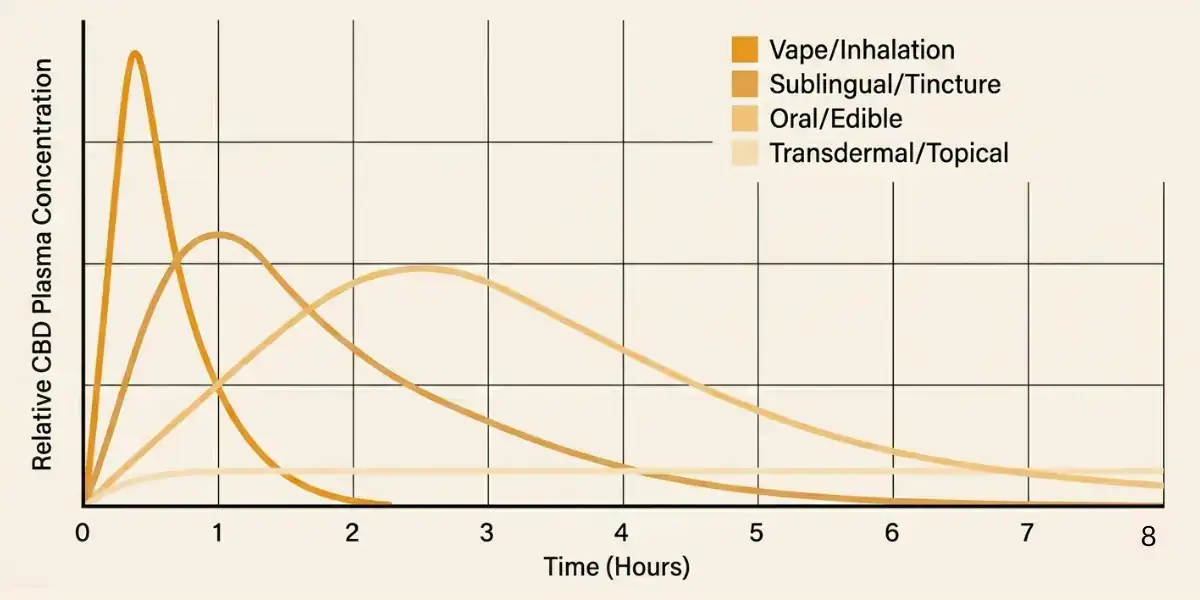
| Inhalation (vape/flower) | 34 to 56% bioavailability. Onset 2-10 min. Duration 2-3 hr |
| Sublingual (tincture under tongue) | 12 to 35%. Onset 15-45 min. Duration 4-6 hr |
| Oral (gummy, capsule, beverage) | 4 to 20% (most sources report 6-13% average). Onset 30-120 min. Duration 4-8 hr |
| Topical (cream, lotion) | <1% systemic (mostly localized). Onset 15-60 min (local). Duration hours |
| Transdermal patch | Delayed systemic delivery. Tmax up to 38 hr post-application |
| Fastest onset | Inhalation. Seconds to lungs, minutes to brain |
| Longest duration | Oral (edibles). Single dose lasts 6 to 8+ hours |
| Most predictable dose | Sublingual tincture. Avoids stomach variability while allowing precise dosing |
| Primary reference | Millar et al. 2018, Frontiers in Pharmacology, systematic review of human CBD pharmacokinetics |
What Is Bioavailability, and Why Does It Matter?
Bioavailability is the proportion of a substance that reaches your systemic circulation (your bloodstream, in other words) in an active, unchanged form. It’s expressed as a percentage. A drug given intravenously has 100% bioavailability by definition, because it goes directly into the blood. Every other route of administration (oral, inhaled, sublingual, topical) delivers less than 100% and the exact percentage depends on how much of the dose gets absorbed and how much survives the trip.
For CBD, bioavailability matters in two concrete ways:
- Label dose is not body dose. A 25mg gummy does not give your body 25mg of CBD. It gives you roughly 1 to 5mg depending on conditions. Dosing calculations that treat the label number as the blood level are wrong
- Products at the same label dose feel different. Two 25mg CBD products with different delivery methods can produce noticeably different subjective effects because one delivers five times more active CBD to your blood than the other
The primary academic reference for this entire topic is a 2018 systematic review by Millar, Stone, Yates, and O’Sullivan in Frontiers in Pharmacology (Volume 9, Article 1365). They analyzed 24 pharmacokinetic studies of CBD in humans and documented half-life ranges, peak plasma concentrations, and bioavailability estimates across multiple routes. It’s the canonical citation most other CBD articles should (and don’t always) point to.
The First-Pass Metabolism Problem
Before we break down each delivery method, one piece of physiology makes the whole picture make sense: the liver’s first-pass metabolism.
When you swallow a CBD gummy, the CBD goes through your stomach, gets absorbed in the small intestine, and enters your portal venous blood. That blood drains directly into your liver before it reaches the rest of your body. In the liver, a family of enzymes called cytochrome P450 (primarily CYP3A4 and CYP2C9 for CBD) metabolize a large portion of the CBD before it can leave the liver and enter systemic circulation. That’s first-pass metabolism. It’s the same process that makes oral delta-9 THC edibles take so long to hit, and the same process that creates the 11-hydroxy-THC metabolite that makes edibles feel different from smoked cannabis.
First-pass metabolism is why oral CBD has such low bioavailability. Most of the CBD never gets to your blood intact. Routes that bypass the digestive tract (inhalation, sublingual, topical, transdermal) skip the first-pass and deliver more CBD to circulation per milligram consumed. That’s the single biggest variable behind why different delivery methods produce such different effective doses.
Method 1: Inhalation (Vapes and Smoking)
Bioavailability: 34 to 56%
Onset: 2 to 10 minutes
Duration: 2 to 3 hours
Inhalation is the highest-bioavailability delivery method by a wide margin. When you inhale CBD vapor or smoke, the CBD crosses from the alveoli in your lungs directly into your pulmonary capillaries, then into your heart, and from there to the rest of your body within seconds. There’s no first-pass metabolism because the blood leaving the lungs doesn’t go through the liver first.
The range (34 to 56%) reflects variation across studies and across device types. High-quality vaporizers with precise temperature control tend to sit at the high end. Combustion (smoking) sits lower, both because some CBD is destroyed by heat and because deeper inhalation patterns and breath-hold times vary between users. McGilveray’s 2005 pharmacokinetic review in Pain Research and Management reported similar patterns for inhaled cannabinoids more broadly, with smoked THC averaging around 30% bioavailability and considerable inter-individual variation.
Inhalation is the method of choice when you need fast onset. Most people feel effects within 5 to 10 minutes, and you can titrate dose in real time by taking additional puffs. The trade-off is duration: the effects fade relatively quickly, typically within 2 to 3 hours for a single session.
Health context for inhalation
Smoking any plant material exposes your lungs to combustion byproducts, including tar and polycyclic aromatic hydrocarbons. Vaping CBD oil avoids most combustion but introduces its own considerations (thinning agents, heating-element compatibility, device quality). If you’re using inhaled CBD regularly, look for clean vape formulations that use hemp-derived terpenes and avoid propylene glycol-heavy dilutents. Our CBD vape cartridge collection is built for this reason.
Method 2: Sublingual (Tinctures and Oils)
Bioavailability: 12 to 35%
Onset: 15 to 45 minutes
Duration: 4 to 6 hours
Sublingual administration is the middle ground between inhalation and oral. When you hold a CBD tincture under your tongue for 60 to 90 seconds before swallowing, some of the CBD absorbs through the highly vascularized mucous membranes in your mouth and enters systemic circulation directly, bypassing the liver.
The catch: most people don’t actually use tinctures sublingually. They drop the oil on their tongue, swallow immediately, and effectively convert the tincture into an oral dose. If you want the sublingual bioavailability advantage, you have to hold it under the tongue. The longer you hold it (up to about 90 seconds), the more absorbs through the oral mucosa. Whatever isn’t absorbed sublingually gets swallowed and enters the normal oral pathway, so you get a mix of both routes.
Tinctures are the most flexible dosing format. You can measure single-milligram precision using the dropper, adjust up or down easily, and get a middle-ground onset that’s faster than gummies but not as immediate as vaping. The primary downsides are the hemp taste (mitigated with flavored formulations) and the discipline required to actually hold the dose under the tongue.
MCT oil and absorption
Most CBD tinctures use MCT (medium-chain triglyceride) oil as a carrier. MCT is chosen because it’s well-tolerated, flavor-neutral, and may slightly improve CBD absorption by keeping the lipophilic CBD molecule dissolved and bioavailable to mucosal tissue. The research on MCT versus other carrier oils for CBD specifically is limited, but MCT is the standard for practical reasons.
Method 3: Oral (Gummies, Capsules, Beverages)
Bioavailability: 4 to 20% (most sources report 6 to 13% average)
Onset: 30 to 120 minutes
Duration: 4 to 8 hours
Oral CBD is the most consumed form because it’s the most convenient (no holding, no inhaling, just chew and swallow). It’s also the lowest-bioavailability method because it runs headlong into the first-pass metabolism problem described above. Most of the CBD you swallow either doesn’t get absorbed from the gut or gets metabolized in the liver before reaching systemic circulation.
The bioavailability range is wide because several variables affect absorption:
- Formulation matters. A gummy with the CBD simply mixed into the base has lower bioavailability than a gummy where the CBD is formulated with emulsifiers or in a lipid carrier
- Food effect is large. Consuming CBD with a high-fat meal can substantially increase absorption, sometimes more than doubling total exposure compared to a fasted state
- Individual CYP enzyme activity varies. People with slower CYP3A4 or CYP2C9 activity clear less CBD during first-pass, which raises their effective bioavailability
Oral CBD has the longest duration of the common methods. Because absorption is slow and metabolism is gradual, effects typically last 4 to 8 hours or more. That’s part of the appeal for evening use or sustained-throughout-the-day dosing.
The honest commercial note: the low-bioavailability reality is why most consumer CBD gummies in the 10 to 25mg range produce inconsistent subjective effects. When only 6 to 13% of the label dose is actually getting into your blood, you’re working with 1 to 3mg effective doses. That’s at or below the threshold where most people notice anything.
Method 4: Topical (Creams and Lotions)
Systemic bioavailability: less than 1%
Local onset: 15 to 60 minutes
Local duration: varies, typically hours
Topical CBD is a different category. Standard creams, lotions, salves, and balms are not designed to deliver systemic CBD. They’re designed to deliver localized effect at the application site, where the CBD interacts with cannabinoid receptors in the skin and superficial tissues.
CBD is strongly lipophilic (fat-soluble) with a log-p in the 6 to 7 range, which means it doesn’t cross the aqueous outer layer of skin easily. Standard topical formulations tend to keep the CBD in the stratum corneum and underlying layers without reaching the bloodstream. That’s fine if your goal is localized effect (muscle soreness, joint discomfort, skin-level support) but it’s the wrong delivery method if you’re trying to influence the whole body.
If a topical advertises “systemic bioavailability,” that’s a red flag unless the product is a specialized transdermal system (next section). Standard creams are local-only by design.
Method 5: Transdermal (Patches)
Systemic bioavailability: variable, product-specific
Onset: slow, gradual
Tmax (time to peak blood level): up to 38 hours post-application
Transdermal patches are distinct from standard topicals. They’re formulated with permeation enhancers (often ethanol, oleic acid, or proprietary delivery systems) specifically designed to push cannabinoids through the skin barrier and into systemic circulation. A 2022 exploratory study on a novel transdermal CBD/THC delivery system in Advances in Therapy found that time to peak plasma concentration can extend up to 38 hours after application, with a smaller maximum concentration than what inhaled or oral dosing produces but with much longer steady-state plasma levels.
The practical use case for transdermal CBD is prolonged, consistent dosing without peaks and valleys. You apply the patch, it delivers cannabinoids into your bloodstream over many hours, and you get a flatter pharmacokinetic curve than any oral or inhaled dose could produce. The trade-off: slow onset and the product-quality question (well-designed patches are expensive and uncommon; poorly designed patches function more like topicals).
Side-by-Side Method Comparison
| Method | Bioavailability | Onset | Peak | Duration | Primary Use Case |
| Inhalation | 34-56% | 2-10 min | 15-30 min | 2-3 hr | Fast relief, precise titration |
| Sublingual | 12-35% | 15-45 min | 1-2 hr | 4-6 hr | Precise dosing, middle-ground speed |
| Oral (edibles) | 4-20% | 30-120 min | 2-4 hr | 4-8 hr | Long-lasting, convenient |
| Topical | <1% systemic | 15-60 min (local) | Varies | Hours (local) | Localized effect only |
| Transdermal patch | Product-specific | Hours | Up to 38 hr | 24+ hr | Sustained steady-state delivery |
Factors That Change Your Personal Bioavailability
The percentages above are population averages from clinical studies. Your individual bioavailability on any given dose depends on several variables.
- Food, especially fat content. A high-fat meal can substantially increase oral CBD absorption. For oral CBD you actually want to eat something fatty, the opposite of what you’d do with most medications
- Body composition. CBD is lipophilic and distributes into fat tissue. Higher body fat percentage means more of the absorbed CBD gets sequestered into adipose storage rather than circulating to receptors
- Liver enzyme activity. CYP3A4 and CYP2C9 variability (genetic and drug-induced) changes how much first-pass metabolism removes before the CBD reaches circulation
- Drug interactions. CBD inhibits CYP3A4 and CYP2C9 itself, which can raise blood levels of medications that use those enzymes. That same inhibition, applied to CBD’s own metabolism, means co-administration with certain drugs can raise CBD’s effective bioavailability
- Inhalation technique. Deep, slow inhalation with 3 to 5 second breath-hold maximizes alveolar absorption. Shallow, fast puffs deliver less
- Formulation quality. Nanoemulsions, liposomes, and self-emulsifying drug delivery systems can improve oral bioavailability. So can MCT-based carrier oils in tinctures. Product formulation matters as much as route
- Tolerance. Regular CBD use can upregulate CYP450 enzyme activity, increasing clearance and reducing perceived effects over time. Tolerance breaks (2 to 4 weeks) can reset this
The practical implication: if you’re trying to compare products or figure out what dose you actually need, treat the label number as a starting point and adjust based on what you observe, not what you expect.
Dose Equivalence Across Methods
How do you translate a dose from one method to another? There isn’t a clinical-grade answer, but you can make reasonable approximations using the midpoint of each bioavailability range.
| If you take this… | Approximate blood CBD | Oral equivalent | Sublingual equivalent | Inhaled equivalent |
| 25mg oral (gummy) | ~2-3mg | 25mg | 10mg | 5mg |
| 25mg sublingual (tincture) | ~6-7mg | 60-75mg | 25mg | 12-15mg |
| 25mg inhaled (vape) | ~11-14mg | 100-150mg | 45-55mg | 25mg |
These are rough approximations. Individual bioavailability varies enough that the same label dose could produce 2x differences between two people using the same method. Use this as a directional tool, not a formula.
The practical takeaway: if a 25mg oral gummy produces no noticeable effect, that’s often because the effective blood dose is 2 to 3mg, which is below most users’ perceptual threshold. Switching to the same label-dose tincture (held sublingually) or vape can produce dramatically different results without increasing the product weight at all.
Which Method for Which Goal?
Different situations favor different delivery methods. A practical breakdown.
Choose inhalation (vape or flower) if:
- You need fast relief (less than 10 minutes to onset)
- You want to titrate dose in real time by taking additional puffs
- You’re dealing with an acute situation and don’t want to wait 90 minutes
- You’re okay with a shorter effect window (2 to 3 hours)
- You have healthy lungs and you’re comfortable with the respiratory route
Choose sublingual (tincture) if:
- You want the bioavailability advantage without inhaling
- You need precise, adjustable dosing (single-milligram increments)
- You’re comfortable with a 15 to 45 minute onset
- You want a middle-ground duration (4 to 6 hours)
- You can commit to holding the oil under your tongue for 60 to 90 seconds
Choose oral (gummy, capsule, beverage) if:
- You want the longest duration of any common method (4 to 8+ hours)
- You prefer the convenience and taste of a food-like product
- Slow onset is acceptable for your use case (evening wind-down, sustained dosing)
- You’re willing to dose higher to compensate for lower bioavailability
- You’ll take it with a fatty meal to improve absorption
Choose topical if:
- Your goal is localized effect (specific muscle, joint, or skin area)
- You don’t want any systemic CBD in your bloodstream
- You’re layering with another method for combined systemic + local approach
- Drug testing is a concern and you want to minimize systemic absorption risk
A Note on Nanoemulsions and “Enhanced” Bioavailability
Nanoemulsion CBD products (and adjacent technologies: liposomal CBD, water-soluble CBD, self-emulsifying drug delivery systems) are designed to improve the bioavailability of oral CBD by creating ultra-small droplets of CBD that disperse in water and are more easily absorbed from the gut.
The science is real. Properly formulated nanoemulsion CBD can have 2 to 4 times the oral bioavailability of standard oil-based CBD, which shifts the effective dose of a 25mg gummy from ~2-3mg bioavailable to ~6-10mg bioavailable. That’s a meaningful difference.
The challenge is verification. Most products labeled “nanoemulsion” or “water-soluble” aren’t independently tested for actual particle size or actual human bioavailability. Marketing claims run far ahead of the science for specific products. If a product is selling on “enhanced bioavailability,” look for:
- Particle size disclosure (true nanoemulsions are typically <200 nm)
- Independent pharmacokinetic testing results (not manufacturer claims)
- Third-party lab confirmation of formulation integrity
- Certificate of analysis showing the actual CBD content matches the label
Our guide on reading certificates of analysis walks through what to look for when evaluating any claimed formulation advantage.
Frequently Asked Questions
Inhalation (vaping or smoking). Clinical studies report 34 to 56% bioavailability for inhaled CBD, compared to 12 to 35% for sublingual tinctures and 4 to 20% for oral products like gummies and capsules. Inhaled CBD also has the fastest onset (2 to 10 minutes) because the CBD crosses directly from lungs to bloodstream without any first-pass metabolism.
Oral CBD goes through the digestive tract, gets absorbed in the small intestine, and then passes through the liver before reaching systemic circulation. The liver’s cytochrome P450 enzymes (primarily CYP3A4 and CYP2C9) metabolize a large portion of the CBD before it can leave the liver intact. This first-pass metabolism is why oral bioavailability is 4 to 20% in clinical studies, compared to 34 to 56% for inhalation.
“Better” depends on what you’re trying to do. Sublingual tinctures have higher bioavailability (12 to 35%) than gummies (4 to 20%) because the CBD absorbs through the mouth’s mucous membranes and partially bypasses first-pass liver metabolism. But tinctures only outperform gummies if you actually hold the oil under your tongue for 60 to 90 seconds before swallowing. Gummies are more convenient, taste better, and have a longer duration of effect.
Yes, significantly for oral CBD. A high-fat meal can substantially increase CBD absorption and total exposure (area under the curve), sometimes more than doubling the amount of CBD that reaches your bloodstream. The fat helps dissolve the lipophilic CBD molecule and facilitates absorption from the small intestine. For fastest effects, take CBD on an empty stomach. For maximum absorption, take it with a fatty meal.
Standard CBD topical products (creams, lotions, salves, balms) deliver less than 1% of the applied CBD to systemic circulation. They’re designed for localized effect at the application site, not whole-body dosing. Specialized transdermal patches use penetration enhancers to push CBD through the skin barrier and into the bloodstream, but that’s a different product category from typical topicals.
Nanoemulsion CBD refers to products where CBD is formulated as ultra-small droplets (typically under 200 nanometers) that disperse in water and are absorbed more efficiently than standard oil-based CBD. The underlying science is well established, and properly formulated nanoemulsions can produce 2 to 4 times the oral bioavailability of conventional oral CBD. The challenge is that many products labeled “nanoemulsion” don’t provide independent verification of actual particle size or human pharmacokinetic data. Look for third-party testing before paying a premium for these claims.
Picking the Right Delivery Method
Bioavailability is the hidden variable in every CBD product comparison. Two 25mg products are not equivalent if one is a gummy and the other is a vape, because the vape may deliver four to five times more active CBD to your bloodstream per milligram consumed. Once you understand the pharmacokinetics, the decision between methods becomes less about product marketing and more about what you actually need the CBD to do.
For fast onset and precise real-time titration, inhaled CBD wins on bioavailability. For precise dosing with moderate speed and longer duration, sublingual tinctures hit a solid middle ground. For sustained all-day effect with maximum convenience, oral gummies work well if you accept the lower bioavailability and dose accordingly (and take them with food). The same delivery-method principles apply to THCa products, which is why our THCa vape collection and THCa flower offer the same inhaled-route advantages with a different cannabinoid profile.
Whatever you choose, verify what you’re paying for. TribeTokes publishes third-party certificates of analysis on every batch, with full cannabinoid content so you know the label number reflects what’s actually in the bottle. For the companion decision on CBD format (full spectrum vs broad spectrum vs isolate), our spectrum comparison guide breaks it down. For how CBD compares to THC in the broader picture, read our CBD vs THC guide. And for the entourage-effect science behind why full-plant products often feel different from isolate, see the entourage effect.
Lab tested. Transparent. No bioavailability claims we can’t back up.
Shop TribeTokes Lab-Tested CBD and THCa
Full third-party COAs on every batch. Woman-owned since 2017. Transparent cannabinoid and terpene reporting on every product.