

Short answer: yes. Delta-8 THC will almost always show up on a standard drug test as a positive for marijuana. Your body breaks it down into nearly the same metabolites as Delta-9 THC, and the immunoassay tests used for pre-employment, DOT, and most workplace screenings can’t tell them apart. “Hemp-derived” and “under 0.3% THC” do not change the test result. This guide walks through exactly why, how long each type of test can detect Delta-8, what the SAMHSA cutoffs mean, and one real nuance in confirmatory testing that most guides miss.
🧪 Lab Tested | 👩💼 Woman-Owned | 🏆 Est. 2017
IN THIS GUIDE
- The Short Answer (And the Honest Version)
- Why Delta-8 Shows Up: The Metabolism
- The Four Test Types and What Each One Catches
- Detection Windows by Use Pattern
- SAMHSA Cutoffs and How Federal Testing Works
- The Confirmatory Test Nuance Most Guides Miss
- Factors That Shift Your Personal Detection Window
- Employment, DOT, Probation: Specific Scenarios
- Working with an MRO After a Positive Result
- What About Detox Products?
- A Safer Path If Testing Is in Your Future
- Frequently Asked Questions
- Shop TribeTokes
Delta 8 Drug Test at a Glance
| Will it show up? | Yes, on standard immunoassay urine, blood, saliva, and hair tests |
| Why? | Delta-8 metabolizes into THC-COOH metabolites nearly identical to Delta-9’s |
| Urine detection | 3 to 7 days (occasional) / 30+ days (daily heavy use) |
| Blood detection | 24 to 48 hours (occasional) / up to 25 hours+ (heavy) |
| Saliva detection | 24 to 72 hours (most users) |
| Hair detection | Up to 90 days for any use pattern |
| SAMHSA cutoff (urine) | 50 ng/mL initial immunoassay, 15 ng/mL GC-MS confirmatory |
| Confirmatory nuance | SAMHSA confirmatory targets Δ9-THC-COOH specifically, but this rarely saves you in practice |
| Legal status defense | None. Hemp-derived does not protect against a positive result |
The Short Answer (And the Honest Version)
Yes, Delta-8 THC will show up on a standard drug test as positive for marijuana. That is true whether you bought it in a state where it is fully legal, whether it came from a licensed retailer with a clean certificate of analysis, and whether the total delta-9 THC in the product tested under the 0.3% federal threshold. None of those facts change what a drug test actually measures.
What a standard drug test measures is a metabolite called THC-COOH (specifically, 11-nor-9-carboxy-tetrahydrocannabinol), which your liver produces after breaking down any THC isomer. Delta-8 and Delta-9 both produce closely related versions of this metabolite. The immunoassay strips used in most pre-employment, workplace, and probation panels can’t tell the difference. A positive’s a positive.
If a test is coming and you’ve been consuming Delta-8, your honest options are limited. There’s no reliable way to mask the metabolite. There’s no commercially available product that clears THC-COOH on a predictable timeline. The useful knowledge is in the details: how long each test can detect you, which tests are most sensitive, and where a single real nuance in SAMHSA confirmatory testing exists that most articles online either miss or misrepresent.
Why Delta-8 Shows Up: The Metabolism
Understanding the result starts with understanding what your liver does to Delta-8. Once Delta-8 THC enters your bloodstream (via lungs from a vape, via your digestive system from a gummy, or via sublingual absorption from a tincture), it travels to the liver, where cytochrome P450 enzymes (primarily CYP2C9 and CYP3A4) metabolize it through two stages.
Stage one: Delta-8 THC is hydroxylated into 11-hydroxy-Δ8-THC. This metabolite is psychoactive and contributes to the subjective effects of Delta-8, especially from edibles where first-pass liver metabolism is heaviest.
Stage two: 11-hydroxy-Δ8-THC is further oxidized into 11-nor-9-carboxy-Δ8-THC (Δ8-THC-COOH), the inactive carboxylic acid metabolite. This compound has no psychoactive effect, but it is lipophilic, so it lingers in your fat tissue and is slowly released into circulation over days to weeks. Eventually it leaves the body through urine and feces.
Here is the important parallel: when Delta-9 THC goes through the same liver machinery, it produces 11-hydroxy-Δ9-THC and then 11-nor-9-carboxy-Δ9-THC (the standard “THC-COOH” that every drug test is designed to find). The Δ8 and Δ9 versions of THC-COOH differ only in the position of one double bond in the carbon ring. Structurally they are almost identical. Chemically they behave almost identically. To an antibody-based immunoassay test that recognizes “THC-COOH,” they look like the same molecule.
That is why Delta-8 shows up positive. The test was designed before Delta-8 was a commercial product, and the antibodies used in the immunoassay cross-react with both isomers because they share the region the antibody binds to.
The Four Test Types and What Each One Catches
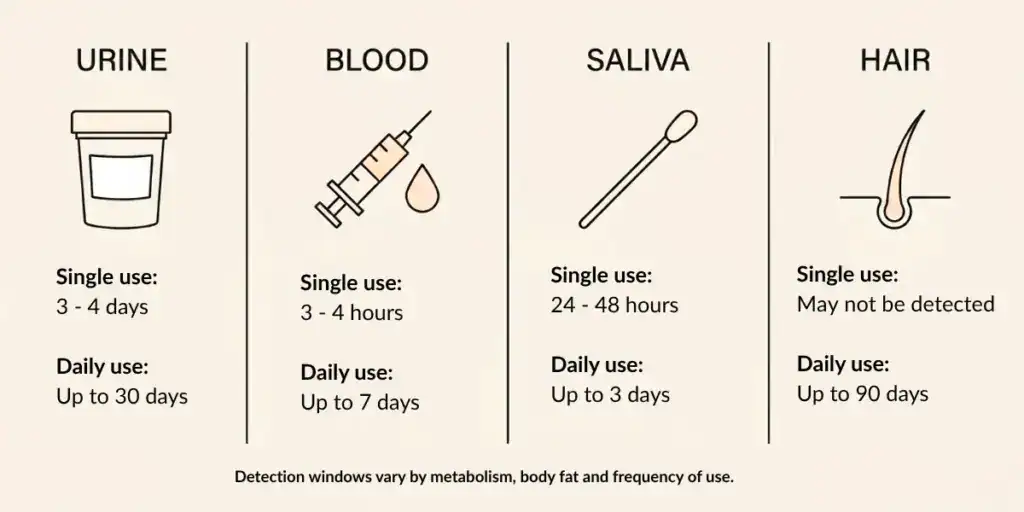
Drug tests come in four main varieties, each with a different detection window and a different sensitivity profile. Here’s how Delta-8 behaves in each one.
| Test Type | What It Measures | Detection Window | Common Use |
| Urine | THC-COOH metabolite | 3 to 30+ days | Pre-employment, DOT, probation, SAMHSA |
| Blood | Active THC and metabolites | 24 to 48 hours (up to ~25 hr for heavy users) | DUI investigations, some clinical settings |
| Saliva | Parent THC compound | 24 to 72 hours | Roadside, some employer random tests |
| Hair | Metabolites bound in keratin | Up to 90 days | Legal proceedings, high-security positions |
Urine tests
By far the most common drug test in the United States. They are what SAMHSA’s Mandatory Guidelines for Federal Workplace Drug Testing prescribe for federal employees and DOT-regulated positions, and most private employers follow a similar protocol. Urine tests measure THC-COOH, which accumulates in fat tissue and leaches out slowly. That is why the detection window varies so widely between occasional users (3 to 7 days) and daily heavy users (30 days or more).
Blood tests
Less common for routine screening because they catch only recent use. Blood levels of THC drop within hours of consumption. Blood tests are most often used in DUI investigations or in clinical settings where recent impairment is the question. For most occasional Delta-8 users, a blood test 48 hours after last use will come back negative.
Saliva tests
Increasingly popular for roadside and some employer random testing because they are easy to administer and catch recent use. Saliva tests detect parent Delta-8 and Delta-9 THC (not the metabolite), so they reflect actual drug use within the last day or two. The window is shorter than urine but longer than blood for most users.
Hair tests
The least forgiving test. THC metabolites circulating in your blood get incorporated into hair follicles as they grow. A 1.5 inch sample of scalp hair covers roughly 90 days of history. Hair tests are common in legal proceedings, security-clearance positions, and some professional licensing contexts. If you used Delta-8 regularly over the last three months, a hair test will almost certainly catch it.
Detection Windows by Use Pattern
The single biggest variable in how long Delta-8 stays detectable is how often you use. Occasional use means your body clears the metabolite before it can build up. Chronic daily use means THC-COOH accumulates in fat tissue and keeps re-entering circulation for weeks after the last dose.
| Use Pattern | Urine | Blood | Saliva | Hair |
| Single use / first time | 3 to 7 days | 24 to 48 hours | 24 to 48 hours | Up to 90 days |
| Occasional (weekly) | 7 to 14 days | 2 to 3 days | 2 to 3 days | Up to 90 days |
| Regular (few times/week) | 14 to 21 days | 3 to 5 days | 2 to 4 days | Up to 90 days |
| Daily heavy | 30+ days (up to 60) | 5 to 7 days | 3 to 4 days | Up to 90 days |
These ranges are typical, not promises. A 130-pound occasional user with a fast metabolism will clear faster than a 220-pound daily user with a high body fat percentage. If you want a more detailed breakdown of the lifecycle factors, our full Delta-8 system guide covers what actually happens to Delta-8 in your body from consumption through excretion.
SAMHSA Cutoffs and How Federal Testing Works
Any conversation about drug testing in the United States has to start with SAMHSA (the Substance Abuse and Mental Health Services Administration), which sets the Mandatory Guidelines for Federal Workplace Drug Testing. These guidelines govern federal employees and DOT-regulated industries (commercial drivers, pilots, transit workers, pipeline operators), and they also set the de facto industry standard that most private employers follow.
The SAMHSA urine test is a two-stage process:
- Initial immunoassay screen at 50 ng/mL. If the sample contains 50 nanograms or more of THC-COOH per milliliter of urine, it is flagged as non-negative and sent for confirmatory testing. If it is below 50 ng/mL, the result is reported as negative and no further testing happens.
- Confirmatory GC-MS or LC-MS/MS at 15 ng/mL. If the initial screen was non-negative, a second portion of the same sample is tested using gas or liquid chromatography mass spectrometry. This test is far more specific. The cutoff drops to 15 ng/mL. If the sample contains 15 ng/mL or more of the specific target metabolite, the result is positive.
This two-stage structure exists because immunoassays are cheap and fast but prone to false positives from cross-reactive substances. Confirmatory GC-MS is expensive but precise. Per Kulig’s 2016 analysis in the Journal of Medical Toxicology, the confirmatory test identifies and quantifies 11-nor-9-carboxy-Δ9-THC specifically, not just total THC-COOH.
That detail matters. Keep reading.
The Confirmatory Test Nuance Most Guides Miss
Here’s where most Delta-8 articles get lazy. The claim usually goes something like: “Delta-8 will fail a drug test because the confirmatory test can’t tell Delta-8 from Delta-9.” That claim’s partially wrong, and the real story is more useful.
The SAMHSA-certified federal confirmatory test specifically targets 11-nor-9-carboxy-Δ9-THC. Not “total THC-COOH.” Not Δ8-THC-COOH. The delta-9 version specifically. In theory, someone who consumed pure Delta-8 with zero Delta-9 contamination could screen positive on the immunoassay (because immunoassay antibodies cross-react with both isomers) and then confirm negative on the GC-MS (because the GC-MS is calibrated only for the Δ9 metabolite).
In theory. In practice, three things make this a terrible thing to bet your job on.
1. Commercial Delta-8 almost always contains Delta-9
federal hemp law allows hemp products to contain up to 0.3% delta-9 THC by dry weight. That is enough to produce meaningful Δ9-THC-COOH levels in your urine after consistent use. A gummy with 10mg of Delta-8 may also contain 0.5 to 3mg of Delta-9, depending on the product. After a few uses, you have both metabolites.
2. Many labs now run Δ8-specific confirmatory panels
Major reference labs (including Mayo Clinic Laboratories) offer confirmatory tests that identify and quantify both Δ8-THC-COOH and Δ9-THC-COOH separately. Employers who know their employees might use Delta-8 can and do order these enhanced panels. If your employer is in this group, the “Δ9-specific confirmatory” defense does not apply.
3. A positive immunoassay alone can create problems
In most employment contexts, a non-negative immunoassay result triggers a conversation with the Medical Review Officer (MRO) before anything is officially reported. But in some workplace policies, particularly in probation, pre-employment for safety-sensitive roles, or “zero tolerance” contracts, a flagged initial screen can still generate paperwork or delay your hire even if the confirmatory ultimately clears you.
Bottom line: The SAMHSA confirmatory-specificity nuance is real science, but it is not a reliable defense. Trace Δ9 contamination in products, enhanced Δ8+Δ9 confirmatory panels, and procedural friction from a flagged screen all make “but the confirmatory test doesn’t target Delta-8” a bet you should not make on something that matters.
Factors That Shift Your Personal Detection Window
Two people consuming the same Delta-8 dose on the same day can test positive for very different lengths of time. The main variables:
Body fat percentage. THC-COOH is fat-soluble. More adipose tissue means more storage and a longer tail
Body mass and hydration. Dilution matters for urine tests. Heavier, more hydrated people may show lower concentrations at any given time point, though extreme dilution can flag the sample as adulterated
Metabolic rate and exercise. Faster metabolism clears metabolites faster. Paradoxically, intense exercise shortly before a test can release stored THC-COOH back into circulation and temporarily raise urine levels
CYP2C9 genetic variants. People with slow CYP2C9 activity (genetic variants *2 and *3) metabolize THC more slowly, which extends the detection window
Product potency and frequency. 50mg of Delta-8 once leaves a much smaller signal than 10mg daily for a month
Time since last use. The only variable you actually control
There is no reliable home formula that tells you “my Delta-8 will be out by Day X.” The ranges in the table above are your best guide, and the honest answer to “will I pass?” is almost always “maybe, but don’t count on it.”
Employment, DOT, Probation: Specific Scenarios
Different testing contexts have different rules and different consequences. Here is how Delta-8 intersects with the most common ones.
Pre-employment drug testing
Most private employers follow SAMHSA-style urine testing: 50 ng/mL immunoassay, 15 ng/mL GC-MS confirmatory. Delta-8 will trigger both stages unless the confirmatory is Δ9-specific and you have no Δ9 metabolites, which is rare in practice. A positive result typically means losing a conditional job offer. Some states have enacted “lawful off-duty conduct” protections for marijuana use by non-safety-sensitive employees, but those protections vary widely and usually do not extend to federally regulated positions.
DOT-regulated positions
If you drive commercially, fly, operate a vessel, work on a pipeline, or work in federally regulated transit, you’re subject to DOT drug testing rules. These follow SAMHSA guidelines strictly, and a 2021 DOT notice explicitly stated that Delta-8 THC isn’t a defense against a positive test, regardless of state law or product legality. A positive DOT test can trigger a mandatory return-to-duty process and can effectively end your career in safety-sensitive work.
Probation and drug courts
Probation and drug court testing is often more frequent and less forgiving than employment testing. A positive result can trigger sanctions ranging from additional court appearances to incarceration. Probation officers and judges are generally not interested in Delta-8’s federal legality argument. If you are on probation, assume any THC metabolite counts.
Military
All branches of the US military prohibit Delta-8 THC and other hemp-derived intoxicants for service members. A positive test can result in disciplinary action up to and including separation.
Insurance medical exams
Life insurance and some health insurance underwriting includes urine drug screens. A positive result does not disqualify you but typically moves you into a higher risk category with higher premiums. For Delta-8 users, the effect is the same as for cannabis users, which is increasingly being treated neutrally by some carriers and unfavorably by others.
Working with an MRO After a Positive Result
If you test positive under SAMHSA rules, the result is reviewed by a Medical Review Officer (MRO) before it is reported to the employer. The MRO is a licensed physician trained in occupational medicine, and one of their jobs is to determine whether there is a legitimate medical explanation for the positive result.
For Delta-8, there usually isn’t one that holds up. An MRO will ask about prescription medications (certain medications can cause true-positive cross-reactions, though rarely for cannabinoids), over-the-counter products, and occupational exposure. Hemp-derived CBD products sometimes come up as a consumer explanation, and some MROs are aware of the trace-Δ9 issue in full-spectrum CBD.
Delta-8 use is generally not a defense under SAMHSA because federal regulation treats Delta-8 as functionally equivalent to marijuana for testing purposes, regardless of federal hemp law. If you genuinely did not know the product contained detectable THC (rare), you can say so to the MRO, but expect skepticism and documentation requirements. Lying to an MRO about the source of a positive result can have its own consequences.
The most productive conversation you can have with an MRO is a truthful one about the product you used, the dose, and the timing. Bring your certificate of analysis if you have it. That does not change the result, but it helps the MRO complete their review correctly and sometimes influences how the positive is classified.
What About Detox Products?
The detox industry is huge. It also has basically no peer-reviewed evidence supporting any product. Detox drinks, cleansing pills, “same-day” masking agents, niacin flushes, and every other commercial “pass a drug test” product falls into one of three categories:
- Dilution. Most detox drinks work by flooding your system with water plus vitamins (to keep creatinine and specific gravity in the normal range so the sample is not flagged as adulterated). Dilution can temporarily lower your THC-COOH concentration below the cutoff, but labs are wise to this and sometimes require a second sample or flag adulteration
- Masking agents. Some products claim to chemically interfere with the test. Federal testing protocols specifically check for adulteration (oxidizers, nitrites, pH manipulation) and will flag attempts to mask
- “Detox” that doesn’t actually clear THC-COOH. No supplement clears THC-COOH from fat tissue faster than your normal metabolism. Time is the only reliable remover
A SAMHSA-certified lab running a DOT test will flag adulterated or substituted specimens, and those flags have their own consequences (often treated the same as a positive result). If you have a test coming and you have been using Delta-8, the safest path is honest.
A Safer Path If Testing Is in Your Future
If you’re in a job, role, or legal situation that includes regular drug testing, Delta-8 isn’t the right cannabinoid for you. No marketing claim about “hemp-derived” or “under 0.3% THC” changes what a standard test measures. If you want the cannabis experience without the testing risk, your options are narrower than the industry advertising suggests.
Non-intoxicating CBD isolate products (pure CBD with zero detectable THC) are the one category that can realistically avoid a positive result, and even that is conditional. “Broad spectrum” and “full spectrum” CBD products can contain trace THC, which accumulates with regular use. If you choose CBD, buy isolate, verify on a third-party COA, and use sparingly.
The only product categories that reliably avoid THC metabolites are:
- Pure CBD isolate (verified by COA showing 0 detectable THC)
- Hemp products with no cannabinoids (seed oil, protein powder, textile uses)
- Zero cannabis use
For a clearer read on what different cannabinoids do on a drug test, our guides on whether CBD shows up on a drug test and THCa and drug testing cover the other common scenarios.
Frequently Asked Questions
Almost always yes. Standard pre-employment drug tests use an immunoassay urine screen at a 50 ng/mL cutoff, followed by a GC-MS confirmatory at 15 ng/mL if the initial screen is flagged. Delta-8 metabolites cross-react with the immunoassay, and most commercial Delta-8 products contain enough trace Delta-9 to also confirm positive on the specific Δ9-THC-COOH confirmatory. “Hemp-derived” and “under 0.3% THC” are not defenses.
Typical windows are 3 to 7 days for occasional users, 7 to 21 days for regular users, and 30 days or more for daily heavy users. Body fat percentage, metabolism, hydration, and CYP2C9 genetics all shift the timeline. These ranges are typical, not guarantees. If a test matters, assume the longer end of your personal range.
Technically yes. SAMHSA’s standard GC-MS confirmatory test specifically targets 11-nor-9-carboxy-Δ9-THC, not Δ8-THC-COOH. In theory, pure Delta-8 with zero Delta-9 contamination could screen positive but confirm negative. In practice, most commercial Delta-8 products contain trace Delta-9, major reference labs offer enhanced Δ8+Δ9 panels, and a flagged initial screen can cause problems even before confirmation. Do not rely on this as a defense.
Yes, and it has the longest detection window of any test. THC metabolites get incorporated into growing hair follicles, so a 1.5 inch scalp hair sample covers roughly 90 days of use history. Hair tests are common in legal proceedings, high-security positions, and some professional licensing. There is no practical way to mask Delta-8 in a hair test.
No commercial detox product has peer-reviewed evidence of reliably clearing THC-COOH from your system faster than normal metabolism. Most detox drinks work by dilution, which labs can flag as adulteration. Masking agents are specifically checked for in federal testing. If you have a test coming and you have been using Delta-8, the most reliable path is time, not a product.
TribeTokes and Drug Testing: Transparent Information
If your work, sport, or legal situation includes regular testing, Delta-8 and other intoxicating hemp cannabinoids are not the right category of product for you. That’s the direct truth. We would rather you have that information up front than discover it on a test day.
If you do choose to use Delta-8 or THCa products and testing is not a factor in your life, the TribeTokes catalog includes fully lab-tested options with third-party certificates of analysis on every batch. Our THCa vape collection and THCa flower include the full cannabinoid and terpene reporting you should expect from any hemp-derived product.
For the lifecycle science (how Delta-8 moves through your body from consumption through excretion), read our how long does Delta-8 stay in your system guide. For the legal-status picture and the November 12, 2026 federal change, our Delta-8 state-by-state legal guide covers what you need to know.
Lab-tested. Transparent. Honest about trade-offs.
Shop TribeTokes Lab-Tested Products
Full cannabinoid and terpene reports on every batch. Woman-owned since 2017. We ship only to states where the product is lawful.