
In 2015, a team of Israeli researchers published what became one of the most cited studies in CBD pharmacology. They gave mice either pure CBD isolate or a full-spectrum hemp extract and measured the anti-inflammatory response at different doses. Isolate showed a bell-shaped dose-response curve (it worked up to a point, then the effect fell off at higher doses). The full-spectrum extract showed a linear dose-response that kept improving with dose and was effective at much lower starting concentrations. One compound, cleaned up and concentrated, performed worse than the plant it came from. That’s the entourage effect, and it’s not mysticism. It has a documented pharmacological explanation.
🧪 Lab Tested | 👩💼 Woman-Owned | 🏆 Est. 2017
Full Spectrum, Broad Spectrum, and Isolate: What Each Actually Means
These three terms describe how much of the original plant’s chemical profile survives the extraction and processing steps between hemp flower and finished product. The difference isn’t about quality in a vague, marketing sense. It’s about which compounds are present and therefore which pharmacological mechanisms are active.
| Property | Full Spectrum | Broad Spectrum | Isolate |
|---|---|---|---|
| Cannabinoids | CBD + full minor cannabinoid profile (CBG, CBN, CBC, trace Delta-9) | CBD + minor cannabinoids, Delta-9 removed | CBD only (99%+ purity) |
| Terpenes | Preserved (varies by processing method) | Preserved (varies) | None |
| Flavonoids | Present | Present | None |
| Delta-9 THC | Trace (<0.3%) | Removed | Absent |
| Drug Test Risk | Low risk with moderate use; real risk with high-dose daily use | Very low; trace amounts possible | Essentially none from the CBD itself |
| Entourage Effect | Full | Partial | Absent |
| Dose Efficiency | Effective at lower doses (linear response) | Better than isolate; less than full spectrum | Bell-curve response; drops off at higher doses |
A few clarifications the labels don’t always provide: “full spectrum” doesn’t mean the terpene profile is intact. High-heat extraction strips terpenes even when minor cannabinoids survive. Cold ethanol and CO2 extraction at low temperatures do a better job of preserving terpenes. The COA terpene panel is the only way to confirm what’s actually present. “Broad spectrum” is more variable than “full spectrum” in terms of what remains after Delta-9 removal, because different manufacturers remove Delta-9 through different processes that disturb the remaining compound profile to different degrees.
The Bell Curve Problem with Isolate
The 2015 Gallily, Yekhtin, and Hanus study (published in Pharmacology & Pharmacy) became foundational for one specific finding: purified CBD showed a bell-shaped dose-response curve for anti-inflammatory activity. Up to a certain dose, CBD isolate produced increasing anti-inflammatory response. Past that dose, the response declined. More CBD produced less effect.
Full-spectrum hemp extract didn’t do this. Its dose-response was linear. More extract produced more effect, and the minimum effective dose was lower than what isolate required to start working at all.
The researchers’ explanation centered on the supporting compounds: other cannabinoids (CBG, CBC, CBN) that each act on distinct receptor pathways, terpenes that modulate those pathways through serotonin and GABA activity, and flavonoids that have their own documented anti-inflammatory mechanisms. None of these compounds alone are as potent as CBD at CB receptor targets. Together, they stabilize and extend the response curve so that the whole extract doesn’t fall into the same drop-off that isolate does.
The same principle applies across CBD, CBG, and minor cannabinoid products: isolates of individual cannabinoids consistently show narrower, less stable dose responses than full-plant extracts in the research literature.
How Cannabinoid Synergy Works
The entourage effect isn’t one mechanism. It’s several distinct pharmacological interactions that happen simultaneously when multiple cannabinoids are present.
CB1 Modulation
CBD acts as a negative allosteric modulator at CB1 receptors, meaning it doesn’t activate the receptor but changes how the receptor responds to THC. In a full-spectrum product with trace Delta-9, this means CBD is simultaneously present with its allosteric target, producing a more regulated CB1 activation profile than Delta-9 alone. The interaction is bidirectional: CBD’s anxiolytic effect at 5-HT1A is also stronger in the presence of other cannabinoids.
CB2 Multi-Source Activation
Full-spectrum hemp products activate CB2 receptors through multiple independent channels: CBD activates CB2 directly; beta-caryophyllene (a terpene) activates CB2 independently; CBG has partial CB2 agonist activity. Three separate compounds hitting the same receptor type from different structural angles produces a more sustained effect than any single agonist at equivalent total dose.
5-HT1A Convergence
CBD activates 5-HT1A serotonin receptors with anxiolytic and mood-stabilizing effects. Limonene and linalool (terpenes) also activate 5-HT1A through different binding mechanisms. CBG interacts with 5-HT1A as well. Multiple compounds converging on the same receptor from different structural approaches creates a more stable activation than a single compound binding alone.
FAAH Inhibition
Fatty acid amide hydrolase (FAAH) is the enzyme that breaks down anandamide, the body’s endogenous cannabinoid. CBD inhibits FAAH, extending anandamide’s activity in the synapse. Several terpenes, including myrcene, also appear to have FAAH-inhibiting activity. The combined FAAH inhibition from multiple compounds produces a more substantial increase in circulating anandamide than CBD alone.
What Terpenes Add to the Equation
The 2015 isolate study demonstrated the principle, but Ethan Russo’s 2011 paper in the British Journal of Pharmacology provided the mechanistic detail. Russo’s framework describes how specific terpenes don’t just add their own effects alongside cannabinoids. They modify how the cannabinoids themselves behave at receptor level.
Myrcene increases blood-brain barrier permeability, which means cannabinoids reach the brain faster and at higher effective concentrations per milligram consumed. A full-spectrum product with 1% myrcene delivers its CBD, CBG, and trace Delta-9 more efficiently than an equivalent isolate at the same nominal dose, purely because the myrcene is facilitating transport.
Limonene’s 5-HT1A activity doesn’t just add its own anxiolytic effect alongside CBD’s 5-HT1A activity. The two compounds together produce a receptor activation that’s more sustained than either would produce alone, because they bind through different allosteric mechanisms on the same receptor. One primes the receptor; the other maintains it.
Linalool’s GABA-A activity adds a calming dimension that CBD doesn’t reach through its own receptor targets. CBD doesn’t modulate GABA-A directly at typical doses. A full-spectrum product with meaningful linalool is accessing a sedating pathway that a CBD isolate product of the same milligram dose simply cannot access.
A full-spectrum product at 20mg CBD is pharmacologically not the same as a CBD isolate product at 20mg. The milligrams are the same. The receptor targets, the delivery efficiency, the pathway coverage, and the dose-response stability are all different. Comparing them by milligrams alone is like comparing a glass of orange juice to 20mg of vitamin C in water. Same number on paper. Completely different bioavailability and co-factor picture.
When Isolate Actually Makes Sense
The entourage effect research favors full-spectrum products for most users in most contexts.
Use Case 1
Drug testing with zero tolerance
Full-spectrum CBD contains trace Delta-9 THC. High-dose daily use accumulates THC metabolites detectable by standard drug tests. For users subject to regular drug testing who cannot accept any non-zero risk, CBD isolate is the only option with effectively zero drug test risk from the CBD itself. Broad spectrum reduces but doesn’t fully eliminate the risk.
Use Case 2
THC-sensitive individuals
Some users experience anxiety or unwanted psychoactive effects from trace Delta-9 THC even at sub-threshold concentrations. For users who know they’re highly sensitive to THC, isolate removes the variable entirely. The entourage effect is real, but it doesn’t help someone who’s distressed by any detectable THC activity.
Use Case 3
Precise research and titration
In clinical research contexts where isolating the effect of a single compound is the scientific goal, isolate is methodologically correct. If you’re trying to understand what CBD specifically does at a specific dose, you need a product where CBD is the only active variable. This is the context for which isolates were originally developed.
Use Case 4
Neutral carrier for flavored formulas
Isolate has essentially no flavor or aroma, making it the appropriate base for products where the formulation requires a neutral cannabinoid carrier. Full-spectrum extracts have distinct flavors that require masking or complimentary formulation. In gummy or flavored beverage products where terpenes would conflict with the flavor profile, isolate may be the formulaic choice.
How to Read a COA for Entourage Quality
A COA doesn’t have an “entourage effect” field. But several data points in a standard COA predict how much entourage effect a product delivers.
Cannabinoid panel breadth. Count how many cannabinoids appear at or above 0.1% concentration. A full-spectrum product with active CBG, CBN, and CBC alongside CBD has a broader receptor coverage than one showing CBD only with trace amounts of everything else. The minimum for a meaningful multi-cannabinoid effect is CBD plus at least one minor cannabinoid above 0.5%.
Total terpene percentage. Above 2% total terpenes indicates a live-resin style product with a meaningful terpene contribution to the entourage effect. Between 0.5% and 2%, the terpene contribution is present but limited. Below 0.5%, the terpenes are functionally irrelevant to the pharmacology regardless of the strain label on the packaging.
Dominant terpene identity. The dominant terpene tells you which entourage mechanism is most active. Myrcene dominant: enhanced delivery efficiency and physical sedation. Limonene dominant: anxiolytic and mood-brightening entourage. Beta-caryophyllene prominent: CB2 anti-inflammatory contribution from the terpene layer. No dominant terpene above 0.3%: the terpene contribution is minimal.
What “live resin” on the label should mean on the COA. A product labeled live resin should show total terpenes above 1.5% on the COA. If a live resin product’s COA shows total terpenes at 0.3%, the label doesn’t match the chemistry. COA verification at tribetokes.com/certificates-of-analysis is how you confirm what’s actually there.
For a detailed guide on reading every section of a COA, see How to Read Cannabis Lab Results (COA).
-
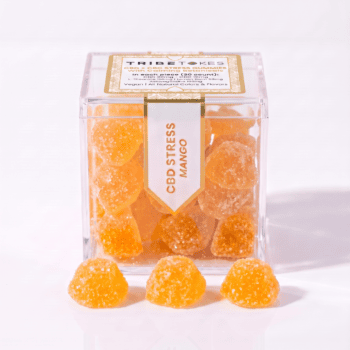
 CBD Gummies for Stress: 30mg CBD + ...Starting from: $45.00 SHOP NOW This product has multiple variants. The options may be chosen on the product page
Frequently Asked Questions
For most users in most contexts, yes. The 2015 Gallily et al. study found full-spectrum hemp extract had a linear dose-response that kept working at lower doses, while CBD isolate had a bell-shaped curve that fell off at higher doses. The multi-compound profile of full-spectrum products activates a broader range of receptor pathways, produces more stable dose responses, and delivers cannabinoids more efficiently through terpene-mediated transport mechanisms. The exception is users who need zero drug test risk or who are sensitive to trace THC, for whom isolate is the appropriate choice.
The entourage effect is the pharmacological phenomenon where the full compound profile of a cannabis or hemp extract produces better outcomes than any single isolated compound at the same dose. Cannabinoids (CBD, CBG, CBN, trace Delta-9) activate different receptor targets simultaneously. Terpenes modulate those receptors and enhance delivery efficiency. Flavonoids add their own anti-inflammatory activity. The interaction of all these compounds at their respective targets produces an effect the individual components can’t replicate alone.
No. Full-spectrum hemp products contain Delta-9 THC below 0.3% by dry weight (legally required for hemp classification). At these concentrations, Delta-9 does not produce psychoactive effects. CBD also acts as a negative allosteric modulator at CB1 receptors, partially counteracting any psychoactive activity from the trace Delta-9. Full-spectrum hemp products from legal hemp sources do not produce intoxication.
Full-spectrum CBD carries a real but low drug test risk with consistent high-dose daily use. The trace Delta-9 THC (below 0.3%) in full-spectrum products accumulates as THC metabolites over time. At typical moderate doses (15–30mg CBD daily), the drug test risk from full-spectrum products is low. At high doses (100mg+ daily) taken consistently over weeks, metabolite accumulation becomes a realistic concern. If you’re subject to drug testing, discuss this with HR or legal counsel before using any full-spectrum product.
Broad spectrum is better than isolate and less reliably effective than full spectrum. Removing Delta-9 THC through additional processing steps also disturbs the remaining compound profile to varying degrees depending on the method used. Some broad-spectrum products retain a rich terpene and minor cannabinoid profile that produces meaningful entourage effects. Others are close to isolates in terms of what remains. The COA terpene panel is the only way to evaluate a specific broad-spectrum product’s actual compound breadth.
CBD’s dose-response curve for some effects is inherently non-linear because CBD acts through multiple receptor mechanisms simultaneously. At lower doses, CBD’s anti-inflammatory and anxiolytic mechanisms are active. At higher doses, CBD also begins interacting with receptors that produce opposing effects, creating a net reduction in the primary benefit. Full-spectrum products escape this ceiling because the supporting compounds stabilize the response across a wider dose range through independent receptor mechanisms that don’t produce the same opposing interactions at higher doses.
The COA is the only reliable verification. A genuine full-spectrum product should show multiple cannabinoids above trace levels (CBD plus meaningful CBG, CBN, or CBC), detectable terpenes above 0.5% total, and trace Delta-9 below 0.3%. A product that shows only CBD on the cannabinoid panel with everything else at ND or below 0.1% is functionally an isolate or near-isolate regardless of the label. Check the COA terpene panel specifically. Many “full spectrum” products strip terpenes even when minor cannabinoids survive.
The terms are used interchangeably in most consumer contexts, but technically “whole plant extract” implies using the entire plant (including stems, leaves, and seeds) rather than isolating the flower and trim. The relevant distinction for entourage effect purposes is the same: does the final extract retain a broad cannabinoid and terpene profile, or has processing removed most of the supporting compounds? The COA answers that question for any specific product regardless of which label the manufacturer applies.
Full Spectrum. Full Terpene Panel. COA on Every Batch.
Third-party tested. ISO-accredited lab. Woman-owned since 2017.