

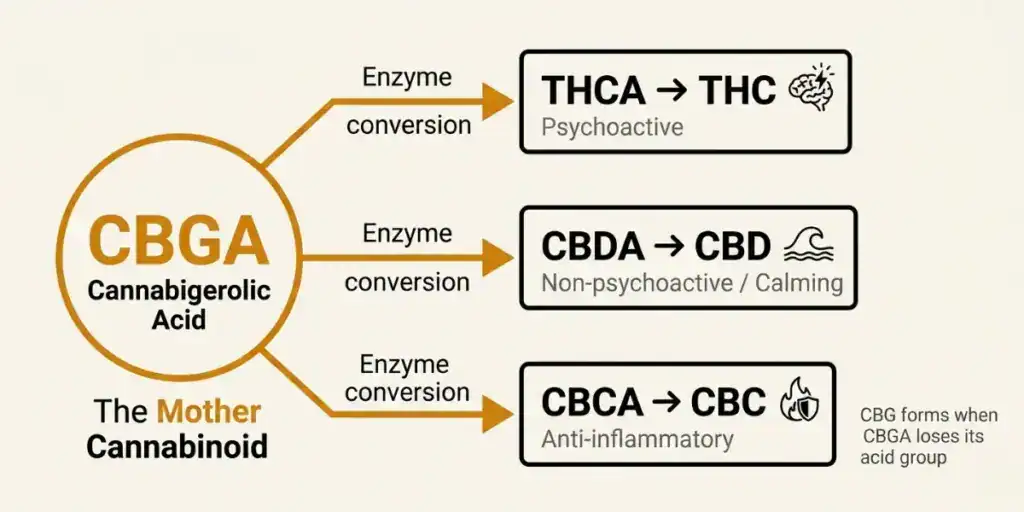
CBG (cannabigerol) has been described as the “mother cannabinoid,” the precursor that the cannabis plant converts into THCA, CBDA, and CBCA as it matures. It’s been studied in labs for almost a decade for anti-inflammatory, antibacterial, and neuroprotective effects, but until July 2024, no human clinical trial had ever tested it directly. That changed with Cuttler et al. 2024 in Scientific Reports, the first placebo-controlled human study of hemp-derived CBG, which found that 20mg produced a 26.5% reduction in anxiety with no intoxication and actually improved verbal memory. This guide walks through every researched benefit of CBG with specific citations, dose data, and an honest read on what’s solid vs what’s extrapolation from animal studies.
🧪 Lab Tested | 👩💼 Woman-Owned | 🏆 Est. 2017
Table of Contents
- What Is CBG?
- The Current State of CBG Research
- Benefit 1: Anxiety and Stress Reduction (Cuttler 2024)
- Benefit 2: Memory and Focus (Cuttler 2024)
- Benefit 3: Inflammation and IBD (Borrelli 2013)
- Benefit 4: Antibacterial Activity (Appendino 2008)
- Benefit 5: Neuroprotection (Valdeolivas 2015)
- Benefit 6: “Energy” and What the Claim Is Actually Based On
- How CBG Works: The Mechanism
- CBG vs CBD vs THC: Quick Comparison
- Dosing: What Research Used vs What’s in Your Product
- Side Effects and Drug Interactions
- How to Evaluate a CBG Product
- Frequently Asked Questions
- Shop TribeTokes
CBG Benefits by the Research
| Anxiety and stress (humans) | Cuttler et al. 2024, Scientific Reports. N=34. 20mg reduced anxiety 26.5% at 20/45/60 min vs placebo |
| Verbal memory (humans) | Same Cuttler 2024 trial. CBG enhanced verbal memory vs placebo, no cognitive impairment |
| Inflammatory bowel disease (mice) | Borrelli et al. 2013, Biochemical Pharmacology. CBG reduced colitis severity, iNOS, myeloperoxidase |
| Antibacterial (in vitro) | Appendino et al. 2008, Journal of Natural Products. CBG active against MRSA strains |
| Neuroprotection (mice) | Valdeolivas et al. 2015, Neurotherapeutics. CBG improved motor deficits in Huntington’s disease models |
| Mechanism (pharmacology review) | Nachnani et al. 2021, J Pharmacol Exp Ther. CBG is unique for α-2 adrenoceptor and 5-HT1A activity |
| Psychoactive? | No. Weakly binds CB1 and CB2. Does not produce a high at typical doses |
| Human-researched dose | 20mg acute (Cuttler 2024). Chronic dosing studies pending |
| “Energy” benefit? | Commonly marketed but no direct human research supports it. Possibly downstream of anxiety reduction |
| Federal legal status | Legal under 2018 Farm Bill as hemp-derived cannabinoid below 0.3% delta-9 THC |
What Is CBG?
CBG stands for cannabigerol. It’s one of over 100 cannabinoids produced by Cannabis sativa, the same plant family that produces THC, CBD, CBN, and CBC. What makes CBG different is that it’s the biosynthetic parent of most of the others.
In the growing cannabis plant, the acidic form CBGA (cannabigerolic acid) is synthesized first. As the plant matures, specialized enzymes convert CBGA into THCA, CBDA, and CBCA, which are the acidic precursors to THC, CBD, and CBC. By the time a plant is harvested, most of the CBGA has been converted into these other compounds, which is why mature flower typically contains less than 1% CBG by weight. That’s also why CBG is sometimes called the “mother cannabinoid” (it’s the chemical parent that gets consumed to make the others).
Commercial CBG is produced a few ways. Some breeders cultivate CBG-dominant strains that have been selected to retain CBG rather than fully convert it to downstream cannabinoids. Some processors use chromatography or other techniques to isolate CBG from extracts. And more recently, biosynthesis has emerged as a production method that bypasses the plant entirely. However it’s produced, the finished CBG compound is chemically identical.
CBG is not psychoactive at typical doses. It binds the CB1 cannabinoid receptor weakly, and it doesn’t produce the euphoria or altered perception associated with THC. At high doses, some users report mild subjective effects, but it’s categorically not an intoxicating cannabinoid. For the compound-level comparison of CBG with CBD and THC, see our CBD vs THC guide.
The Current State of CBG Research
Here’s the honest starting point for any CBG benefits article: as of April 2026, most CBG research is preclinical. That means animal models (usually mice) and in vitro cell studies. The translation from mouse colitis reductions to human therapeutic effects is never automatic, and most CBG marketing gets this wrong.
That said, the picture changed meaningfully in 2024 when Cuttler and colleagues published the first placebo-controlled human trial of CBG in Scientific Reports (PMID 39003387). The trial was modest in size (N=34 healthy cannabis users) and short-duration (acute effects, not chronic), but it was the first time anyone had rigorously tested what CBG does in humans. The findings were promising enough that the CBG category now has a meaningful human data point instead of “here’s what happens in mice.”
The 2021 pharmacology review by Nachnani, Raup-Konsavage, and Vrana in the Journal of Pharmacology and Experimental Therapeutics is a good summary of what was known prior to Cuttler 2024. The authors concluded that CBG has therapeutic potential for neurologic disorders (Huntington’s, Parkinson’s, multiple sclerosis), inflammatory bowel disease, and antibacterial activity, while acknowledging that “little research has been performed on this unregulated molecule.”
What follows is a benefit-by-benefit review with the specific primary sources for each claim. Where the evidence is solid, we say so. Where it’s extrapolation from animals, we say that too.
Benefit 1: Anxiety and Stress Reduction (Cuttler 2024)
This is the strongest CBG benefit claim in the scientific literature as of April 2026, and it’s one of the few with direct human data.
The study
Cuttler et al. 2024, “Acute effects of cannabigerol on anxiety, stress, and mood: a double-blind, placebo-controlled, crossover, field trial,” published in Scientific Reports. The research team came from Washington State University and UCLA. It was a double-blind, placebo-controlled crossover trial with 34 healthy cannabis users who received either 20mg of hemp-derived CBG or a matched placebo on separate sessions.
Key findings
- Anxiety reduction: 20mg CBG produced a 26.5% average reduction in anxiety ratings compared to placebo at 20 minutes, 45 minutes, and 60 minutes after ingestion
- Stress reduction: Significant reduction in subjective stress ratings at the first measurement time point
- No intoxication: Participants reported no subjective drug effects, no impairment, and no typical cannabis-associated effects
- No cognitive impairment: CBG did not slow reaction time or produce the motor or memory deficits associated with THC
The trial is significant because it’s the first. But it’s also a starting point, not a finishing line. Sample size was small (N=34), the study tested acute effects (single dose) rather than chronic dosing, and participants were healthy cannabis users rather than people with diagnosed anxiety disorders. Replication in larger, clinical populations is needed before CBG can be considered a validated anti-anxiety compound.
What the trial does establish is that CBG at 20mg produces a measurable, real, subjective anxiety-reducing effect in humans without intoxication. That’s a meaningful baseline. For context on how this compares to CBD’s anxiety evidence, our CBD vs THC guide covers Shannon 2019 and the broader CBD-anxiety literature.
Benefit 2: Memory and Focus (Cuttler 2024)
The Cuttler 2024 trial produced a second surprising finding that was somewhat incidental to the anxiety primary outcome: CBG enhanced verbal memory compared to placebo. This was unexpected because cannabinoids (particularly THC) are generally associated with acute memory impairment, not enhancement.
Participants performed better on word recall tasks after 20mg CBG than after placebo. The effect was measurable and reported as statistically significant in the paper. This is the first human evidence that a hemp-derived cannabinoid may have pro-cognitive rather than anti-cognitive acute effects.
Why might this happen pharmacologically? One hypothesis comes from Nachnani 2021: CBG has activity at the α-2 adrenoceptor, a receptor family involved in attention, working memory, and prefrontal cortex function. CBG’s activity at α-2 might produce modest cognitive benefits via a similar mechanism.
The “focus” benefit that CBG is commonly marketed for likely flows from some combination of anxiety reduction (less anxious people tend to focus better), this verbal memory effect, and α-2 adrenoceptor activity. The data is early. But the direction of evidence is consistent with the marketing claim, which is unusual in the cannabinoid space.
Benefit 3: Inflammation and IBD (Borrelli 2013)
Anti-inflammatory effects are probably the most-studied therapeutic area for CBG, primarily in animal and cell models. The canonical paper is Borrelli et al. 2013, “Beneficial effect of the non-psychotropic plant cannabinoid cannabigerol on experimental inflammatory bowel disease,” in Biochemical Pharmacology (DOI 10.1016/j.bcp.2013.01.017).
The study
Borrelli’s team tested CBG in a mouse model of colitis induced by dinitrobenzene sulfonic acid (DNBS), which produces symptoms similar to human inflammatory bowel disease. Mice received CBG orally and were assessed for intestinal inflammation markers.
Key findings
- CBG reduced the colon weight-to-length ratio (a standard colitis severity measure)
- CBG reduced myeloperoxidase activity (an inflammatory enzyme produced by neutrophils)
- CBG reduced inducible nitric oxide synthase (iNOS) expression
- CBG increased superoxide dismutase (SOD) activity (an antioxidant defense enzyme)
- CBG normalized changes in interleukin-1β, interleukin-10, and interferon-γ associated with the colitis model
- In cultured macrophages, CBG reduced nitric oxide production; this effect was partly modulated by CB2 receptor activity
Follow-up research has continued to support CBG’s anti-inflammatory effects in GI models, including more recent studies published in 2024 testing high-CBG hemp extracts in ulcerative colitis models. The body of preclinical evidence for CBG as an anti-inflammatory compound is substantial.
Honest caveats
Everything described above is mouse data. It suggests CBG may help with inflammatory conditions in humans, but no randomized human trial has tested this yet. If you have diagnosed IBD, Crohn’s disease, or ulcerative colitis, CBG is not a substitute for proven medical treatment. It might be a reasonable adjunct to discuss with a gastroenterologist, but that’s a clinical conversation, not a self-treatment recommendation.
Benefit 4: Antibacterial Activity (Appendino 2008)
CBG’s antibacterial potential was demonstrated in a landmark 2008 study: Appendino et al., “Antibacterial Cannabinoids from Cannabis sativa: A Structure-Activity Study,” in the Journal of Natural Products. The paper tested the five major cannabinoids (CBD, CBC, CBG, THC, and CBN) against a panel of methicillin-resistant Staphylococcus aureus (MRSA) strains, including clinically relevant drug-resistant isolates.
Key findings
All five cannabinoids showed potent activity against MRSA strains. CBG was among the compounds with significant antibacterial activity at concentrations that were meaningful for laboratory testing. The paper also mapped structure-activity relationships, finding that the core cannabinoid scaffold (with its phenolic hydroxyl groups and prenyl/alkyl tail) was what drove activity, while methylation, acetylation, or additional prenyl groups reduced activity.
More recent work has extended this finding. Follow-up studies have shown anti-biofilm activity and sensitization effects where cannabinoids restore antibiotic efficacy against resistant strains. MRSA is a serious clinical problem with limited treatment options, and CBG’s activity is one of the more interesting findings in the minor cannabinoid research space.
Honest caveats
This is in vitro (test tube) data. Antibacterial activity in a petri dish doesn’t automatically translate to a treatment for infection in humans, because systemic bioavailability, tissue penetration, and safe effective doses all have to be established. No human trial has tested CBG as an antibacterial treatment. The clinical picture for cannabinoid antibacterials is promising but not proven.
Benefit 5: Neuroprotection (Valdeolivas 2015)
The neuroprotective research on CBG centers on Valdeolivas et al. 2015, “Neuroprotective Properties of Cannabigerol in Huntington’s Disease: Studies in R6/2 Mice and 3-Nitropropionate-lesioned Mice,” in Neurotherapeutics (PMID 25252936).
The study
Huntington’s disease is a genetic neurodegenerative disorder that causes progressive motor and cognitive deterioration. The study used two mouse models: the R6/2 transgenic mouse (a genetic model of Huntington’s) and mice treated with 3-nitropropionate (a chemical model that produces Huntington-like striatal damage).
Key findings
- In the 3-nitropropionate model, CBG was strongly neuroprotective, improving motor deficits and preserving striatal neurons
- CBG reduced reactive microgliosis (inflammatory activation of brain immune cells)
- CBG reduced the upregulation of proinflammatory markers
- CBG improved antioxidant defenses
- In the R6/2 transgenic model, CBG produced a lower but still significant improvement in rotarod motor performance
Honest caveats
This is mouse data for a specific neurodegenerative disease. It’s a hypothesis-generating finding for further research, not a treatment recommendation for humans with Huntington’s or related conditions. The Nachnani 2021 review placed CBG among minor cannabinoids with promising neuroprotective signals that warrant further study, alongside work on Parkinson’s disease and multiple sclerosis models.
Benefit 6: “Energy” and What the Claim Is Actually Based On
“CBG for energy” is one of the most common CBG marketing claims. Let’s be honest about what it’s based on.
There is no published human clinical trial that tested CBG for energy, wakefulness, or alertness as a primary outcome. There is no animal study that directly measured energy output or endurance. The “energy” claim appears to be an extrapolation from three threads:
- CBG is non-intoxicating. Unlike THC, CBG doesn’t produce couch-lock or sedation at typical doses. Consumers who switch from THC products to CBG often describe feeling “clearer” or “more alert” by comparison. That’s a relative comparison, not an absolute stimulant effect
- α-2 adrenoceptor activity. The adrenergic system is involved in arousal and attention regulation. CBG’s activity here might theoretically contribute to feeling more focused, though there’s no direct human data on alertness per se
- Anxiety reduction carries subjective energy benefits. People with chronic low-level anxiety often describe feeling “drained.” Reducing that anxiety can feel like more available mental energy, even though no stimulant is involved
What you should not expect from CBG: caffeine-like stimulation, direct wakefulness promotion, or an objective energy-boost measurable on a performance test. If you want those effects, caffeine has orders of magnitude more evidence. What CBG may realistically offer is a non-sedating, non-intoxicating cannabinoid experience with possible focus and anxiety benefits that feel like more usable daytime energy. That’s a meaningful difference from “gives you energy” as a straight claim.
Marketing reality check: “CBG for energy” works as shorthand for “CBG is the non-sedating cannabinoid.” It does not work as a literal stimulant claim. A 20mg CBG dose is not a replacement for adequate sleep, nutrition, or caffeine if you need actual alertness.
How CBG Works: The Mechanism
CBG interacts with multiple receptor and enzyme systems, which is part of why its effects span so many functional areas. The pharmacology review by Nachnani et al. 2021 laid out the key mechanisms.
- Alpha-2 adrenoceptor partial agonist: This is one of CBG’s more distinctive properties. The α-2 receptors are involved in attention, mood regulation, and sympathetic nervous system modulation. Other α-2 agonists include clonidine and guanfacine, which are used clinically for ADHD and hypertension
- 5-HT1A serotonin receptor activity: 5-HT1A is involved in anxiety regulation, mood, and thermoregulation. Buspirone (a clinical anxiolytic) is a 5-HT1A partial agonist. CBG’s activity here is a plausible mechanism for the Cuttler 2024 anxiety findings
- Weak CB1 and CB2 binding: CBG binds both primary cannabinoid receptors but weakly. This is part of why it’s non-psychoactive. The CB2 activity contributes to its anti-inflammatory effects, particularly in immune tissue and the gut
- Anandamide reuptake inhibition: CBG slows the reuptake of anandamide (one of your body’s endogenous endocannabinoids). This indirectly enhances endocannabinoid signaling without CBG itself binding CB1 strongly
- TRPV1 and related channel effects: CBG interacts with several transient receptor potential (TRP) channels involved in pain sensing, temperature, and inflammation
- PPAR-gamma activity: Some CBG activity at nuclear PPAR-γ receptors may contribute to anti-inflammatory and metabolic effects
The multi-target pharmacology is why CBG has shown effects across so many different experimental models. It also makes translating a single “mechanism of action” harder, because CBG is likely working through several pathways simultaneously depending on the system being studied. For the underlying science on how cannabinoids interact with receptors more broadly, our entourage effect guide covers the receptor-system basics.
CBG vs CBD vs THC: Quick Comparison
| Property | CBG | CBD | THC |
| Psychoactive? | No (weak CB1 binding) | No | Yes |
| Primary receptor | α-2 adrenoceptor + 5-HT1A | Negative allosteric CB1 + 5-HT1A | CB1 partial agonist |
| Human trials | 1 RCT (Cuttler 2024, N=34) | Multiple (Epidiolex FDA-approved) | Extensive |
| Typical plant concentration | <1% in mature flower | Dominant in hemp | Dominant in marijuana |
| Main research areas | Anxiety, memory, IBD, antibacterial, neuroprotection | Epilepsy, anxiety, inflammation | Nausea, appetite, pain, sleep |
| FDA-approved drug | None | Epidiolex (2018, epilepsy) | Marinol, Syndros, Cesamet |
| Drug test risk | Low for pure CBG isolate | Low for CBD isolate | High (triggers positive) |
For the full CBD breakdown, including the spectrum decision, see our full spectrum vs broad spectrum vs isolate guide. For bioavailability across delivery methods (which applies to CBG too, though CBG-specific PK data is sparser), see our CBD bioavailability guide.
Dosing: What Research Used vs What’s in Your Product
The dose-gap conversation for CBG is early because there’s only one human trial to reference, but the trial’s dose is the most defensible benchmark we have.
| Outcome | Research Dose | Source | Typical Commercial Product |
|---|---|---|---|
| Anxiety reduction (acute) | 20mg oral CBG | Cuttler 2024, Scientific Reports | 5-25mg per serving (varies widely) |
| Memory enhancement (acute) | 20mg oral CBG | Cuttler 2024 (secondary finding) | Same product category as above |
| Anti-inflammatory (animal) | Roughly 1-30 mg/kg in mice (extrapolation to human uncertain) | Borrelli 2013 | Not established for human use |
| Chronic dosing | Not established in humans | None | Varies |
Practical implication: if you want to replicate the Cuttler 2024 anxiety finding, look for products dosed at 20mg CBG per serving. Many sleep and focus gummies contain 5 to 10mg of CBG alongside other cannabinoids, which is below the researched-effective anxiety dose. That doesn’t mean they can’t work for you, but the science-backed starting point is 20mg. Higher doses haven’t been tested in humans, so going above 20mg is entering unstudied territory.
Take CBG products as directed on the label. Because CBG is lipophilic like other cannabinoids, taking it with a small fatty snack may improve absorption. Give any new cannabinoid at least a few consistent days of use before evaluating effects, even for acute benefits like anxiety reduction.
Side Effects and Drug Interactions
The Cuttler 2024 trial is the primary human safety reference we have for CBG. In that study, 20mg CBG produced no significant adverse events, no cognitive impairment, no motor impairment, and no subjective drug effects compared to placebo. That’s a strong acute safety signal in healthy adults. It’s also not a full long-term safety picture.
Reported or plausible side effects
- Mild dry mouth (as with other cannabinoids)
- Possible drowsiness at higher doses (inconsistent with Cuttler 2024 but reported anecdotally)
- Lowered intraocular pressure (preclinical finding; not necessarily clinically problematic but worth noting for people with existing eye conditions)
- Interaction with cytochrome P450 enzymes, though less-studied than CBD’s interactions
Drug interaction considerations
CBG, like CBD, can inhibit CYP450 enzymes that metabolize many prescription medications. The interaction profile for CBG specifically is less characterized than for CBD, but the same caution applies: if you take prescription medications (particularly blood thinners, seizure medications, immunosuppressants, or certain antidepressants), ask your doctor or pharmacist before starting CBG.
Drug test considerations
CBG is not the target molecule in standard drug tests (which look for THC-COOH). Pure CBG isolate with a clean certificate of analysis should not trigger a positive test. Full-spectrum CBG products contain trace delta-9 THC (up to 0.3% by dry weight under federal hemp law), which can produce a positive test with regular use. For the full breakdown, see our guides on whether CBD shows up on a drug test and Delta-8 drug test implications, which cover the same principles.
How to Evaluate a CBG Product
Product selection matters more for CBG than for CBD because CBG is newer to commercial production and quality varies widely.
- Verify the actual per-serving dose. Look at milligrams per gummy, per capsule, or per dropper, not total bottle content. For the anxiety benefit backed by Cuttler 2024, aim for 20mg per serving
- Check the certificate of analysis. A legitimate CBG product will publish a third-party lab report showing actual CBG content, other cannabinoids present, and absence of pesticides, heavy metals, residual solvents, and microbial contamination. Our guide on reading certificates of analysis covers the details
- Check THC content. If you’re drug tested, CBG isolate products with 0 detectable THC are the lowest-risk option. Full-spectrum products contain trace THC
- Consider the delivery method. CBG tinctures held sublingually will absorb better than swallowed gummies. For fast onset in acute-anxiety situations, sublingual is the better format. For sustained effect, gummies or capsules work
- Ignore “CBG cures X” marketing. Given one human trial, no consumer-facing CBG product has research support for treating specific conditions. Products that claim otherwise are ahead of the science
- Beware of unusual combination marketing. “CBG + CBN + CBC for sleep + focus + energy” products are selling complexity rather than research-backed formulation. The evidence supports specific cannabinoids for specific outcomes, not a grab-bag approach
Frequently Asked Questions
There’s one placebo-controlled human trial that supports this. Cuttler et al. 2024 in Scientific Reports tested 20mg hemp-derived CBG in 34 healthy adults and found a 26.5% reduction in anxiety ratings at 20, 45, and 60 minutes post-dose compared to placebo. It’s the first human CBG trial, so the evidence base is limited, but the finding is solid enough to make CBG a reasonable experimental option for acute anxiety reduction without intoxication.
No. CBG binds the CB1 cannabinoid receptor (the one responsible for THC’s psychoactive effects) only weakly, and it does not produce euphoria, altered perception, or the characteristic cannabis high at typical doses. The Cuttler 2024 trial specifically measured subjective drug effects at 20mg and found no evidence of intoxication compared to placebo.
Based on the current research, CBG has direct human evidence for acute anxiety reduction and verbal memory enhancement (Cuttler 2024). It has preclinical (mouse) evidence for inflammatory bowel disease (Borrelli 2013), antibacterial activity including against MRSA (Appendino 2008), and neuroprotection in Huntington’s disease models (Valdeolivas 2015). Most claims beyond those categories are extrapolation or marketing.
The research-supported dose for acute anxiety reduction is 20mg oral CBG, based on Cuttler et al. 2024. Many commercial products contain 5 to 10mg per serving, which is below the researched effective dose. If you want to match the Cuttler trial, look for 20mg per serving. Higher doses haven’t been tested in humans, so going above 20mg is entering unstudied territory.
“Energy” from CBG is not supported by direct human research. No trial has tested CBG for alertness, wakefulness, or objective energy output. The energy claim is partly marketing shorthand for “non-sedating cannabinoid” and partly extrapolation from CBG’s α-2 adrenoceptor activity and its anxiety-reducing effect. People with high baseline anxiety sometimes describe feeling more usable daytime energy after taking CBG, but this is not a direct stimulant effect. If you need objective alertness, caffeine has orders of magnitude more supporting evidence.
Hemp-derived CBG is federally legal in the United States under the 2018 Farm Bill, provided the source plant contains less than 0.3% delta-9 THC by dry weight. This legal framework is the same as for hemp-derived CBD. Note that a federal change signed November 12, 2025 (H.R. 5371 Section 781) will redefine hemp starting November 12, 2026, which will primarily affect intoxicating hemp products. Non-intoxicating CBG products are expected to remain legal, but regulations are evolving. For context, see our Delta-8 legal states guide.
Shopping for Research-Dosed CBG
The CBG category has matured enough that products backed by the Cuttler 2024 anxiety finding are starting to appear at research-matching 20mg doses. The commercial landscape is still catching up to the science. Most shelf-facing products under-dose CBG, so label reading matters more here than in the better-established CBD space.
TribeTokes publishes third-party certificates of analysis for every batch with full cannabinoid and terpene profiles, so you can verify actual CBG content per serving. If you’re experimenting with CBG, look for products that disclose mg per serving (not just “contains CBG”) and match the 20mg target if anxiety is your primary goal.
For the broader cannabinoid picture, our CBD vs THC guide covers the compound-level decision framework. For the related comparison of CBN vs CBD for sleep (which is a parallel “minor cannabinoid” comparison), see the CBN vs CBD for sleep guide. For the underlying plant pharmacology on why CBG is called the “mother cannabinoid,” the entourage effect guide covers the biosynthesis side. And for the terpenes that often accompany CBG in full-spectrum products, our terpenes guide is the companion reference.
Lab tested. Transparent. Research-aligned dosing.
Shop TribeTokes Lab-Tested Hemp Products
Full third-party COAs on every batch. Woman-owned since 2017. Research-aligned cannabinoid dosing.