
The endocannabinoid system is the biological network that explains why cannabis affects human beings the way it does. Your body built this system for itself, not for cannabis. Cannabis just happens to produce compounds structurally similar to the ones your body already makes. Researchers only discovered the system in the early 1990s, which means it was regulating mood, pain, sleep, appetite, and immune function in every human on earth for millennia before anyone knew it existed. This guide covers what the system is, how it works, what it regulates, and why understanding it makes every cannabis and CBD product decision easier.
🧪 Lab Tested | 👩💼 Woman-Owned | 🏆 Est. 2017
IN THIS GUIDE
Endocannabinoid System at a Glance
| Discovered | 1988-1995 (CB1 receptor 1988; anandamide 1992; 2-AG 1995) |
| Present in | All vertebrates; one of the most widespread receptor systems in the mammalian brain |
| Three components | Endocannabinoids (signaling molecules), receptors (CB1 and CB2), enzymes (synthesis and breakdown) |
| What it regulates | Mood, pain perception, sleep, appetite, immune response, inflammation, memory, stress response |
| Primary receptors | CB1 (brain/CNS-heavy) and CB2 (immune system/peripheral tissues) |
| Key endocannabinoids | Anandamide (AEA) and 2-arachidonoylglycerol (2-AG) |
| Why plant cannabinoids work | THC, CBD, CBG, and other phytocannabinoids interact with ECS receptors because they share structural similarities with endocannabinoids |
| Named after | Cannabis: the plant that led researchers to discover the system |
What Is the Endocannabinoid System?
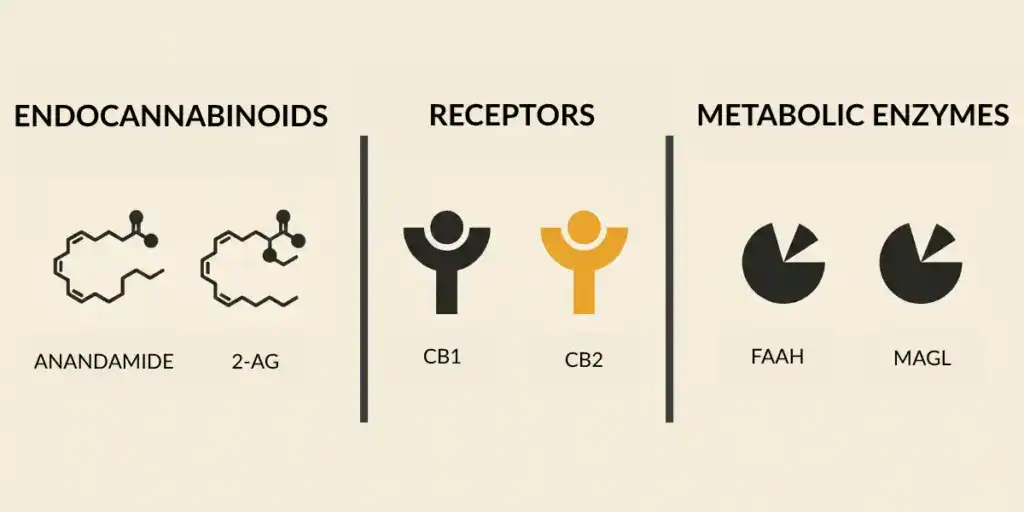
The endocannabinoid system (ECS) is a cell-signaling network found throughout the bodies of all vertebrates. It uses chemical messengers called endocannabinoids to regulate communication between cells: pain responses, emotional processing, immune activity, and more. The “endo” prefix means these cannabinoids are endogenous: produced inside the body itself, not introduced from outside.
The system gets its name from cannabis, which is slightly ironic: researchers were studying how THC affects the brain when they found the receptor it binds to: a receptor the body had built for its own purposes entirely. That discovery led directly to the identification of the body’s own cannabis-like molecules, the endocannabinoids. Cannabis research didn’t just give us a recreational drug or a medical therapy. It gave us a major physiological system we hadn’t known existed.
Unlike most neurotransmitter systems, the ECS operates in reverse. Traditional neurotransmitters are released from one cell and travel forward to receptors on another cell. The ECS works backwards: signals are released from the receiving cell and travel back to the sending cell. This retrograde signaling allows the ECS to act as a brake or a volume dial. It modulates how strongly other systems in the brain and body are firing.
Source: Pacher, P., Bátkai, S., and Kunos, G. (2006). “The Endocannabinoid System as an Emerging Target of Pharmacotherapy.” Pharmacological Reviews, 58(3), 389-462. PubMed: 16968947.
How the ECS Was Discovered
The endocannabinoid system was not discovered as a system. It was assembled piece by piece across nearly a decade, each discovery making the previous one make more sense.
1964: Raphael Mechoulam and Yechiel Gaoni at Hebrew University isolate and characterize Delta-9 THC, identifying it as the primary psychoactive compound in cannabis. Researchers now have a specific molecule to trace through the body.
1988: Allyn Howlett and William Devane at St. Louis University discover that mammalian brain tissue contains specific binding sites for THC; the binding is far too specific to be coincidental. The brain has a receptor built for a cannabis compound. The question immediately becomes: why would the brain have a receptor for a plant compound?
1990: Lisa Matsuda and colleagues at the National Institute of Mental Health clone the CB1 receptor and sequence its gene. The result is a molecular map of a distinct receptor type concentrated in the brain. Scientists can now study exactly where and how it works.
1992: Mechoulam’s lab in Jerusalem identifies the first endogenous ligand for the CB1 receptor: a molecule the brain produces naturally that binds to the same receptor as THC. Mechoulam names it anandamide, from the Sanskrit word ananda (bliss). The body’s own cannabis-like molecule has a name now.
1993: Sean Munro and colleagues discover a second cannabinoid receptor, CB2, expressed predominantly in immune tissues rather than the brain. The receptor system now has two distinct arms with different tissue distributions and different functional roles.
1995: Mechoulam’s group identifies a second major endocannabinoid: 2-arachidonoylglycerol (2-AG), present in higher concentrations in the brain than anandamide and capable of activating both CB1 and CB2 receptors.
By the mid-1990s, the picture was clear: the body has a dedicated signaling system with its own receptors, its own signaling molecules, and its own enzymatic machinery for building and breaking down those molecules. Cannabis compounds work by interacting with a system the body built for itself. The endocannabinoid system had a name.
Sources: Devane, W.A. et al. (1988). “Determination and characterization of a cannabinoid receptor in rat brain.” Molecular Pharmacology, 34(5), 605-613. PubMed: 2848184. | Devane, W.A. et al. (1992). “Isolation and structure of a brain constituent that binds to the cannabinoid receptor.” Science, 258(5090), 1946-1949. PubMed: 1470919. | Matsuda, L.A. et al. (1990). “Structure of a cannabinoid receptor and functional expression of the cloned cDNA.” Nature, 346(6284), 561-564. PubMed: 2165569.
The Three Components of the ECS
Endocannabinoids
Endocannabinoids are the signaling molecules of the ECS: the body’s own cannabis-like compounds. Two are well-characterized:
Anandamide (AEA) is synthesized on demand in the postsynaptic cell when it’s needed, not stored in advance. It binds primarily to CB1 receptors. Anandamide has a short half-life because the enzyme FAAH (fatty acid amide hydrolase) breaks it down rapidly. This brief window of activity is by design: the ECS is a system built for precise, time-limited signals, not continuous activation. Anandamide is associated with mood elevation, reduced pain signaling, and what some researchers call a “runner’s high” response. Physical activity increases anandamide levels in the bloodstream.
2-Arachidonoylglycerol (2-AG) is present in the brain at concentrations roughly 170 times higher than anandamide. It’s a full agonist at both CB1 and CB2 receptors and activates both completely. The enzyme MAGL (monoacylglycerol lipase) handles its breakdown. 2-AG is associated with immune modulation, neuroprotection, and pain response. Its abundance suggests it may be the primary endocannabinoid for routine ECS signaling, with anandamide playing a more specialized role.
Receptors: CB1 and CB2
Both CB1 and CB2 are G protein-coupled receptors (GPCRs), a large family of cell surface receptors that transmit signals through the cell membrane. They are activated by endocannabinoids and blocked by antagonists.
CB1 receptors are among the most densely expressed GPCRs in the mammalian brain. They’re concentrated in areas governing memory and cognition (hippocampus), movement coordination (basal ganglia and cerebellum), pain processing (spinal cord), and emotional regulation (amygdala and prefrontal cortex). CB1 is also present in peripheral tissues including the liver, adipose tissue, and the gut. The high brain concentration of CB1 is why THC, which binds strongly to CB1, has such pronounced cognitive and psychoactive effects.
CB2 receptors are expressed primarily in immune tissues: the spleen, tonsils, thymus, and circulating immune cells. They’re also found in peripheral sensory neurons and, increasingly, research is finding CB2 expression in the brain as well, particularly in microglia, the brain’s resident immune cells. CB2 activation is associated with anti-inflammatory effects and immune modulation without the psychoactive effects linked to CB1 activation. This is why CB2-targeting compounds are of significant research interest for inflammatory conditions.
Enzymes: Synthesis and Breakdown
The ECS includes specific enzymes that control when and how long endocannabinoids are active. Two are most important:
FAAH (fatty acid amide hydrolase) is the primary enzyme for anandamide breakdown. It degrades AEA rapidly after it has served its signaling purpose. Inhibiting FAAH (something CBD does to a moderate degree) extends anandamide’s active window in the synapse. This is one of the proposed mechanisms behind CBD’s observed anxiolytic effects.
MAGL (monoacylglycerol lipase) handles the breakdown of 2-AG. Together, FAAH and MAGL act as off-switches for the endocannabinoid system. Their job is to end the signal once it has served its purpose.
Source: Di Marzo, V. and Petrosino, S. (2007). “Endocannabinoids and the regulation of their levels in health and disease.” Current Opinion in Lipidology, 18(2), 129-140. PubMed: 17353663.
What the ECS Regulates
The ECS has sometimes been described as the body’s master regulatory system. That’s an overstatement, but not by as much as the skeptics would like. The system’s retrograde signaling role means it functions as a modulator of other systems rather than a direct controller. What it modulates is broad:
| Function | Mechanism | Research status |
| Pain perception | CB1 receptors in the spinal cord and brain modulate pain signal transmission; CB2 in immune cells affects inflammation-driven pain | Well-established in preclinical models; growing clinical evidence |
| Mood and anxiety | CB1 in the amygdala and prefrontal cortex regulates stress responses and fear extinction; anandamide associated with mood stability | Strong preclinical evidence; growing clinical evidence (especially CBD and anxiety) |
| Sleep | ECS modulates sleep-wake cycles; anandamide levels increase with sleep deprivation; CB1 activation promotes sleep onset and slow-wave sleep | Preclinical evidence strong; human studies ongoing |
| Appetite and metabolism | CB1 in the hypothalamus regulates hunger signals; CB1 in adipose tissue affects fat metabolism | Well-established (explains THC’s appetite stimulation) |
| Immune function | CB2 on immune cells modulates inflammation and immune cell migration; 2-AG plays key role in immune regulation | Well-established in preclinical models; active clinical research |
| Memory | CB1 in the hippocampus affects memory consolidation and the forgetting of aversive memories (fear extinction) | Well-established; explains THC’s short-term memory effects and interest in PTSD applications |
| Neuroprotection | ECS activation, particularly 2-AG at CB2, associated with reduced neuroinflammation and protection after brain injury | Strong preclinical evidence; early clinical research |
Why so many functions? The ECS is a modulator, not a direct actor. CB1 and CB2 receptors are expressed alongside receptors for other neurotransmitters. When the ECS activates, it turns up or turns down those neighboring signals. Because those neighboring signals govern mood, pain, sleep, appetite, and immunity, the ECS has a hand in all of them without being the primary controller of any single one.
CB1 vs. CB2 Receptors: What the Difference Means
The CB1/CB2 distinction is practical, not just academic. Knowing which receptor a cannabinoid targets tells you a great deal about what that cannabinoid is likely to do.
CB1 is the psychoactive receptor. Any cannabinoid that strongly activates CB1 (THC being the main example) will produce cognitive and experiential effects: mood changes, altered time perception, appetite stimulation, memory disruption at high doses. This is because CB1 is dense in the brain areas governing these functions. CB1 is also why THC can produce anxiety at high doses: the amygdala, which processes fear and threat responses, is richly CB1-expressing, and strong CB1 activation in anxious individuals can amplify rather than quiet that response.
CB2 is the peripheral and immune receptor. Cannabinoids that preferentially target CB2 can modulate inflammation and immune function without producing psychoactive effects, because CB2 is not densely expressed in the brain areas that drive intoxication. This is why researchers interested in anti-inflammatory applications of cannabinoids are often focused on CB2-selective compounds. It’s also why topical cannabinoids can affect local inflammation through skin-level CB2 receptors without reaching the brain at all.
CBD fits neither of these profiles cleanly. It doesn’t bind strongly to CB1 or CB2 and works through a more diffuse set of mechanisms: not the direct psychoactivity of CB1 activation, not the peripheral immune modulation of CB2 targeting. CBD doesn’t get you high. It also doesn’t behave predictably across individuals the way a clean receptor agonist does. Both facts follow from the same underlying pharmacology.
Source: Munro, S., Thomas, K.L., and Abu-Shaar, M. (1993). “Molecular characterization of a peripheral receptor for cannabinoids.” Nature, 365(6441), 61-65. PubMed: 7689702.
How Plant Cannabinoids Interact with the ECS
Plant cannabinoids (phytocannabinoids) work by mimicking, amplifying, or modifying endocannabinoid signaling. Each does so through a different mechanism, which produces distinct effects.
THC (Delta-9 THC and THCa)
THC is a partial agonist at CB1 receptors. It binds to the same receptor site as anandamide but with stronger affinity and a longer duration of action. Anandamide is broken down by FAAH within minutes; THC lingers for hours. The result is sustained, exaggerated CB1 activation, which is what produces the cannabis “high.” THCa, the acidic precursor form found in hemp-derived THCa flower, is non-psychoactive in the raw plant because it doesn’t bind effectively to CB1. When heat is applied (smoking, vaping), a chemical reaction converts THCa to THC, activating the CB1 mechanism.
CBD (Cannabidiol)
CBD has very low binding affinity for CB1 and CB2 receptors. It works primarily through other pathways: it’s an agonist at 5-HT1A serotonin receptors; it activates TRPV1 receptors involved in pain and temperature regulation; and it inhibits FAAH, the enzyme that breaks down anandamide. By slowing anandamide’s degradation, CBD allows the body’s own endocannabinoid to remain active longer. CBD also acts as a negative allosteric modulator at CB1: it changes the receptor’s shape in a way that makes THC and anandamide bind less strongly. This is why CBD can reduce the intensity of a THC experience without blocking it entirely.
CBG (Cannabigerol)
CBG is a partial agonist at both CB1 and CB2 receptors with lower potency than THC at CB1. It also inhibits the reuptake of GABA, the brain’s primary inhibitory neurotransmitter, which may contribute to its reported relaxing properties. CBG is of particular research interest for CB2-mediated effects on inflammation. It’s found in only trace amounts in most cannabis plants (typically below 1%), which makes CBG-rich products significantly more expensive to produce than CBD or THC products.
CBN (Cannabinol)
CBN forms naturally in the cannabis plant as THC oxidizes over time. It’s a partial agonist at CB1 receptors with roughly one-tenth the potency of THC, and also activates CB2. Preclinical research associates CBN with sedative properties, and it appears frequently in sleep-oriented formulas for that reason. Because CBN forms through THC degradation, aged or improperly stored cannabis tends to be higher in CBN and lower in THC than fresh material.
Source: Russo, E.B. (2011). “Taming THC: Potential cannabis synergies and phytocannabinoid-terpenoid entourage effects.” British Journal of Pharmacology, 163(7), 1344-1364. PubMed: 21749363.
Clinical Endocannabinoid Deficiency
In 2001, Ethan Russo, a neurologist and cannabinoid researcher, proposed Clinical Endocannabinoid Deficiency (CECD): the idea that some people may have constitutionally low endocannabinoid tone, insufficient production or activity of anandamide and 2-AG, and that this deficiency could underlie a cluster of conditions characterized by heightened pain sensitivity, sleep disruption, and mood dysregulation.
The conditions Russo associated with potential CECD include migraine, fibromyalgia, and irritable bowel syndrome. All three share certain features: they’re more common in women, they respond poorly to conventional treatments, they frequently co-occur in the same patients, and none has a clear identified cause. The CECD hypothesis suggests a common underlying mechanism: insufficient ECS tone leaving the body’s pain and stress-modulating systems underactive.
This remains a hypothesis, not an established diagnosis. There is no validated clinical test for endocannabinoid deficiency, and the supporting evidence is largely circumstantial: observational studies and mechanistic arguments rather than controlled trials. That said, the hypothesis has generated legitimate research interest and has been updated in peer-reviewed publications as recently as 2016. It’s worth knowing about. It’s not worth treating as settled science.
Source: Russo, E.B. (2016). “Clinical Endocannabinoid Deficiency Reconsidered: Current Research Supports the Theory in Migraine, Fibromyalgia, Irritable Bowel, and Other Treatment-Resistant Syndromes.” Cannabis and Cannabinoid Research, 1(1), 154-165. PubMed: 28861491.
Why This Matters for Cannabis Products
The ECS isn’t just background science. It’s the framework that explains every meaningful difference between cannabis products:
- Why different cannabinoids do different things. THC activates CB1 directly and produces psychoactive effects. CBD modulates the system indirectly and doesn’t produce intoxication. CBG and CBN have their own distinct receptor profiles with distinct effect patterns. These aren’t marketing categories. They’re pharmacological differences at the receptor level.
- Why format and delivery method matter. The ECS is distributed throughout the body, but the concentration varies by tissue type. Inhaled cannabinoids reach CB1-dense brain tissue almost immediately. Topically applied cannabinoids interact with CB1 and CB2 receptors in the skin and underlying tissue without reaching the brain. Edibles have a delayed, prolonged effect because they’re metabolized through the liver before reaching the bloodstream. The same cannabinoid, delivered differently, reaches different parts of the ECS. The skin has its own ECS. Read more
- Why full-spectrum products work differently than isolates. Terpenes also interact with the ECS and with other receptor systems. Myrcene, for example, may enhance cannabinoid permeability across the blood-brain barrier. Linalool acts on GABA receptors. When you use a full-spectrum product with the complete terpene and cannabinoid profile intact, you’re engaging more of the ECS’s signaling complexity than a single isolated cannabinoid can do alone. This is the mechanism behind the entourage effect.
- Why tolerance develops. Sustained, heavy CB1 activation downregulates receptor expression: the brain reduces the number of available CB1 receptors in response to chronic overstimulation. Regular cannabis users develop tolerance for this reason, and abstinence periods restore sensitivity. The ECS self-regulates.
- Why individual response varies so much. People differ in their baseline endocannabinoid tone, their receptor density, and their enzyme activity rates. Some people have naturally higher FAAH activity, which means anandamide breaks down faster and the system responds more strongly to CBD’s FAAH inhibition. These individual differences are real and largely genetic. Two people taking the same dose of the same product will not necessarily have the same experience, and this isn’t a mystery. It’s ECS biology.
Frequently Asked Questions About the Endocannabinoid System
The endocannabinoid system is a cell-signaling network throughout your body that uses chemical messengers called endocannabinoids to regulate mood, pain, sleep, appetite, immune response, and other functions. It works by modulating how other signaling systems fire, turning them up or down as needed. The body produces its own cannabis-like molecules (endocannabinoids) that activate this system. Plant cannabinoids like THC and CBD interact with the same receptor network, which is why they have effects on mood, pain, and other ECS-regulated functions.
The endocannabinoid system was not built for cannabis. It was built for the body’s own endocannabinoids, anandamide and 2-AG. Cannabis compounds happen to share enough structural similarity with these molecules that they can bind to the same receptors. Researchers discovered the ECS because they were trying to understand why THC affects the brain, and they found a receptor the brain had made for its own purposes. Cannabis didn’t create the system. The system was there first.
CB1 receptors are concentrated in the brain and central nervous system, particularly in areas governing memory, movement, pain, and emotional processing. Activating CB1 (which THC does strongly) produces psychoactive effects. CB2 receptors are found primarily in immune tissues and peripheral organs. CB2 activation is associated with anti-inflammatory and immune-modulating effects without the psychoactive effects linked to CB1. Some cannabinoids preferentially target one receptor type; many activate both to varying degrees.
Endocannabinoids are cannabinoid-like molecules produced inside the body. The two most studied are anandamide (AEA) and 2-arachidonoylglycerol (2-AG). They’re synthesized on demand, act on nearby receptors, and are broken down rapidly by specific enzymes. Phytocannabinoids (cannabinoids from the cannabis plant, like THC, CBD, CBG, and CBN) interact with the same receptor system but differ in their binding affinities, mechanisms, and how long they remain active. THC, for example, binds CB1 much longer than anandamide does, which is part of why its effects are more prolonged and pronounced.
Yes. The ECS is present in all vertebrates: every mammal, bird, reptile, and fish. It’s one of the most evolutionarily ancient signaling systems identified, present in animals that existed long before cannabis appeared as a plant species. All humans have CB1 and CB2 receptors, produce anandamide and 2-AG, and have the enzymatic machinery to build and break down endocannabinoids. What varies between individuals is baseline endocannabinoid tone, receptor density, and enzyme activity, which is why people respond differently to the same cannabinoid dose.
THC is a partial agonist at CB1 receptors. It binds to the same receptor that anandamide does, but with higher binding affinity and a much longer duration of activity. The brain’s FAAH enzyme breaks down anandamide in minutes; THC lingers for hours. The result is sustained CB1 activation in the brain’s mood, memory, and pain-processing regions, which produces the characteristic cannabis high. THC also activates CB2 receptors, contributing to some of its anti-inflammatory effects. The intensity of the experience correlates with CB1 receptor density in the user’s brain and their tolerance level.
CBD has low binding affinity for both CB1 and CB2 receptors and does not produce psychoactive effects. It works through several indirect mechanisms: it inhibits FAAH, the enzyme that breaks down anandamide, effectively extending anandamide’s active window; it activates 5-HT1A serotonin receptors associated with anxiety and mood regulation; it activates TRPV1 receptors involved in pain and temperature processing; and it acts as a negative allosteric modulator at CB1, changing the receptor’s shape in a way that reduces THC’s binding affinity. This combination of mechanisms, acting across multiple receptor systems simultaneously, is why CBD’s effects are harder to predict and why individual responses vary.
Anandamide is the body’s primary endocannabinoid, discovered in 1992 by Raphael Mechoulam’s lab. Its name comes from the Sanskrit word for bliss. Anandamide binds to CB1 receptors and is associated with mood elevation, reduced pain signaling, and the neurological effects of aerobic exercise (the runner’s high is at least partly mediated by anandamide, not endorphins as long believed). Anandamide is broken down quickly by the enzyme FAAH, so its effects are brief under normal conditions. Compounds that slow FAAH activity (CBD among them) allow anandamide to remain active longer, which is one of the proposed mechanisms behind CBD’s mood-stabilizing effects.
Endocannabinoid tone refers to the baseline level of endocannabinoid activity in a person’s system: how much anandamide and 2-AG are being produced, how sensitive their CB1 and CB2 receptors are, and how efficiently the enzymes are managing the cycle. Higher endocannabinoid tone means the ECS is more active at baseline. Lower tone means it’s running below optimal. Tone varies between individuals and can be affected by lifestyle factors including sleep, exercise, stress, and diet. Regular aerobic exercise, for example, has been shown to increase anandamide levels. Chronic stress and sleep deprivation may deplete endocannabinoid tone over time.
Individual variation in ECS response has four main sources: receptor density (CB1 and CB2 expression varies genetically, so some people have more receptors in certain brain regions), FAAH enzyme activity (faster FAAH means anandamide breaks down quicker, which also affects how strongly CBD’s FAAH inhibition is felt), baseline endocannabinoid tone, and prior cannabis use history, which affects receptor downregulation. Body composition and metabolism add further variability. The practical implication is that dose ranges are starting points, not guarantees. Calibrating your own response over several sessions is the only reliable way to find your effective dose.
Shop TribeTokes: Built for the ECS
Full-spectrum CBD, CBG-boosted formulas, and THCa products designed to work with your endocannabinoid system. Third-party tested. Woman-owned since 2017.
Sources
- Devane, W.A. et al. (1988). “Determination and characterization of a cannabinoid receptor in rat brain.” Molecular Pharmacology, 34(5), 605-613. PubMed: 2848184.
- Matsuda, L.A. et al. (1990). “Structure of a cannabinoid receptor and functional expression of the cloned cDNA.” Nature, 346(6284), 561-564. PubMed: 2165569.
- Devane, W.A. et al. (1992). “Isolation and structure of a brain constituent that binds to the cannabinoid receptor.” Science, 258(5090), 1946-1949. PubMed: 1470919.
- Munro, S., Thomas, K.L., and Abu-Shaar, M. (1993). “Molecular characterization of a peripheral receptor for cannabinoids.” Nature, 365(6441), 61-65. PubMed: 7689702.
- Mechoulam, R. et al. (1995). “Identification of an endogenous 2-monoglyceride, present in canine gut, that binds to cannabinoid receptors.” Biochemical Pharmacology, 50(1), 83-90. PubMed: 7605349.
- Pacher, P., Bátkai, S., and Kunos, G. (2006). “The Endocannabinoid System as an Emerging Target of Pharmacotherapy.” Pharmacological Reviews, 58(3), 389-462. PubMed: 16968947.
- Di Marzo, V. and Petrosino, S. (2007). “Endocannabinoids and the regulation of their levels in health and disease.” Current Opinion in Lipidology, 18(2), 129-140. PubMed: 17353663.
- Russo, E.B. (2011). “Taming THC: Potential cannabis synergies and phytocannabinoid-terpenoid entourage effects.” British Journal of Pharmacology, 163(7), 1344-1364. PubMed: 21749363.
- Russo, E.B. (2016). “Clinical Endocannabinoid Deficiency Reconsidered.” Cannabis and Cannabinoid Research, 1(1), 154-165. PubMed: 28861491.