
CBG (cannabigerol) is a non-intoxicating cannabinoid from hemp, and it’s where the plant’s cannabinoid chemistry starts. A young plant makes it first, as CBGa (cannabigerolic acid), and enzymes then turn most of that CBGa into the acid forms of THC, CBD and CBC. That’s why CBG gets called the “mother cannabinoid,” and why a mature plant usually holds less than 1% of it. The scarcity is part of why CBG products are newer, and why the research is still catching up to the reputation. One thing to know about TribeTokes: CBG is already built into most of our CBD lineup. Every CBD vape contains CBG, and most CBD gummies and tinctures add 10mg CBG per serving, so if you’ve used our CBD, you’ve probably had CBG already. This guide covers what CBG is, how it works, what the research shows, whether it gets you high and how to take it.
🧪 Lab Tested | 👩💼 Woman-Owned | 🏆 Est. 2017
IN THIS GUIDE
- What Is CBG?
- Why CBG Is the “Mother Cannabinoid”
- How CBG Works in the Body
- Does CBG Get You High?
- What Is CBG Used For? What the Research Shows
- CBG vs. CBD: What’s the Difference?
- CBG Formats
- How to Dose CBG
- Is CBG Safe? Side Effects and Interactions
- CBG and Drug Testing
- What to Look for When Buying CBG
- Frequently Asked Questions
CBG at a Glance
| Full name | Cannabigerol (CBG) |
| Why “mother cannabinoid” | CBGa (its acidic form) is the biosynthetic precursor from which THCa, CBDa, and CBCa are all synthesized in the plant |
| Psychoactive? | No. CBG doesn’t produce intoxicating effects at typical doses. |
| Primary reputation | Mental clarity, focus, daytime wellness; the more activating counterpart to CBD’s calming profile |
| Research status | Early stage; strong preclinical evidence, limited human trials |
| Federal legal status | Legal when hemp-derived under federal hemp law |
| Common formats | Tinctures, gummies, vapes |
| Drug test risk | Low. Drug tests look for THC metabolites, not CBG. Pick THC-free CBG and check that the batch COA shows THC as non-detect. |
| TribeTokes CBG rating | 4.85/5 from 13 dedicated CBG product reviews; 4.80/5 from 732 reviews across CBG-enhanced CBD products (CBD vapes, gummies, tinctures) |
What Is CBG?
Cannabigerol (CBG) is a non-intoxicating cannabinoid found in hemp and cannabis plants. Unlike CBD, which is abundant in mature hemp, or THC, which is the primary psychoactive compound in cannabis, CBG exists in very low concentrations in most mature plant material: typically less than 1% by dry weight. This scarcity is what kept CBG in the background for decades while CBD and THC attracted most of the research attention.
The “mother cannabinoid” label is scientifically grounded. CBGa (cannabigerolic acid, the raw acidic form of CBG) is the foundational biosynthetic compound from which the plant’s other major cannabinoids are built. In that sense, CBG isn’t just another cannabinoid alongside CBD and THC. It’s the compound that makes those cannabinoids possible in the first place.
CBG was first isolated from cannabis in 1964 by Raphael Mechoulam and Yehiel Gaoni at the Hebrew University of Jerusalem, the same team that later isolated THC. It received relatively little commercial or research interest until the mid-2010s, when broader legalization of hemp research created space to study minor cannabinoids more seriously. Commercial CBG products have emerged primarily since 2019, made possible by selective breeding programs that produce high-CBG hemp strains before the plant converts its CBG reserves into other cannabinoids.
Source: Gaoni, Y. and Mechoulam, R. (1964). “Isolation, structure, and partial synthesis of an active constituent of hashish.” Journal of the American Chemical Society, 86(8), 1646-1647. doi:10.1021/ja01062a046.
Why CBG Is the “Mother Cannabinoid”
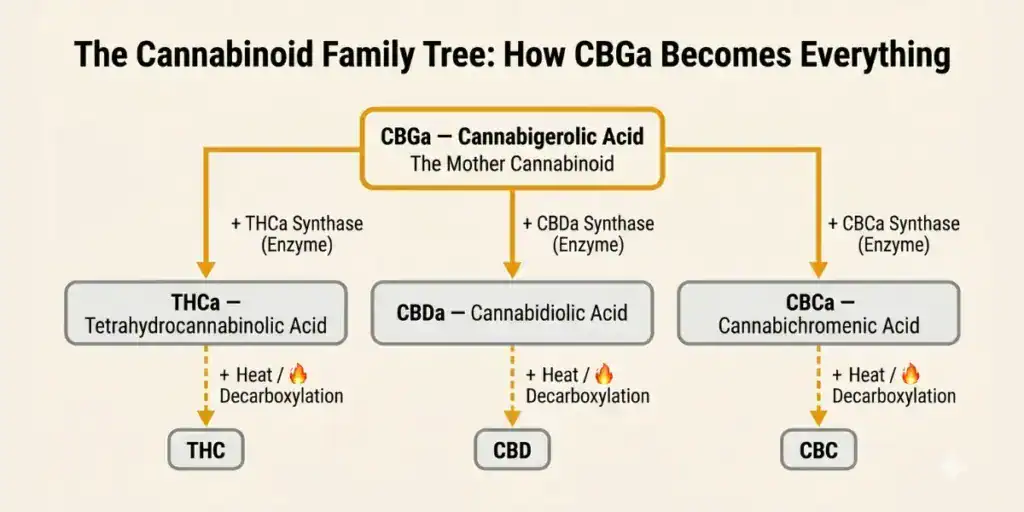
In the early stages of plant growth, the cannabis plant produces cannabigerolic acid (CBGa) through a reaction between olivetolic acid and geranyl pyrophosphate. CBGa is the starting point: the raw material from which the plant’s enzymatic machinery builds everything else.
Three separate enzymes then convert CBGa into the three major cannabinoid precursors: THCA synthase converts CBGa into THCa; CBDA synthase converts it into CBDa; and CBCA synthase converts it into CBCa. As the plant matures, these enzymes work through the available CBGa supply. By harvest time in a typical cannabis strain, nearly all the CBGa has been converted. The mature plant contains THC, CBD, and CBC. Very little CBG survives.
This is why growing CBG commercially requires a different approach. Producers either harvest hemp early, before the conversion enzymes have had time to work through the CBGa supply, or breed strains with genetic mutations that reduce the activity of the downstream synthase enzymes. Either way, more CBGa stays unconverted. Both approaches are more resource-intensive than standard hemp cultivation, which is part of why CBG products typically cost more than equivalent CBD products.
The decarboxylation step (heat converting CBGa to CBG, or THCa to THC) works the same way it does for all cannabinoids. Raw CBGa in plant material converts to CBG when heated. In commercial CBG products, the extract has already been processed to activate the cannabinoids.
Source: Taguchi, C. et al. (2021). “Cannabinoid Biosynthesis.” Essays in Biochemistry, 65(6), 849-858. PubMed: 34263294.
How CBG Works in the Body
CBG interacts with the endocannabinoid system, but its mechanism is meaningfully different from both CBD and THC, which is part of why its effects feel different to most users.
CBG binds to both CB1 and CB2 receptors, the same targets as THC. But unlike THC, which is a potent CB1 agonist (activates the receptor strongly and produces psychoactive effects), CBG is a partial agonist with much lower binding affinity. It activates these receptors, but weakly enough that it doesn’t produce intoxication. This also means CBG may actually modulate THC’s effects at CB1 by competing for the same receptor site; some research suggests CBG can blunt THC’s psychoactive intensity when taken together.
Beyond the ECS, CBG shows several mechanisms that distinguish it from CBD:
GABA reuptake inhibition. CBG inhibits GABA reuptake in the brain, meaning more GABA remains available between neurons. GABA is the primary inhibitory neurotransmitter: it regulates neuronal excitability and has anxiolytic and muscle-relaxing effects. A 2011 review by Cascio et al. identified this mechanism and noted its potential relevance for anxiety and muscle tension. This is a different mechanism from CBD’s serotonin pathway action.
Alpha-2 adrenoreceptor agonism. CBG appears to act on alpha-2 adrenoreceptors, which are involved in regulating norepinephrine release. This pathway is relevant to both pain modulation and anxiety; alpha-2 agonists are used clinically for both.
5-HT1A antagonism. Where CBD acts as a serotonin receptor agonist (which contributes to its calming and anxiolytic effects), CBG appears to act as an antagonist at the same receptor. This difference in mechanism may explain why some users describe CBG as more mentally activating and less sedating than CBD. Opposing actions at the same receptor produce very different effects.
Sources: Cascio, M.G. et al. (2010). “Evidence that the plant cannabinoid cannabigerol is a highly potent alpha2-adrenoceptor agonist and moderately potent 5HT1A receptor antagonist.” British Journal of Pharmacology, 159(1), 129-141. PubMed: 19824792. | Nachnani, R. et al. (2021). “The Pharmacological Case for Cannabigerol.” Journal of Pharmacology and Experimental Therapeutics, 376(2), 204-212. PubMed: 33168643.
Does CBG Get You High?
No, CBG doesn’t get you high. It does touch CB1, the same receptor THC uses, but only weakly. It’s a partial agonist, which means it nudges the receptor instead of switching it fully on. In the first placebo-controlled human trial, 34 adults took 20mg of CBG and reported no drug effects compared with placebo, and their word recall actually improved (Cuttler et al., Scientific Reports, 2024).
What people describe instead is a steady, level-headed feeling, more alert than sleepy. The one catch is THC content. CBG products made from full-spectrum hemp can carry trace THC (up to 0.3% by dry weight), which is rarely enough to feel but can matter on a drug test. Our CBG Tincture is made from purified cannabinoids, so there’s no THC in the formula. For the longer answer, read does CBG get you high.
What Is CBG Used For? What the Research Shows
Most people use CBG for daytime focus and calm without a high, and researchers are studying it for inflammation, gut health, nerve pain and bacteria. The research is early but moving fast. Most of what’s published is preclinical (animal studies and cell culture work), with limited human trials. The 2021 review by Nachnani et al. in the Journal of Pharmacology and Experimental Therapeutics is the most thorough synthesis of the current evidence, with preclinical findings across anxiety, inflammation, neuroprotection, pain, and antibacterial activity. For a study-by-study breakdown, read the research on CBG benefits.
Focus and Mental Clarity
The focus reputation for CBG is mostly anecdotal so far. The one placebo-controlled human trial, a 2024 study of 34 adults, found a single 20mg dose improved word recall along with lower anxiety, but it didn’t test attention directly (Cuttler et al., Scientific Reports). The biological plausibility is reasonable: GABA reuptake inhibition can reduce mental noise and anxiety-driven cognitive disruption, while the alpha-2 adrenoreceptor pathway influences norepinephrine, a neurotransmitter associated with attention and arousal. Users who describe CBG as “cleaner” than CBD or as more conducive to daytime productivity are likely experiencing these mechanisms, though controlled trials are needed to confirm it.
Megan M. uses the CBG tincture mid-day: “I use this in the middle of the day with my second coffee and it’s a great boost and is so helpful for my anxiety. I’m able to get more done.”
Inflammation and Pain
Preclinical research on CBG and inflammation is more developed than the focus research. A 2013 study by Borrelli et al. in Biochemical Pharmacology found CBG effective at reducing inflammation in a mouse model of inflammatory bowel disease. A 2015 study by the same group found neuroprotective effects in a Huntington’s disease mouse model. These are animal studies, not human trials, and direct extrapolation is a significant leap. But the mechanistic rationale is solid enough that human research is now underway.
Antibacterial Properties
One of the more striking findings in CBG research: a 2020 study by Farha et al. in ACS Infectious Diseases found CBG effective against MRSA (methicillin-resistant Staphylococcus aureus) in vitro and in a mouse model of MRSA infection. This doesn’t mean CBG is a treatment for MRSA (topical applications and systemic treatments are very different things, and in vitro findings routinely fail to translate to clinical use), but it established CBG as a cannabinoid with meaningful antibacterial activity worth investigating further.
Where the Evidence Stands
CBG has a well-characterized mechanism of action, compelling preclinical findings, and a strong anecdotal track record for daytime wellness and focus. What it doesn’t have yet is a body of controlled human trials equivalent to what exists for CBD. The reputation is ahead of the published evidence: not by fabrication, but by biology that clinical research simply hasn’t caught up to yet.
Sources: Nachnani, R. et al. (2021). “The Pharmacological Case for Cannabigerol.” JPET, 376(2), 204-212. PubMed: 33168643. | Borrelli, F. et al. (2013). “Beneficial effect of the non-psychotropic plant cannabinoid cannabigerol on experimental inflammatory bowel disease.” Biochemical Pharmacology, 85(9), 1306-1316. PubMed: 23415610. | Farha, M.A. et al. (2020). “Uncovering the Hidden Antibiotic Potential of Cannabis.” ACS Infectious Diseases, 6(3), 338-346. PubMed: 31760757.
CBG vs. CBD: What’s the Difference?
CBD and CBG are often marketed interchangeably as “non-intoxicating wellness cannabinoids.” The mechanisms behind each are different enough that it actually matters which one you choose.
In short, CBD tends to feel calming and CBG tends to feel clear and alert. Part of that comes down to one serotonin receptor (5-HT1A), which CBD switches on and CBG appears to block. CBD also has far more human research behind it, including an FDA-approved medicine, while CBG has one small 2024 trial. Plenty of people use both, CBG in the morning and CBD at night. For the full head-to-head on anxiety, focus, sleep, dosing and cost, read our CBG vs CBD comparison.
CBG Formats
CBG Tincture
The tincture is the most established CBG format and allows the most precise dose control. Held under the tongue (sublingually) for 60-90 seconds, it absorbs partially through the mucous membrane before the remainder is swallowed and digested. Sublingual onset is 15-45 minutes, fast enough for daytime use where you’re not planning 90 minutes ahead. TribeTokes’ CBG tincture is a THC-free, CBD-boosted formula at 1,800mg per bottle (1,200mg CBG + 300mg CBD + 300mg CBGa), so each 0.5ml serving gives you 20mg CBG with 5mg CBD and 5mg CBGa. It’s made from purified cannabinoids rather than a full-spectrum extract, which keeps every dose consistent and keeps THC out of the formula.
CBG Gummies
Gummies are digested before the cannabinoids absorb, which means 45-90 minute onset and longer, more gradual duration than a tincture. For consistent daytime baseline support rather than a specific targeted window, the slower onset is less of a limitation. The CBG gummies collection includes options for different times of day and use cases. For a THC-free daily pick, the Extra Strength Wellness gummies with CBD and CBG pair 90mg CBD with 10mg CBG (start with half).
CBG Vapes
The fastest onset format. Inhaled CBG absorbs through lung tissue directly into the bloodstream, with effects noticeable in minutes. Made for situational use rather than consistent daily supplementation: before a presentation, during a stressful commute, or any moment where you want fast effect onset. The CBG vape collection covers carts and disposables. Prefer CBD and CBG together? Our CBD CBG vape pen pairs them in one full gram disposable.
Which Format?
Tincture for consistent daily supplementation with precise dose control. Gummies for longer-duration daytime support with less timing precision needed. Vapes for fast onset when you need it specifically. Many users keep a tincture as their daily baseline and a vape for situational use.
How to Dose CBG
CBG dosing research is even less developed than CBN’s, because human trials are fewer and dose-response studies are limited. The general starting principle: lower than you’d think, and give it a week to establish a baseline.
| User type | Starting range | Notes |
| New to CBG | 5-15mg CBG per day | Start with a quarter dropper (about 10mg) of tincture in the morning. Give it 3-5 days before adjusting. Effects accumulate with regular use for some people. |
| Regular daytime use | 15-30mg CBG | Most regular users land in this range. Morning or early afternoon. The TribeTokes CBG tincture is CBD+CBG+CBGa at 1,800mg total; dose accordingly. |
| Stacking with CBD | CBG in AM; CBD in PM | A common split: CBG for morning clarity, CBD for evening wind-down. Adjust each independently based on effect. |
| Situational (vape) | 1-2 puffs, then wait | Same protocol as any cannabinoid vape: start low, evaluate after 15 minutes before taking more. |
CBG is non-intoxicating, which means you don’t need to worry about taking too much in the “getting too high” sense. But higher doses don’t necessarily produce better outcomes: the mechanisms CBG works through (GABA, adrenergic, serotonin receptor modulation) have non-linear dose responses. Starting low and working up slowly is the right approach, not because CBG is dangerous, but because you’ll get clearer signal about what’s working.
Timing matters for CBG more than for CBD. Its alert, wide-awake character makes morning or early afternoon the right window. Evening use at higher doses may interfere with sleep for people who are sensitive to the adrenergic stimulation pathway.
Is CBG Safe? Side Effects and Interactions
For most healthy adults, CBG looks well tolerated, but there’s no long-term safety data yet. In the 2024 trial, a single 20mg dose caused no significant side effects and no problems with thinking or movement compared with placebo. Real-world users mostly agree: in a 2022 survey of 127 people who use CBG, 44% reported no side effects at all. The most common ones were dry mouth (17%), sleepiness (15%), a bigger appetite (12%) and dry eyes (9%) (Russo et al., Cannabis and Cannabinoid Research).
Medication is the bigger thing to watch. Like CBD, CBG can slow the liver enzymes (the CYP450 family) that clear many prescription drugs, including blood thinners and some seizure and mood medications. If you take any prescription, check with your doctor or pharmacist before adding CBG. Skip it if you’re pregnant or breastfeeding, since there’s no safety research for either. For the full list, see the side effects and drug interactions research in our CBG benefits guide.
CBG and Drug Testing
CBG is non-intoxicating and metabolizes through a different pathway than THC. Standard drug tests look for THC-COOH, a THC metabolite, and CBG doesn’t produce it. A THC-free CBG product with a batch COA showing non-detectable THC shouldn’t cause a positive.
Two things to verify before using any CBG product if you’re subject to testing:
Check the batch COA for non-detectable Delta-9 THC. TribeTokes CBG products are formulated with hemp-derived CBD and CBG; COAs confirm non-detectable Delta-9 THC. Any product that contains even trace THC carries accumulation risk with regular use; verify the actual batch you’re receiving, not a generic product-level test.
Know your immunoassay panel. Most modern workplace drug screens use antibody-based tests calibrated specifically for THC-COOH. Older panels and some high-sensitivity tests have occasionally shown cross-reactivity with non-THC cannabinoid metabolites. This is uncommon but documented. If testing context is high-stakes, consult the testing authority before using any cannabinoid product.
The practical reality: THC-free CBG with a COA showing non-detectable THC shouldn’t cause a positive. Full-spectrum CBG products carry trace THC, so if a clean test matters, stick to THC-free and read the full COA before you buy.
What to Look for When Buying CBG
The CBG market is smaller and less developed than the CBD market, which means wider quality variation and more room for misleading products.
Full-panel COA from an accredited lab. Same standard as any cannabinoid product: potency for CBG and CBD, plus heavy metals, pesticides, residual solvents, and microbials. A CBG product without published, batch-specific, full-panel COAs is an unknown risk. Potency-only COAs are insufficient.
Actual CBG content on the COA. A lot of products marketed as “CBG” contain token amounts of CBG (5mg in a product with 1,000mg of CBD, for instance) alongside heavy CBD content. That’s a CBD product with a marketing label. Check the actual CBG milligrams per serving on the COA. A meaningful daily dose is 10mg or more of CBG specifically.
Full-spectrum vs. isolate. CBG isolate products exist and allow precise CBG-specific dosing, but full-spectrum or broad-spectrum formulations that include the plant’s broader terpene and cannabinoid profile typically produce better-reported outcomes. The TribeTokes CBG tincture takes the other route on purpose: it’s built from purified CBG, CBD and CBGa, so you get the cannabinoid pairing with no THC in the formula.
Production transparency. CBG requires more investment to produce than CBD (earlier harvest windows, specialized breeding, lower yields). A CBG product priced identically to an equivalent CBD product should prompt questions about what corners were cut.
Frequently Asked Questions About CBG
CBG (cannabigerol) is a non-intoxicating cannabinoid found in hemp plants. It’s called the mother cannabinoid because its acidic form, CBGa (cannabigerolic acid), is the biosynthetic precursor from which THCa, CBDa, and CBCa are all synthesized in the plant. As hemp matures, enzymes convert most of the CBGa into other cannabinoids. By harvest, very little CBG remains in the finished plant material. Commercial CBG products require early harvesting or specialized breeding programs to capture enough CBG before conversion occurs.
No. CBG is non-intoxicating at any typical dose. It binds to CB1 and CB2 receptors (the same targets as THC) but with much lower affinity and without producing psychoactive effects. Users describe the experience as mentally clear and alert, distinctly different from the intoxication associated with THC. CBG is safe to use during the day without impairing function.
Both are non-intoxicating cannabinoids, but they have different mechanisms and different effect profiles. CBD acts as a 5-HT1A serotonin receptor agonist, contributing to its calming and anxiolytic effects. CBG acts as an antagonist at the same receptor, which is part of why CBG feels more activating and less sedating than CBD. CBG also inhibits GABA reuptake and acts on alpha-2 adrenoreceptors, mechanisms that CBD doesn’t share. In practice: CBD is better for relaxation and sleep support; CBG is better for daytime clarity and focus. Many people use both.
The focus reputation comes from CBG’s GABA reuptake inhibition and alpha-2 adrenoreceptor agonism, both of which influence anxiety and mental clarity. By increasing available GABA between neurons, CBG may reduce the background anxiety that disrupts concentration. The adrenergic pathway influences norepinephrine, which is associated with attention and arousal. Human trials specifically examining focus are limited; most evidence is preclinical. The anecdotal evidence for daytime productivity and reduced anxiety-driven distraction is strong and consistent.
Morning to early afternoon is the right window for most people. CBG’s activating character makes it poorly suited to evening use for people sensitive to adrenergic stimulation; it may interfere with sleep if taken too late. For a tincture, 30-45 minutes before you want the effect to peak is typical. For gummies, 60-90 minutes. For situational use (presentation, stressful event), a vape gives onset in minutes.
5-15mg CBG per day is a reasonable starting range for most people. Start with a quarter dropper (about 10mg) of tincture in the morning and give it 3-5 days before adjusting. CBG is non-intoxicating, so there’s no risk of taking “too much” in the impairment sense; higher doses don’t necessarily produce better effects. The mechanisms CBG works through have non-linear responses, and many users find lower doses more effective than higher ones for clarity and focus.
THC-free CBG shouldn’t. CBG doesn’t produce THC-COOH, the metabolite standard drug screens look for. Full-spectrum CBG products carry trace THC, though, and some immunoassay panels have shown cross-reactivity with other cannabinoid metabolites, so if a clean test matters, choose THC-free and verify the batch COA.
Yes, and many people find the combination more effective than either alone. A common protocol: CBG in the morning for daytime clarity and focus, CBD in the evening for relaxation and sleep preparation. Some formulas, including TribeTokes’ CBG tincture, combine CBG with CBD (plus CBGa) in one bottle, so you get both in every serving.
Yes, when derived from hemp. Hemp-derived CBG is within the federal hemp definition as long as the finished product contains 0.3% or less Delta-9 THC. TribeTokes CBG products are hemp-derived and third-party tested to confirm compliance. Most states align with federal law on hemp-derived cannabinoids including CBG, though regulations continue to evolve.
Supply and production complexity. Mature hemp plants contain very little CBG (typically less than 1% by dry weight) because most CBGa has been converted to THCa and CBDa by harvest time. Producing useful CBG concentrations requires either harvesting hemp earlier than optimal (reducing overall yield) or cultivating specialized high-CBG strains through selective breeding programs. Both approaches are more resource-intensive than standard CBD hemp cultivation, and those costs are reflected in the price of CBG products.
Shop TribeTokes CBG Products
CBG comes standard in most of our CBD lineup, including every CBD vape (here’s how vaping CBD oil works), or go straight to the THC-free CBG Tincture for Wellness and the rest of our CBG products. Every batch is third-party lab tested with COAs posted before it ships, and if you shop by state, start with our hemp products in Colorado.
Sources
- Gaoni, Y. and Mechoulam, R. (1964). “Isolation, structure, and partial synthesis of an active constituent of hashish.” Journal of the American Chemical Society, 86(8), 1646-1647. doi:10.1021/ja01062a046.
- Taguchi, C. et al. (2021). “Cannabinoid Biosynthesis.” Essays in Biochemistry, 65(6), 849-858. PubMed: 34263294.
- Cascio, M.G. et al. (2010). “Evidence that the plant cannabinoid cannabigerol is a highly potent alpha2-adrenoceptor agonist and moderately potent 5HT1A receptor antagonist.” British Journal of Pharmacology, 159(1), 129-141. PubMed: 19824792.
- Nachnani, R. et al. (2021). “The Pharmacological Case for Cannabigerol.” Journal of Pharmacology and Experimental Therapeutics, 376(2), 204-212. PubMed: 33168643.
- Borrelli, F. et al. (2013). “Beneficial effect of the non-psychotropic plant cannabinoid cannabigerol on experimental inflammatory bowel disease.” Biochemical Pharmacology, 85(9), 1306-1316. PubMed: 23415610.
- Farha, M.A. et al. (2020). “Uncovering the Hidden Antibiotic Potential of Cannabis.” ACS Infectious Diseases, 6(3), 338-346. PubMed: 31760757.