
Delta 8 vapes are the fastest-acting format in the Delta 8 lineup: effects arrive in minutes, not hours. This guide covers how they work, the differences between carts and disposables, distillate vs. live resin, how to choose a strain, how to dose without overdoing it, what separates quality products from low-quality ones, and what you need to know about drug testing. 4.86/5 from 1,037 vape-specific reviews.
🧪 Lab Tested | 👩💼 Woman-Owned | 🏆 Est. 2017
Delta 8 Vapes at a Glance
| What it is | Vaporized Delta 8 THC oil; hemp-derived, within the federal hemp definition |
| Main formats | 510-thread cartridges (require battery) and all-in-one disposable vape pens |
| Oil types | Distillate (refined, potent, mild flavor) and live resin (full terpene profile, more complex) |
| Onset | 5-10 minutes (fastest of all Delta 8 formats) |
| Duration | 2-4 hours typical |
| Starting dose | 1-2 puffs; wait 15-20 minutes before taking more |
| Drug test risk | High. Delta 8 vapes will produce a positive result on a standard drug test. |
| TribeTokes vape rating | 4.86/5 from 1,037 Delta 8 vape reviews |
What Is a Delta 8 Vape?
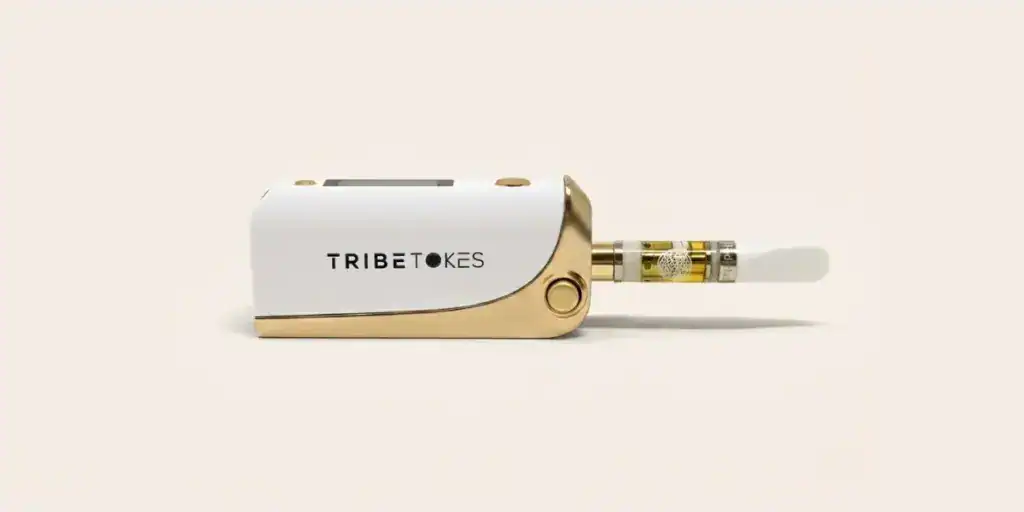
A Delta 8 vape is a device that heats Delta 8 THC oil to the point of vaporization so it can be inhaled. No combustion, no smoke. The oil converts to vapor, which carries the active cannabinoids into your lungs and bloodstream. Delta 8 THC itself is a naturally occurring cannabinoid found in small concentrations in hemp plants. Commercial Delta 8 oil is produced by converting hemp-derived CBD through an isomerization process and then refined to remove impurities. Responsible production at every stage results in a clean, consistent product.
Delta 8 THC is within the federal hemp definition when derived from hemp containing 0.3% or less Delta-9 THC by dry weight. The oil in a Delta 8 vape is typically a concentrate ranging from 70% to 95% Delta 8 THC by volume, depending on the formulation and whether terpenes or other cannabinoids are blended in. A 1-gram cart contains roughly 700-950mg of active Delta 8 THC.
The effects are distinct from Delta 9 THC, which is what you’d find in a licensed dispensary. Most users describe Delta 8 as producing a clearer, less anxious high at comparable doses: present enough to notice, mild enough to manage. Tolerance and individual body chemistry drive a lot of variation in that experience.
How Delta 8 Vapes Work
All Delta 8 vapes share the same basic mechanism: a battery heats a ceramic or metal coil, the coil heats the oil, and the oil vaporizes. You inhale the vapor, which absorbs through lung tissue directly into the bloodstream, bypassing the digestive system entirely. That’s why onset is so much faster with vaping than with edibles. Your blood carries cannabinoids to the brain within minutes rather than the 45-90 minutes it takes for an edible to clear the digestive system.
The temperature matters. Most quality batteries allow voltage adjustment, which affects vapor temperature. Lower voltage (around 2.6V) produces cooler, more flavorful vapor with slightly less cannabinoid density per hit. Higher voltage (around 3.2-3.6V) produces warmer, denser vapor with more intensity per hit and more terpene burnoff. For live resin carts where flavor is a selling point, starting at lower voltage preserves the terpene profile better. For distillate carts, the difference is less noticeable.
The internal hardware varies by product type: cartridges use a removable oil reservoir that attaches to a battery, while disposables integrate the battery and reservoir into a single sealed unit. Both use the same vaporization principle. The difference is in convenience, cost structure, and whether you want to switch between strains without changing batteries.
Carts vs. Disposables
| 510-Thread Cartridges | Disposable Vapes | |
| What you need | Cart + separate 510-thread battery | Nothing; draw-activated, all-in-one |
| Setup | Thread cart onto charged battery | No setup; ready to use out of the box |
| Cost per mg | Lower; battery is a one-time purchase | Slightly higher; battery included in unit cost |
| Strain flexibility | Swap carts without changing batteries | One strain per device; buy separately for each |
| Voltage control | Yes, if battery supports it | Fixed (preset to optimal range) |
| Best for | Regular users who want flexibility and better value over time | New users, travel, situations where you want zero setup |
For first-time buyers, a starter kit (battery + cart bundle) gives you the flexibility of carts at a price point close to a disposable. Once you know which strains you like, buying carts individually is more economical than disposables for regular use. If you want simplicity above everything else, a disposable is genuinely hard to beat. “No setup, ready to go” is the honest summary, and there’s a real use case for that.
Levester J., who uses TribeTokes mini starter kits, put it this way: “Light weight, fits perfectly in my pocket discreetly. I am in my zone around everyone, everywhere, and nobody knows.” That discretion is a real feature of both formats, but especially the smaller battery/cart combinations.
Distillate vs. Live Resin
The oil type is where the most meaningful variation in Delta 8 vapes lives. There are two main production approaches, and they produce noticeably different experiences.
Distillate
Distillate is highly refined Delta 8 oil. The refinement process concentrates Delta 8 THC and removes most other plant compounds, including much of the terpene content. The result is a potent, clean oil that delivers a consistent, THC-forward experience. Flavor is mild to moderate, depending on whether botanical or cannabis-derived terpenes are reintroduced after distillation. Distillate vapes are the classic format in this category: high potency, predictable, and widely available. TribeTokes full-spectrum distillate carts use cannabis-derived terpenes reblended into the extract, which gives them more flavor character than a plain distillate would have.
Live Resin
Live resin uses a different starting point. Instead of dried and cured hemp, it starts with freshly harvested plant material that’s flash-frozen immediately after harvest. That freezing step preserves the plant’s full terpene and cannabinoid profile before any drying or curing can degrade it. The resulting extract has a broader range of terpenes and minor cannabinoids than distillate, which produces a more complex flavor and what many users describe as a fuller-feeling effect. The entourage effect (the theory that cannabinoids and terpenes work better together than any single compound alone) is most applicable here.
“The live resin vapes are so smooth and tasty. They provide a comfortable high without any jitters or coughing,” wrote Christopher F. after switching to live resin carts.
Which Is Right for You?
Neither is objectively better. Distillate delivers potent, reliable Delta 8 with a cleaner profile. Live resin delivers a fuller sensory experience with more terpene complexity and subtly different effects. Regular users often keep both in rotation for different situations. If you’re new to Delta 8 vapes, distillate is a solid starting point: consistent and easy to calibrate. Once you’ve established your baseline, live resin is worth trying.
How to Choose a Strain
Delta 8 vape carts and disposables come in a range of strain profiles: indica, sativa, and hybrid. Strain type signals the terpene profile and the general experiential direction of the product, though individual variation in response is real and significant.
| Strain type | General character | Common terpenes | Typical use context |
| Indica | Body-forward, relaxing, calming | Myrcene, linalool, caryophyllene | Evening, winding down, sleep support |
| Sativa | Head-forward, energizing, uplifting | Limonene, pinene, terpinolene | Daytime, creative work, social settings |
| Hybrid | Balanced: body and head effects | Varies by specific cultivar | Flexible; bridges the gap between indica and sativa |
James B. nailed the practical split: “The sativa knocks the work day edge off. The indica allows you to leave the work day behind.” Most regular users end up with one of each for different parts of the day. Hybrids like Birthday Cake or Blue Dream sit in the middle, useful when you want both elements without committing to either end of the spectrum.
For first-time users, a hybrid is often the best starting point. Indicas can feel heavier than expected for someone new to Delta 8; sativas can occasionally feel too stimulating at higher doses. A hybrid gives you the full experience without the edges.
What Delta 8 Vapes Feel Like
Delta 8 vapes produce psychoactive effects. That’s the point. What distinguishes them from Delta 9 THC products is the character of those effects: most users describe Delta 8 as producing euphoria, relaxation, and mood elevation with less of the anxious edge that some people experience with higher-potency Delta 9.
Onset from vaping is fast: most people notice something within 5-10 minutes. The effects typically build over 15-30 minutes and peak somewhere around 45-90 minutes depending on dose and individual metabolism. Duration is generally 2-4 hours, though this varies with dose, tolerance, and body composition. Unlike edibles, which can linger for 6-8 hours at higher doses, vaping gives you a more defined window.
Cody R. described it from the strain level: “Slurricane: Relaxed, Euphoric, Happy, Focused and Creative. 60% Body, 40% Head. Smoothest vape I’ve ever had.” That body/head split language is useful shorthand for how indica-dominant hybrids tend to land: present in both dimensions but weighted toward the physical.
Brittany R. wrote: “I don’t feel groggy after I wake up or slumped throughout the day.” No next-day heaviness. That’s a recurring theme for people switching from Delta 9 or traditional sleep aids, and it shows up often enough in the review data to count as a pattern, not an outlier.
Delta 8 vapes are psychoactive, and dose affects intensity significantly. At 1-2 puffs, most users experience mild to moderate effects. At 5+ puffs in a single session, you’re in clearly altered territory. That’s not inherently a problem, but it should be expected going in.
How to Dose a Delta 8 Vape
Vaping is the most controllable Delta 8 format for dosing. Onset is fast and duration is short. You can gauge two puffs within 20 minutes and decide whether to take more, which you can’t do with edibles where you’re committing to hours before knowing where you’ve landed.
New to Delta 8 vapes: Start with 1-2 puffs. Wait a full 15-20 minutes before deciding whether to take more. Delta 8’s onset is fast, but it doesn’t peak immediately. Taking additional puffs before the first has fully come on is the most common reason new users end up more high than intended.
Occasional users: 2-4 puffs is a common starting range. Strain and format (distillate vs. live resin) affect potency per hit, so even if you’ve used Delta 8 before, give a new cart a session to calibrate before assuming your usual dose applies.
Regular users: Tolerance builds with regular use, just as it does with any cannabinoid. If you’re finding you need significantly more to achieve the same effect, a tolerance break (even a few days of abstinence) typically restores sensitivity quickly.
“It only takes a hit or two to do the job. Same with Remedy,” wrote Lori J. Two hits. Wait. That’s the dose protocol for most people most of the time.
Voltage matters too. On an adjustable battery, starting low (2.6V) and moving up if needed controls dose more precisely than jumping straight to high voltage. Higher voltage extracts more oil per hit, which means more Delta 8 per puff.
What to Look for in a Quality Delta 8 Vape
The Delta 8 market has a genuine quality problem. Because hemp-derived cannabinoids exist in a regulatory gray zone below the pharmaceutical oversight of state dispensaries, the range from excellent to dangerous products is wide.
Third-Party Lab Testing (COAs)
A Certificate of Analysis from an ISO 17025-accredited third-party lab is the non-negotiable quality signal. The COA should confirm Delta 8 potency, non-detectable heavy metals, non-detectable pesticides, non-detectable residual solvents, and microbial safety. Potency-only COAs are not sufficient: they tell you what’s in the oil but not what shouldn’t be there. If a brand doesn’t publish COAs or only makes them available on request, that’s a meaningful red flag.
TribeTokes publishes batch-specific COAs at tribetokes.com/certificates-of-analysis before products ship. Not by product line; by batch, so you can verify the specific oil in the cart you’re holding.
Ingredient Simplicity
Quality Delta 8 vape oil needs two things: Delta 8 THC and terpenes. Cannabis-derived terpenes add flavor and contribute to the effect profile. Botanical terpenes (from non-cannabis plant sources) are acceptable but produce a different character. What you don’t want to see: cutting agents like vitamin E acetate, MCT oil, or propylene glycol. These are associated with lung irritation and were responsible for the EVALI outbreak in 2019. The best vapes list a short ingredient deck that you can account for entirely.
Hardware Quality
The cart hardware affects the experience. Common cart problems with lower-quality products: clogging, leaking, uneven heating that burns oil rather than vaporizing it, and cracked ceramic cores. Emma S. pointed to cart reliability as a deciding factor: “I’ve tried different brands of D8 cartridges and always come back to TribeTokes. Cartridges never clog, my favorite brand.” That mechanical consistency matters. A clogged cart isn’t just inconvenient; it can overheat and degrade oil quality.
Source Transparency
Know where the Delta 8 is coming from. Responsible brands source hemp-derived CBD from licensed farms and carry that sourcing transparency through to the finished product. Brands that can’t or won’t tell you where their starting material originates are an unknown risk.
Red Flags to Avoid
- No COA, or COAs that only show potency without safety panels
- Products claiming to contain both Delta 8 and synthetic cannabinoids without clear labeling
- Unusually low prices (quality Delta 8 extraction and testing have real costs)
- Discolored or unusually dark oil (quality distillate is clear to light amber; live resin is amber to golden)
- Strong chemical or solvent smell beyond normal cannabis terpene character
Delta 8 Vapes and Drug Testing
Delta 8 vapes will produce a positive result on a standard drug test. This is not negotiable and it doesn’t matter that Delta 8 is within the federal hemp definition, hemp-derived, or labeled differently from Delta 9. Standard immunoassay tests detect THC-COOH, a metabolite that Delta 8 and Delta 9 both produce through the same metabolic pathway. The test cannot distinguish the source.
Detection windows vary by test type and frequency of use. For a urine test (the most common workplace screening format), occasional users typically clear the 50 ng/mL detection threshold within 3-7 days. Regular daily users can test positive for 30 days or longer. Blood and saliva tests have shorter windows; hair tests extend up to 90 days.
If you are subject to any drug testing, do not use Delta 8 products. If drug testing is a concern and you want to use cannabinoid products, CBD-only products with COAs confirming non-detectable Delta-9 THC are the appropriate alternative. TribeTokes CBD products are verified THC-free by batch.
TribeTokes Delta 8 Vapes
TribeTokes has produced Delta 8 vapes since 2017, before the category was crowded and before most of the brands currently flooding the market existed. Every batch is third-party tested at ISO 17025-accredited labs for potency, pesticides, heavy metals, residual solvents, and microbials, with COAs published by batch at tribetokes.com/certificates-of-analysis. The lineup spans 12+ strain-specific distillate carts, a full live resin cart selection, disposable vapes in both formats, and three battery options (Saber, Wand, Mini) at different price points and form factors. Prefer a slower, longer effect than a vape? Our CBD-boosted Delta 8 gummies take 30 to 90 minutes to start and last for hours.
“Superior taste and potency are spot on. Always come back,” wrote Jennifer F. after multiple orders. 4.86/5 from 1,037 Delta 8 vape reviews. Woman-owned since 2017.
Shop: Delta 8 vape carts | Delta 8 disposables | Delta 8 live resin carts | Delta 8 live resin disposables | starter kits
Frequently Asked Questions
A Delta 8 vape is a device that heats hemp-derived Delta 8 THC oil to vaporization temperature so it can be inhaled. No combustion; the oil converts to vapor rather than smoke. Delta 8 THC is within the federal hemp definition when derived from hemp, and vaping is the fastest-acting format for Delta 8, with onset in 5-10 minutes. The two main hardware types are 510-thread cartridges (used with a separate battery) and all-in-one disposable vape pens.
A cart (cartridge) is a replaceable oil reservoir that threads onto a separate 510-thread battery. A disposable integrates the battery and oil reservoir into one sealed unit: draw-activated, no setup, no charging. Carts give you more flexibility (swap strains without changing batteries, lower cost per milligram over time) while disposables offer maximum convenience. For regular users, carts are more economical. For first-timers or travel, disposables are hard to beat.
Distillate is highly refined Delta 8 oil with most other plant compounds removed, producing potent, consistent, THC-forward effects with mild to moderate flavor. Live resin starts with fresh-frozen hemp. That flash-freeze preserves the plant’s full terpene and cannabinoid profile before any degradation occurs. Live resin has broader flavor complexity and what many users describe as a fuller effect profile, consistent with the entourage effect. Neither is objectively better. Distillate is reliable and predictable; live resin goes deeper on flavor and complexity.
Indica-dominant strains are generally body-forward and calming: a natural fit for evening use. Sativa-dominant strains tend toward head-forward and energizing effects, better suited for daytime. Hybrids land somewhere in between. Individual response varies, but the indica/sativa/hybrid framework is a useful starting map. For first-time Delta 8 vape users, a hybrid is typically the best entry point: it provides the full range of effects without the stronger directional pull of a pure indica or sativa.
If you’re new to Delta 8 vapes: 1-2 puffs, then wait a full 15-20 minutes before taking more. Delta 8 from vaping arrives quickly but doesn’t peak immediately. Taking more before the first dose has fully come on is the most common way new users end up taking more than intended. Experienced users typically settle into a personal range of 2-5 puffs per session depending on tolerance and the specific product. Higher voltage on an adjustable battery means more oil per hit, so factor that in when switching settings.
Typically 2-4 hours, with peak effects around 45-90 minutes after the last puff. This is shorter than edibles (which can last 6-8 hours at higher doses) and makes vaping more controllable for managing duration. Individual variation is real; body weight, metabolism, tolerance, and the specific product all affect duration. Most people find the effects have largely resolved within 3 hours of a standard session.
Yes. Delta 8 is psychoactive. The experience is generally described as euphoric and relaxing, with most users reporting less anxiety and cognitive disruption than they’d expect from comparable Delta 9 THC doses. The intensity scales with how much you use: 1-2 puffs produces mild to moderate effects for most people; more puffs produce more pronounced effects. For a non-psychoactive option, CBD is the appropriate alternative.
Third-party COAs from an ISO 17025-accredited lab are the primary quality signal. The COA should cover potency plus full safety panels for heavy metals, pesticides, residual solvents, and microbials. Ingredient lists should be short: Delta 8 oil and terpenes, nothing else needed. Avoid products with cutting agents like vitamin E acetate or MCT oil. For hardware, look for ceramic core construction and carts from brands with a documented track record of no clogging or leaking.
Yes. Delta 8 and Delta 9 THC produce the same primary urinary metabolite, THC-COOH, which is what standard immunoassay drug screens detect. The legal status of Delta 8 as hemp-derived or hemp-derived has no bearing on the test result. Occasional users typically test positive for 3-7 days on a urine screen; regular daily users can test positive for 30 days or longer. If you are subject to drug testing of any kind, do not use Delta 8 products.
Check the COA. A complete COA from a third-party, ISO 17025-accredited lab should show non-detectable results for heavy metals, pesticides, residual solvents, and microbial contamination, in addition to confirming Delta 8 potency. Potency-only lab reports are not sufficient. Inspect the oil as well: quality Delta 8 oil is clear to light amber (distillate) or golden amber (live resin); dark or unusually colored oil is a warning sign. The ingredient list should be short: oil and terpenes, nothing else required.
Shop TribeTokes Delta 8 Vapes
4.86/5 from 1,037 vape reviews. Batch-specific COAs before every shipment. 12+ strain options, distillate and live resin, carts and disposables.