
Delta 8 THC is a naturally occurring cannabinoid that produces psychoactive effects at lower intensity than traditional Delta 9 THC. It’s within the federal hemp definition when derived from hemp, which has made it one of the most popular alternatives to state-dispensary cannabis. This guide covers the chemistry, the pharmacology, the honest comparison to Delta 9, and how to choose a product that’s actually worth buying.
🧪 Lab Tested | 👩💼 Woman-Owned | 🏆 Est. 2017
Delta 8 THC at a Glance
| Full name | Delta-8 tetrahydrocannabinol (Δ8-THC) |
| Structural difference from Delta 9 | Double bond at 8th carbon vs. 9th carbon |
| Primary mechanism | CB1 and CB2 receptor partial agonist |
| Psychoactive? | Yes, milder than Delta 9 |
| Relative potency vs. Delta 9 | Roughly two-thirds the potency in human studies |
| Natural concentration in cannabis | Trace amounts only; market supply is produced from hemp-derived CBD |
| Federal legal status (U.S.) | hemp-derived when hemp-derived (the Agricultural Improvement Act of 2018) |
| State legal status | Legal in most states; some states have specific restrictions |
| Drug test risk | Yes; will produce positive urine screen |
| TribeTokes rating | 4.8/5 from 1,500+ Delta 8 vape and gummy reviews |
What Is Delta 8 THC?
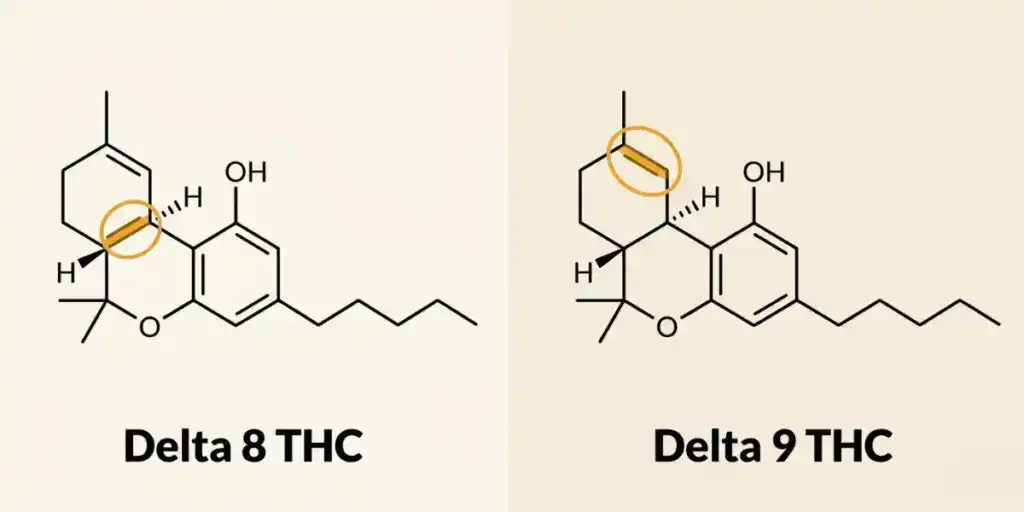
Delta 8 tetrahydrocannabinol is a cannabinoid found in Cannabis sativa plants. It’s structurally similar to Delta 9 THC, the primary psychoactive compound in cannabis, but differs in one meaningful way: the double bond in its carbon chain sits at the eighth carbon position rather than the ninth. That single positional shift produces measurably different pharmacological properties, including lower CB1 receptor binding affinity and, as a result, milder psychoactive effects.
Delta 8 occurs naturally in cannabis plants, but only in trace amounts, typically less than 1% of total cannabinoid content. This is why commercially sold Delta 8 products are almost never extracted directly from the plant. Instead, they’re produced by chemically converting hemp-derived CBD into Delta 8 through an isomerization process.
Despite being a minor cannabinoid by natural occurrence, Delta 8 has grown into one of the largest segments of the hemp market since federal hemp law created a federal legal pathway for hemp-derived cannabinoids. The appeal breaks down simply: genuine psychoactive effects at a milder intensity than traditional cannabis, hemp-derived when properly produced from hemp, and available without a dispensary.
How Delta 8 Is Produced
Because Delta 8 exists only in trace amounts in hemp plants, it can’t be extracted directly the way CBD or THCa can. Commercial Delta 8 is produced through acid-catalyzed isomerization: hemp-derived CBD is converted into Delta 8 using a solvent and an acid catalyst, and the solvent and catalyst are then fully removed through a purification process, typically chromatography. When this is done responsibly by a qualified lab, the result is clean Delta 8 distillate with residual solvents below detection limits, the same quality standard you’d expect from any premium hemp extract.
The process itself isn’t the issue. The issue is that not every producer holds the same standards. A brand running proper purification and testing with an accredited third-party lab delivers a clean product. A brand skipping those steps delivers something else. That’s why the residual solvents panel on a Delta 8 COA is the quality signal that separates responsible producers from the rest; it is direct verification that the purification was actually completed. TribeTokes’ Delta 8 products are tested for residual solvents on every batch, with COAs published before products ship.
Not all Delta 8 is created equal: The isomerization process is established chemistry. What varies is whether brands do it right. Responsible production from quality hemp-derived CBD, followed by proper purification and accredited third-party lab testing, results in a clean product. The COA’s residual solvents panel is what proves it. If a brand can’t show you that panel, that’s the answer.
How Delta 8 Works in the Body
CB1 and CB2 Receptor Binding
Delta 8 THC is a partial agonist of both CB1 and CB2 cannabinoid receptors, the same receptor targets as Delta 9 THC. CB1 receptors are concentrated in the brain and central nervous system, governing the psychoactive effects. CB2 receptors are distributed primarily in immune tissue. What differs between Delta 8 and Delta 9 is binding affinity: Delta 8 binds CB1 with measurably lower affinity than Delta 9, which accounts for its reduced psychoactive potency. A 2022 systematic review by Tagen and Klumpers in the British Journal of Pharmacology concluded that Delta 8 is a CB1 partial agonist with pharmacokinetics and pharmacodynamics broadly similar to Delta 9, with the reduced potency explained primarily by the weaker CB1 binding affinity.
Source: Tagen, M. and Klumpers, L.E. (2022). “Review of delta-8-tetrahydrocannabinol (Δ8-THC): Comparative pharmacology with Δ9-THC.” British Journal of Pharmacology, 179(15). PubMed: 35523678.
Metabolism
Delta 8 follows the same metabolic pathway as Delta 9. Both are processed by the liver’s cytochrome P450 enzyme system, producing an active hydroxylated metabolite (11-hydroxy-Delta 8 THC), the same type of metabolite that Delta 9 produces (11-hydroxy-Delta 9 THC). This is why Delta 8 and Delta 9 have similar detection windows on drug tests and why edible Delta 8 has a delayed, longer-lasting effect profile compared to inhaled Delta 8. Your liver is doing the same conversion work on both compounds.
What Does Delta 8 Feel Like?

The most consistent descriptor in user reports for Delta 8 is “milder.” That’s not marketing language; it reflects the pharmacology. Lower CB1 binding affinity produces a genuinely less intense psychoactive effect, and most people who use both Delta 8 and Delta 9 describe the Delta 8 experience as clearer-headed, less likely to provoke anxiety, and easier to manage without overshooting a comfortable dose.
What people commonly report with Delta 8:
- Relaxation without sedation. At moderate doses, many users describe a body calm that doesn’t necessarily translate to couch-lock or drowsiness, particularly with sativa-leaning strain profiles.
- Mild euphoria. The mood lift is present but generally described as gentler than Delta 9, with less intensity in perceptual changes.
- Reduced anxiety risk. The lower CB1 affinity appears to make the anxiety-amplifying effects some users experience with high-dose Delta 9 less likely with Delta 8. This is not a guarantee; individual responses vary and higher doses of Delta 8 can still provoke anxiety in some people.
- Appetite stimulation. Same CB1-mediated pathway as Delta 9; the appetite effect is real and present.
- Standard physical effects. Dry mouth, red eyes, and slightly elevated heart rate at onset are all consistent with CB1 activation, same as Delta 9.
“What a relaxing product. Mellowing effect within an hour. No residual effects or after taste,” wrote Stephen M. after ordering TribeTokes Delta 8 gummies. That clean, manageable experience is what the pharmacology would predict at a moderate dose from a well-formulated product.
Delta 8 vs. Delta 9 THC: Key Differences
The two most important distinctions are potency and legal status. Everything else follows from those two.
| Feature | Delta 8 THC | Delta 9 THC |
| Double bond position | 8th carbon | 9th carbon |
| CB1 binding affinity | Lower; roughly two-thirds the potency of Delta 9 | Higher; primary psychoactive cannabinoid in cannabis |
| Psychoactive intensity | Milder; clearer-headed experience reported by most users | Stronger; more intense perceptual and cognitive effects |
| Anxiety risk | Lower, particularly at moderate doses | Higher at elevated doses; dose-dependent |
| Natural concentration in plant | Trace amounts only (under 1%) | Dominant cannabinoid in cured cannabis flower |
| Market source | Produced by CBD isomerization from hemp | Extracted from cannabis or produced synthetically (dronabinol) |
| Federal legal status | hemp-derived when hemp-derived (the Agricultural Improvement Act of 2018) | Schedule I federally; legal medically/recreationally in ~40 states |
| Available without dispensary | Yes; ships to most states | No; state dispensary only |
| Drug test result | Positive on standard urine screen | Positive on standard urine screen |
| Onset when inhaled | 5-10 minutes | 1-10 minutes |
| Duration when inhaled | 2-4 hours | 1-3 hours |
| Clinical research base | Limited; primarily preclinical | Extensive; FDA-approved pharmaceutical derivatives |
One carbon position, one double bond shift. That’s the whole structural story. The practical result is a cannabinoid that’s genuinely milder and more manageable than Delta 9, still psychoactive, still drug-test positive, still subject to varying state regulations, but meaningfully easier to dose for most people.
Delta 8 Dosing Guide
Delta 8’s lower potency means the dosing math is different from Delta 9. Products formulated for Delta 8 use higher milligram amounts per serving than comparable Delta 9 products; 25mg per gummy is common for Delta 8, where 10mg would be a standard Delta 9 serving. These ranges reflect commonly reported thresholds, not medical recommendations.
| Experience level | Inhalation (vape or smoke) | Edibles | Notes |
| First-time or cannabis-naive | 1 inhalation; wait 10-15 min | Half a gummy (approx. 12-15mg for standard D8 products) | Start here regardless of confidence level. Edibles: wait two full hours before deciding to take more. |
| Occasional user | 2-3 inhalations | 1 gummy (approx. 25mg) | 25mg is the standard single serving for most Delta 8 edibles. This is the typical starting point for someone with general cannabinoid experience. |
| Regular cannabis user | Several inhalations per session | 25-50mg | Experienced Delta 9 users often find Delta 8 requires more volume to achieve comparable effects. Adjust based on actual experience, not assumption. |
| High tolerance | Varies | 50mg+ | Tolerance to Delta 8 builds with regular use. Two-week abstinence periods substantially reset CB1 receptor sensitivity for most users. |
The edibles rule applies here exactly as it does with Delta 9: the delayed onset (45-90 minutes to peak) makes it easy to take a second dose before the first has arrived. Take your starting dose, wait a full two hours, assess, and only then decide whether to add more. “I’m a bit of a lightweight so I cut the gummies in half,” wrote William S., describing the sensible approach for anyone starting out with Delta 8 edibles.
What the Research Shows
Delta 8’s research base is more limited than Delta 9’s, though the foundational pharmacology is well characterized. The most thorough published review to date, Tagen and Klumpers (2022) in the British Journal of Pharmacology, found that Delta 8 and Delta 9 have broadly similar pharmacokinetics and pharmacodynamics, with the potency gap explained by weaker CB1 receptor affinity. On clinical data: a 1973 human study by Hollister and Gillespie established Delta 8’s potency at roughly two-thirds that of Delta 9 under controlled conditions, and that figure has held up over subsequent research.
A 2022 survey study by Kruger and Kruger published in the Journal of Cannabis Research collected self-reported experiences from 521 Delta 8 users. The most commonly reported reasons for use were relaxation (71%), euphoria (68%), and relief from stress (55%). Notably, 77% reported preferring Delta 8 to Delta 9 for its milder effect profile, and side effect reports were substantially lower than what users reported with Delta 9. Importantly, this was a self-reported survey, not a controlled clinical trial; it describes consumer experiences rather than establishing clinical efficacy.
Source: Kruger, J.S. and Kruger, D.J. (2022). “Delta-8-THC: Delta-9-THC’s nicer younger sibling?” Journal of Cannabis Research, 4(1). PMC8725316.
The FDA has issued consumer advisories about Delta 8 products, primarily related to products that are mislabeled, improperly tested, or contain contaminants from the isomerization process. This is a manufacturing quality concern, not a pharmacological condemnation of Delta 8 itself, but it underscores why buying from brands with verifiable, batch-specific third-party lab testing is essential.
Legal Status
Delta 8 THC derived from hemp sits in a hemp-derived category under federal hemp law, which removed hemp and hemp-derived cannabinoids from the federal Controlled Substances Act. federal hemp law defines hemp as cannabis with 0.3% or less Delta 9 THC by dry weight. Delta 8, when produced from hemp-derived CBD, falls within this framework and is not Delta 9 THC, making hemp-derived Delta 8 hemp-derived to produce, sell, and possess.
State law is a different picture. Several states have enacted their own restrictions on Delta 8 specifically, or on psychoactive hemp products more broadly. State regulations in this category update frequently, so confirming your state’s current hemp laws before purchasing is worthwhile. TribeTokes’ product pages include current shipping restriction notices, and norml.org/laws maintains a regularly updated state-by-state guide.
Federal vs. state: The federal hemp definition doesn’t mean universally legal. Delta 8 occupies a genuinely complex legal position that varies by state and changes more often than most people expect. Buying from a brand that stays current on compliance is the clearest path through it.
Drug Testing: Delta 8 Will Show Up
Delta 8 and Delta 9 follow the same metabolic pathway and produce the same class of urinary metabolites (THC-COOH) that standard drug screens detect. A positive drug test result is the predictable outcome of using Delta 8 products in any form. The legal status of Delta 8, or the fact that it came from hemp, has no bearing on what the test detects.
Detection windows mirror Delta 9: occasional users may clear metabolites in 3-7 days; regular users can test positive for 30 days or longer because THC metabolites are fat-soluble and accumulate with consistent use. Body composition, metabolism, and frequency of use all affect individual timelines, but no reliable shortcut exists to accelerate clearance.
If you are subject to drug testing for any reason, employment, probation, athletic competition, professional licensing, or otherwise: do not use Delta 8 products.
Which Format Is Right for You?
TribeTokes carries Delta 8 in vape cartridges, disposable vape pens, and gummies across a range of strain profiles and extract types. Here’s how the formats compare:
| Format | Onset | Duration | Best for | Available at TribeTokes |
| Delta 8 vape cart (distillate) | 5-10 min | 2-4 hours | Consistent daily use; 510-thread battery required; full range of strains | D8 Vape Cart |
| Delta 8 vape cart (live resin) | 5-10 min | 2-4 hours | Full-spectrum terpene profile; premium flavor; strain specificity matters to you | D8 Live Resin Carts |
| Delta 8 disposable vape (distillate) | 5-10 min | 2-4 hours | No battery required; travel; first-time vape users; grab-and-go | D8 Distillate Disposable |
| Delta 8 disposable vape (live resin) | 5-10 min | 2-4 hours | All-in-one convenience with live resin quality; best of both worlds | D8 Live Resin Disposable |
| Delta 8 gummies | 45-90 min | 4-8 hours | No inhalation; longer-lasting effects; precise mg dosing; easier on the lungs | D8 Gummies |
| Delta 8 live resin gummies | 45-90 min | 4-8 hours | Full-spectrum edible experience; richer cannabinoid and terpene profile | D8 Live Resin Gummies |
| Delta 8 tincture | 15-45 min | 3-6 hours | Sublingual dosing; consistent measurement; mid-range onset between inhale and edible | D8 Tincture |
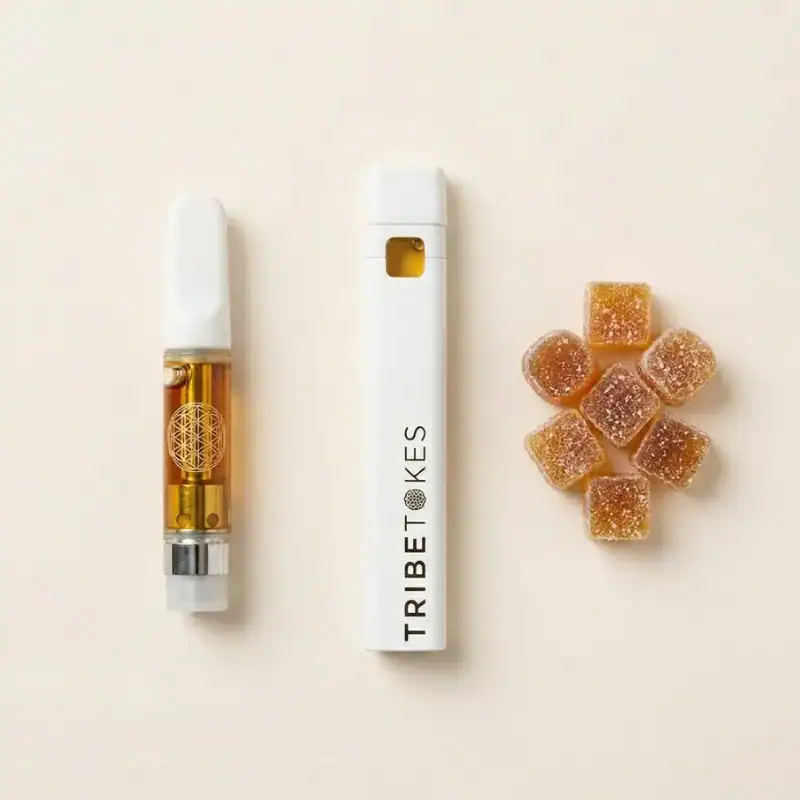
The distillate-vs-live-resin distinction is worth naming directly. Distillate is refined Delta 8 oil that’s been processed to isolate the cannabinoid; it’s consistent, potent, and clean. Live resin is extracted from fresh-frozen plant material, preserving the terpene profile of the living plant alongside the cannabinoids. Live resin products tend to have more complex flavor and a broader spectrum of compounds that interact with the endocannabinoid system together. Neither is wrong: distillate offers consistency, live resin offers complexity. “Love the new flavors of live resins. Big live resin fan so keep them coming,” wrote Anne-Marie W. after ordering the TribeTokes live resin carts. Some people have a clear preference once they’ve tried both.
What to Look for When Buying Delta 8
The Delta 8 market has more variance in quality than most hemp categories, not because responsible production is difficult, but because not every brand is doing it responsibly. Here’s what to look for.
Third-party lab testing, and specifically the right panels. A COA that only covers potency is insufficient for Delta 8. You need to see: potency (Delta 8 percentage), residual solvents (confirming purification was completed), pesticides, heavy metals, and for vapes, a microbials panel. If a brand can’t produce documentation on all five, pass.
Extract quality and transparency. Know whether you’re buying distillate or live resin, and know what that means for the product. Distillate = refined, consistent, uniform. Live resin = full-spectrum, strain-specific, higher cost. A brand that won’t tell you which type you’re buying is either uninformed or hiding something. TribeTokes states the extract type on every product listing and COA.
Strain profiles and terpene sourcing. For vape products specifically, the experience varies significantly by strain. The terpenes that drive indica vs. sativa vs. hybrid effects are present in full-spectrum live resin products and may be present in natural or synthetic form in distillate products. Look for brands that specify whether terpenes are cannabis-derived or artificially added.
How to Read a Certificate of Analysis (COA)
A COA is the third-party lab report that verifies what’s actually in a Delta 8 product. For Delta 8, the critical panels are: potency (Delta 8 percentage, and confirmation that D9 THC is at or below 0.3% for federal compliance), residual solvents (the production quality check unique to this category), pesticides, and heavy metals. For vapes, a microbials panel matters too.
Three checks before accepting a COA: the lab must be ISO 17025-accredited; the batch number on the COA must match the batch number on your product; and the report must be current and batch-specific, not a blanket document covering different production runs. If the residual solvents panel is missing or “not tested,” that’s a hard stop. It means either the producer skipped the test or doesn’t want you to see the result.
All TribeTokes COAs are available by product and batch at tribetokes.com/certificates-of-analysis, accessible before you order.
What to Avoid When Buying Delta 8
The quality floor in the Delta 8 market is lower than in most hemp categories because the production chemistry is more complex and the regulatory oversight is thinner. These are the clearest red flags:
- No residual solvents panel on the COA. This is the one panel that’s Delta 8-specific and non-negotiable. If it’s absent, the production process has not been independently verified. Do not buy.
- COA from a non-accredited lab. ISO 17025 accreditation is the standard that makes a lab’s results credible. Proprietary “in-house” testing or unaccredited third-party labs do not meet this standard.
- Very low prices. Proper isomerization, purification, and third-party testing cost money. Delta 8 products priced significantly below market are almost always skipping one of those steps. The savings aren’t worth it.
- Vague extract type labeling. “Delta 8 oil” without specifying distillate, live resin, or extract type is not transparency. It’s evasion.
- No D9 THC compliance documentation. Federal legality depends on D9 THC being at or below 0.3% in the finished product. If the COA doesn’t show this clearly, the product’s federal legal status cannot be confirmed.
- Products that claim Delta 8 is identical to dispensary THC. It’s not. The pharmacology is similar but measurably different. Any brand making that equivalence claim is prioritizing sales over accuracy.
Why TribeTokes
“I love these gummies after a long stressful day. They are the perfect way for my mind to destress and my body to relax. My go-to gummy in the evening,” wrote Theresa C. That kind of repeat-order loyalty is what consistent quality looks like in practice.
TribeTokes has been in the hemp cannabinoid market since 2017 and has been producing Delta 8 products since the category emerged post-federal hemp law. The lineup covers distillate and live resin vape carts, distillate and live resin disposables, gummies, and tinctures. Every vape product uses only two ingredients: Delta 8 extract and strain-specific natural terpenes. No MCT oil, no PG, no VG, no Vitamin E acetate. Every batch is tested at an ISO 17025-accredited third-party lab across all relevant panels, with COAs posted by product and batch before products ship. Woman-owned, operating at the standard the market doesn’t always hold itself to.
Frequently Asked Questions About Delta 8 THC
“Regular THC” in common usage means Delta 9 THC, the primary psychoactive compound in cannabis. Delta 8 THC is a structural isomer of Delta 9: the same molecular formula, but with the double bond in the carbon chain at the eighth position rather than the ninth. That structural difference produces lower binding affinity at CB1 receptors, which translates to milder psychoactive effects, roughly two-thirds the potency of Delta 9 in human studies. Both are psychoactive, both will produce a positive drug test, and both are federally regulated differently than CBD. The practical differences are potency and legal status: Delta 8 is within the federal hemp definition when hemp-derived; Delta 9 is federally Schedule I.
Hemp-derived Delta 8 THC is within the federal hemp definition, which removed hemp and hemp-derived cannabinoids from the federal Controlled Substances Act. Delta 8 is not Delta 9 THC, so properly produced hemp-derived Delta 8 falls within federal hemp law’s framework. State law is more varied. Over a dozen states have enacted specific restrictions on Delta 8 or have broader laws that affect psychoactive hemp products. Before purchasing, confirm your state’s current regulations. TribeTokes’ product pages reflect current shipping restrictions by state.
Yes. Delta 8 is psychoactive and will produce intoxicating effects. The experience is consistently described as milder, clearer-headed, and less anxiety-prone than Delta 9 at comparable doses, but it is not a non-intoxicating cannabinoid. The milder effect profile makes Delta 8 more manageable for many users, particularly those who find Delta 9 too intense or anxiety-inducing. If you are new to Delta 8, start with a low dose (half a gummy or one inhalation) and wait to assess before taking more. Treat it as a genuinely psychoactive substance, because it is one.
Yes. Delta 8 and Delta 9 are metabolized through the same pathway, producing the same urinary metabolites (THC-COOH) that standard drug screens detect. A positive test result is the predictable outcome of using Delta 8 in any form. The legal status of the product and the fact that it came from hemp have no bearing on what the test detects. Detection windows are similar to Delta 9: occasional users may clear in 3-7 days; regular users can test positive for 30 days or more. If you are subject to any drug testing, do not use Delta 8.
The same factors that affect Delta 9 detection windows apply to Delta 8: frequency of use, body composition, metabolism, and the sensitivity threshold of the test used. For occasional users (once or twice per week), metabolites typically clear within 3-7 days. For regular users (daily or near-daily), the window extends to 30 days or longer because THC metabolites are fat-soluble and accumulate in body tissue with consistent use. Individual variation is significant, and no reliable shortcut exists to predict exactly when metabolites will fall below a test’s threshold.
Delta 8 is a naturally occurring cannabinoid, but it exists in cannabis plants only in trace amounts, typically less than 1% of total cannabinoid content. The commercial Delta 8 market is supplied almost entirely through chemical conversion: hemp-derived CBD is isomerized using an acid catalyst and solvent to produce Delta 8, and then the solvent is removed through chromatographic purification. The finished product is the same molecule that occurs naturally; getting it to commercial scale involves converting an existing hemp molecule, not building something new from scratch. This is why the residual solvents panel on a Delta 8 COA is non-negotiable; it is the verification that purification was completed.
Distillate is refined Delta 8 oil that’s been processed to isolate the cannabinoid with high purity. It’s consistent, potent, and uniform across batches. Terpenes may be added back in after distillation (either cannabis-derived or botanical). Live resin is extracted from fresh-frozen plant material before drying or curing, which preserves the terpene profile of the living plant alongside the cannabinoids. Live resin has broader full-spectrum complexity, more strain-specific flavor, and a richer overall profile, at higher cost. Both are legitimate products. Distillate suits people who want consistent, predictable potency. Live resin suits people who want the strain-specific experience and full-spectrum benefits.
THCa and Delta 8 are both hemp-derived psychoactive cannabinoids, but they are chemically distinct with different profiles. THCa is the acidic precursor cannabinoid found in raw hemp flower; when consumed via smoking or vaping, THCa flower, vapes, and pre-rolls produce psychoactive effects comparable to traditional cannabis. Delta 8 is an isomer of Delta 9 THC produced from CBD through chemical conversion, with milder psychoactive effects than either THCa or Delta 9. In practical terms: reach for THCa if you want a full-spectrum, traditional cannabis-like experience from hemp. Reach for Delta 8 if you want something genuinely milder and more manageable. Both carry drug test risk when consumed via inhalation.
For edibles, half a gummy (roughly 12-15mg for standard Delta 8 products, which are typically dosed at 25mg per piece) is the right starting point. Take it, wait two full hours before considering more, and assess the experience before adding. For inhalation products, one puff and a 10-15 minute wait is the practical starting protocol. Delta 8’s lower potency compared to Delta 9 sometimes leads people to assume they need more than they do. Start lower than you think you need. The experience from a single well-dosed serving of Delta 8 is often more present than first-time users expect, particularly with live resin products whose terpene complexity adds to the effect.
Delta 8’s lower CB1 binding affinity makes anxiety a less common side effect than with Delta 9, particularly at moderate doses. The Kruger and Kruger 2022 survey found that most Delta 8 users specifically cited lower anxiety as a reason for preferring it over Delta 9. That said, Delta 8 is still psychoactive and can provoke anxiety, especially at higher doses, in new or uncomfortable settings, or in individuals with high sensitivity. The risk is lower than with Delta 9 but not zero. The practical guidance is the same as with any psychoactive cannabinoid: start with a low dose, use in a comfortable setting, and don’t stack doses before the first one has fully expressed.
Shop Delta 8 THC Products
Full-spectrum distillate and live resin vape carts, disposables, gummies, and tinctures. 4.8/5 from 1,500+ reviews. No fillers, no cutting agents. Third-party tested every batch.
Sources
- Tagen, M. and Klumpers, L.E. (2022). “Review of delta-8-tetrahydrocannabinol (Δ8-THC): Comparative pharmacology with Δ9-THC.” British Journal of Pharmacology, 179(15), 3915-3933. PubMed: 35523678.
- Kruger, J.S. and Kruger, D.J. (2022). “Delta-8-THC: Delta-9-THC’s nicer younger sibling?” Journal of Cannabis Research, 4(1), Article 4. PMC8725316.
- U.S. Food and Drug Administration. “5 Things to Know about Delta-8 Tetrahydrocannabinol.” FDA.gov.
- U.S. Food and Drug Administration. “Hemp Production and the 2018 Farm Bill.” Congressional Testimony, July 25, 2019. FDA.gov.
- National Institute on Drug Abuse. “Cannabis (Marijuana) Drug Facts.” NIDA.nih.gov.