
Most people assume CBD and THC sit on a potency spectrum: CBD is mild, THC is strong, pick based on how much effect you want. That assumption is wrong, and it’s the reason so many people accidentally make their anxiety worse with cannabis. At high doses, CBD and THC have pharmacologically opposite effects on anxiety. CBD is anxiolytic across its dose range. THC is anxiolytic at low doses and anxiogenic at high ones. A 2010 neuroimaging study found CBD doesn’t just take a different path to reducing anxiety. It blocks the anxiety-inducing effects of THC at a receptor level. These aren’t two versions of the same thing. They’re two different conversations with your nervous system.
🧪 Lab Tested | 👩💼 Woman-Owned | 🏆 Est. 2017
The Core Pharmacological Difference
CBD and THC work through entirely different receptor systems.
CBD
Primary anxiety target 5-HT1A serotonin receptor
CB1 activation None at standard doses
Dose-response curve Bell-shaped (anxiolytic across moderate range)
Anxiety risk at high doses Low
Psychoactive No
Drug test (full-spectrum) Low but real
THC (including Delta-8)
Primary anxiety target CB1 receptor (amygdala)
CB1 activation Full agonist (D9); partial agonist (D8)
Dose-response curve Biphasic (anxiolytic low, anxiogenic high)
Anxiety risk at high doses Real, especially D9
Psychoactive Yes
Drug test Will produce a positive
CBD’s anxiolytic effect runs through the serotonin system. It acts as a partial agonist at 5-HT1A, the same receptor targeted by buspirone (a prescription anxiolytic) and indirectly by SSRIs. Lower amygdala reactivity, reduced threat-level perception of ambiguous stimuli, calmer baseline. None of this involves CB1 receptors, which is why CBD doesn’t produce a psychoactive effect and doesn’t carry THC’s dose-dependent anxiety risk.
THC’s relationship with anxiety runs through CB1 receptors in the amygdala and prefrontal cortex. At low levels of CB1 activation, the effect can be calming. At high levels, the same receptors amplify amygdala reactivity rather than suppress it. The exact threshold varies by individual, by tolerance, by context, and by the specific THC isomer; the inversion is real and well-documented. CBD inhibits the enzyme FAAH, raising anandamide (the body’s endocannabinoid), which at CB1 receptors is modulatory rather than strongly activating.
The Dose-Dependency Problem with THC
The most common cannabis-and-anxiety mistake isn’t choosing THC over CBD. It’s choosing THC and then taking too much. The clinical literature is consistent: THC at lower doses tends to reduce anxiety; THC at higher doses tends to provoke it, and this pattern holds across Delta-9, Delta-8, and most other THC isomers to varying degrees.
The mechanism is CB1 receptor dynamics. At low occupancy (from a small dose), CB1 activation in the limbic system is calming through several pathways including GABA modulation. At high occupancy (from a larger dose or a dose beyond an individual’s tolerance), CB1 activation in the amygdala begins amplifying the threat-detection circuit instead of quieting it. THC doesn’t need to be at a clinical dose to cross this line. For anxiety-prone users, the therapeutic window can be narrow (sometimes just a few milligrams wide).
Redosing too quickly is the most common way people overshoot it. Edibles with 45 to 90 minute onset times are particularly high-risk because users redose before the first dose has peaked, then find themselves double- or triple-dosed an hour later. “These are great but they hit heavy!! I take 1/4 and then ease into the next 1/4,” T P. (Buzzed THC Gummies). Starting at a quarter-dose and waiting the full window is the only reliable way to stay in the anxiolytic range. Inhaled CBD sidesteps most of the redose trap, since the effect arrives quickly enough to judge one puff before taking another, which is the practical case for CBD pens for anxiety when timing matters.
There’s a built-in buffer worth knowing about: CBD blunts THC’s intensity. Taken together, CBD takes the edge off both the psychoactivity and the anxiety spike a too-high THC dose can trigger, which is why a CBD-boosted or CBD-dominant product gives you a wider margin than THC on its own. It doesn’t cancel the dose-dependency rule. It just softens the penalty for bumping up against it. That is also why our best cannabis for anxiety picks, ranked by customer reviews, lead with CBD-boosted options.
Why Delta-8 THC Carries Lower Anxiogenic Risk
Delta-8 THC is a partial CB1 agonist. Delta-9 THC is a full agonist. That distinction matters for anxiety.
Partial agonism means Delta-8 activates CB1 receptors to a lower maximum ceiling than Delta-9, regardless of dose. You can take more Delta-8 without hitting the same level of CB1 receptor occupancy. The dose-dependent anxiety inversion still exists with Delta-8, but the threshold is higher and the effect at equivalent milligram doses is gentler. Users who experience paranoia or acute anxiety from Delta-9 THC often tolerate Delta-8 significantly better at the same or even higher dose.
“These are the perfect gummies for me, smoking and strong items make me paranoid. I don’t find that with these,” Lisa R. (Delta-8 THC Gummies). “One gummy seems to do the trick for me. Gives me a nice mellow high without any paranoia,” Kurt C. (Delta-8 Live Resin Gummies).
Delta-8 still produces psychoactive effects and still requires careful dosing for anxiety-prone users. It will produce a positive result on standard drug tests. The lower anxiogenic risk compared to Delta-9 is a relative, not absolute, difference. For someone with significant anxiety sensitivity, CBD-only may still be the better starting point before introducing any THC isomer.
When THC Can Actually Help Anxiety
THC does have anxiety-reducing properties, but only under the right conditions.
Low-dose THC works best for stress relief at the end of the day, when cognitive function doesn’t need to be maintained and the user is experienced enough to know their threshold. Evening wind-down, post-work decompression, situations where the anxiolytic effect of mild CB1 activation is wanted without needing to stay sharp. “I love these gummies after a long stressful day. They are the perfect way for my mind to destress and my body to relax. My go-to gummy in the evening,” Theresa C. (Delta-8 Live Resin Gummies).
THC also addresses the sleep disruption component of anxiety better than CBD alone for many users. CB1 activation promotes sleep onset and reduces REM sleep (which carries the emotionally activating dreams that can worsen anxiety cycles). For anxious people whose biggest problem is racing-mind insomnia, a low dose of Delta-8 or a 1:1 CBD:THC formula at bedtime may outperform CBD alone.
CBN is worth stacking in here too. It’s the cannabinoid most associated with bedtime wind-down, and a lot of people pair it with a low dose of THC at night: THC helps with sleep onset, CBN adds to the mellow, settled feeling that keeps an anxious mind from re-engaging once the lights are off.
Social anxiety is context-dependent. Some people find that low-dose THC reduces the threat-level perception of social situations; others find it amplifies self-consciousness and paranoia. There’s no way to predict this without personal experimentation, starting low, and having a known-quantity product with consistent dosing per gummy or draw.
For social anxiety specifically, CBD is the more dependable starting point. It’s the one cannabinoid with direct human evidence in a social anxiety population (the Crippa neuroimaging study below), and because it’s non-psychoactive there’s no risk of it tipping into the self-consciousness THC can amplify. If you want THC in the mix for a social setting, keep it low and pair it with CBD so you’re not gambling on which direction it takes you.
What the Research Shows
CBD for anxiety disorders
Blessing et al. 2015 (PMID 26341731) reviewed the preclinical and human evidence for CBD across generalized anxiety disorder, social anxiety disorder, PTSD, panic disorder, and OCD-related disorders. The review found consistent anxiolytic effects through 5-HT1A and endocannabinoid mechanisms, with a favorable safety profile. CBD’s lack of CB1 agonism was identified as the key reason it doesn’t share THC’s dose-dependent anxiety risk.
CBD blocks THC-induced anxiety
Bhattacharyya et al. 2010 (PMID 20562093) used fMRI to demonstrate that CBD attenuated THC-elicited paranoia and hippocampal-dependent memory impairment in healthy volunteers. CBD pretreatment reduced striatal and hippocampal activity patterns associated with THC-induced anxiety.
CBD neuroimaging in social anxiety
Crippa et al. 2011 (PMID 21035503) showed that CBD produced significant anxiety reduction in generalized social anxiety disorder patients alongside measurable changes in limbic and paralimbic blood flow, including in the amygdala. This was one of the first studies to map CBD’s anxiolytic effects to specific neurological changes rather than self-reported mood.
Matching the Right Cannabinoid to Your Anxiety
| Anxiety Pattern | Recommended Approach | Why | Drug Test Risk |
| Daytime anxiety, need to stay functional | CBD or CBG (tincture) | 5-HT1A anxiolytic effect; no CB1 activation; no psychoactive effect | Low but real (full-spectrum) |
| Anxiety-prone, worried about worsening it | CBD-only products | No dose-dependent anxiety inversion; predictable across dose range | Low but real (full-spectrum) |
| Evening wind-down after high-stress day | Low-dose Delta-8 THC gummies | CB1 anxiolytic effect at low doses; partial agonism reduces paranoia risk vs D9 | Will produce positive |
| Anxiety causing sleep disruption | Low-dose Delta-8 + CBD (or 1:1 ratio) | THC promotes sleep onset; CBD buffers the anxiety risk at CB1 level | Will produce positive |
| Social anxiety, daytime use | CBD vape or sublingual tincture | Fast onset; non-psychoactive; no risk of THC amplifying self-consciousness | Low but real (full-spectrum) |
| Subject to drug testing | CBD-only products | THC (all isomers) will produce a positive drug test; full-spectrum CBD carries low but real risk | Low but real (full-spectrum) |
TribeTokes Products by Approach
CBD + CBG: Predictable, Non-Psychoactive, All-Day
CBG Tincture (Full Spectrum)
★★★★★ 4.85 from 13 reviews
CBG + CBD
Full Spectrum
Sublingual
Non-Psychoactive
CBD’s 5-HT1A serotonin activity alongside CBG’s alpha-2 adrenoceptor mechanism, which reduces norepinephrine-driven hyperarousal. No CB1 activation. No psychoactive effect. No dose-dependent anxiety inversion. The combination addresses the two most common biological drivers of anxiety simultaneously: serotonin dysregulation and sympathetic nervous system overactivation. Full-spectrum trace D9: low but real drug test risk; review COA at tribetokes.com/certificates-of-analysis. “It’s a great boost and is so helpful for my anxiety. I’m able to get more done,” Megan M.
CBD: Fast Onset for Acute Anxiety, THC-Free
CBD Live Resin Gummies (CBG-Boosted)
★★★★★ 4.65 from 37 reviews
Full Spectrum CBD
CBG-Boosted
Live Resin
Vegan
Daily CBD gummies for cumulative endocannabinoid tone support and consistent anxiety baseline reduction. The live resin extraction preserves the full terpene profile; the CBG boost adds adrenoceptor coverage. Non-psychoactive. Best for chronic background anxiety rather than acute situational use (onset is 45 to 90 minutes). Full-spectrum trace D9: low but real drug test risk; review COA at tribetokes.com/certificates-of-analysis. “I have always suffered with severe anxiety. This vape is fast-acting and helps a lot,” Nicole D. (CBD Vape).
Low-Dose THC: Evening Stress Relief, Start Low
Buzzed Delta-8 THC Gummies
★★★★★ 4.77 from 77 reviews
Delta-8 THC
CBD-Boosted
6–8 hr Duration
Positive Drug Test
Delta-8 THC’s partial CB1 agonism produces a calming effect at low doses with lower paranoia and anxiety risk than Delta-9 THC. The CBD boost in the formula helps buffer the dose-dependent anxiety risk. Start at a quarter gummy. Wait the full 45 to 90 minute onset window before assessing. Not appropriate as a first cannabinoid for anxiety-prone users. Best for evening use after the day’s cognitive demands are done. Will produce a positive result on standard drug tests. “They don’t make you feel jittery. Just a smooth relaxing feeling lasting all evening,” Kimberly R. COAs at tribetokes.com/certificates-of-analysis.
-
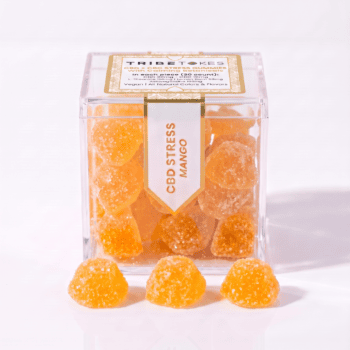
 CBD Gummies for Stress: 30mg CBD + ...Starting from: $45.00 SHOP NOW This product has multiple variants. The options may be chosen on the product page
-
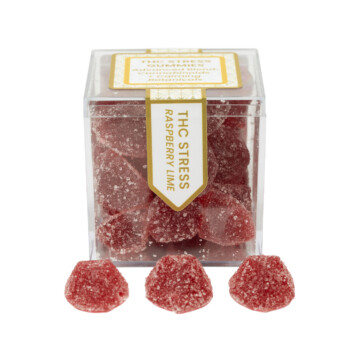
THC Stress Gummies | THC, CBD, CBC ...Starting from: $45.00 SHOP NOW This product has multiple variants. The options may be chosen on the product page
Frequently Asked Questions
CBD is more predictable for anxiety management. Its anxiolytic mechanism operates through 5-HT1A serotonin receptors without activating CB1, so there’s no dose-dependent anxiety inversion. THC can reduce anxiety at low doses through CB1 activation in the limbic system, but at higher doses the same mechanism amplifies anxiety rather than reducing it. For anxiety-prone users, CBD-first is the lower-risk approach. THC-containing products (particularly Delta-8 at low doses) have a role for stress relief and sleep, but require careful dosing.
At higher doses, yes. THC activates CB1 receptors in the amygdala; at low levels this can reduce anxiety, but at high levels it amplifies the threat-detection circuit instead. The threshold varies by individual, tolerance, and which THC isomer is used. Delta-9 THC carries the highest anxiogenic risk; Delta-8 carries lower risk as a partial CB1 agonist. Anyone who has experienced paranoia or acute anxiety from cannabis has likely exceeded their personal CB1 threshold. Starting at the lowest available dose and waiting the full onset window before redosing is the primary risk mitigation.
Research suggests yes, at a neurological level. A 2010 neuroimaging study by Bhattacharyya et al. found that CBD pretreatment attenuated THC-induced paranoia and hippocampal activity patterns associated with THC-elicited anxiety in healthy volunteers. Products that combine CBD and Delta-8 THC in a ratio formulation may offer THC’s sleep and stress benefits with CBD providing a biological buffer against its anxiogenic potential.
CBD’s dose-response curve for anxiety is bell-shaped: effects build through a moderate range, then plateau or diminish at very high doses. Clinical studies showing anxiolytic benefit have used a wide range (25mg to 400mg) depending on the type of anxiety and study design. For daily use, start at 15 to 25mg consistently for two to four weeks before evaluating. For acute situational anxiety, 40 to 60mg sublingual 30 minutes before the stressor is more common among users who report benefit. Avoid the assumption that more is always more effective.
Lower-risk, not zero-risk. Delta-8 THC is a partial CB1 agonist; Delta-9 is a full agonist. Partial agonism means Delta-8 has a lower maximum CB1 activation ceiling at any dose, so the dose-dependent anxiety inversion occurs at higher amounts and with less intensity. People who experience paranoia from Delta-9 THC often tolerate Delta-8 better. For anxiety-prone users, Delta-8 is the more appropriate THC isomer if THC is going to be used at all. It still produces psychoactive effects and still requires low-dose starting points.
Full-spectrum CBD products carry low but real drug test risk from trace Delta-9 THC with regular daily use. CBD isolate products carry essentially no risk. Delta-8 THC gummies and vapes will produce a positive result on standard drug tests. Review COA levels at tribetokes.com/certificates-of-analysis before choosing a product if subject to testing.
Yes, and the research supports a synergistic relationship. CBD appears to reduce THC-induced anxiety at a neurological level, which means a 1:1 or CBD-dominant ratio product may deliver THC’s sleep and stress benefits with less anxiogenic risk than THC alone. The key is keeping the THC component low and choosing Delta-8 over Delta-9 for anxiety applications. Start with a heavily CBD-dominant ratio if you’re anxiety-prone; adjust toward more THC only if you establish tolerance at the lower dose first.
Discuss with your prescriber first. CBD inhibits CYP3A4 and CYP2D6 liver enzymes that metabolize many psychiatric medications including SSRIs, SNRIs, buspirone, and benzodiazepines. CBD co-administration could raise blood levels of these medications, changing both efficacy and side effect risk. Do not discontinue prescription anxiety treatment in favor of CBD or THC without medical guidance. THC should be used with particular caution alongside benzodiazepines and other CNS depressants due to additive sedation risk.
CBD for Predictable Relief. Low-Dose D8 for Evening Stress.
Lab-tested, COA on every batch. Woman-owned since 2017.