
Here’s something most people don’t know: CBD targets the same serotonin receptor as buspirone, a prescription anxiolytic. Different binding site, but the same address in the brain. That’s not a coincidence. The 5-HT1A receptor is a key node in the anxiety circuitry, and cannabinoids engage it alongside two other pathways (endocannabinoid tone and possibly GABA modulation) simultaneously. The clinical evidence for CBD and anxiety is stronger than for most other conditions cannabinoids are used for. What matters is: which type of anxiety, at what dose, and (critically) whether you’re using CBD or THC, because those two go in opposite directions at high doses.
🧪 Lab Tested | 👩💼 Woman-Owned | 🏆 Est. 2017
How Anxiety Works in the Brain
Anxiety isn’t a malfunction. It’s the brain’s threat-detection system doing exactly what it evolved to do: flood your body with stress hormones when danger appears, keep your nervous system on high alert until the threat passes, and encode the experience so you recognize similar dangers faster next time. The problem most people experience isn’t broken threat detection; it’s a miscalibrated threshold. The alarm fires too easily, too often, or stays on too long after the actual threat has resolved.
Three systems drive this process: the HPA axis (hypothalamic-pituitary-adrenal, which coordinates the cortisol stress response), the limbic system (especially the amygdala, which processes threat signals), and the serotonin and endocannabinoid systems, which regulate the overall sensitivity of the alarm. CBD’s mechanisms map most directly onto that third regulatory layer.
How Cannabinoids Address the Anxiety Circuitry
5-HT1A serotonin receptor
CBD is a partial agonist at 5-HT1A, the same receptor targeted by buspirone (a prescription anxiolytic) and partly by SSRIs. Activation of 5-HT1A reduces amygdala reactivity and lowers the perceived threat level of ambiguous stimuli. CBD appears to engage this receptor without the side effect profile of full agonists, and at lower doses than would be needed to activate CB1 or CB2 meaningfully.
Endocannabinoid tone
CBD inhibits FAAH, the enzyme that breaks down anandamide (the body’s own endocannabinoid). Higher anandamide levels reduce amygdala-driven fear responses and are associated with calmer baseline emotional reactivity. The clinical endocannabinoid deficiency hypothesis proposes that low anandamide tone is a contributing factor in anxiety-prone individuals specifically. FAAH inhibition is a mechanism-matched intervention at that root, not a symptomatic one.
CBG and alpha-2 adrenoceptors
CBG (cannabigerol) addresses anxiety through a different pathway than CBD. It acts as an alpha-2 adrenoceptor agonist, which reduces norepinephrine release. Norepinephrine is the “fight-or-flight” neurotransmitter; lowering its release dampens the physical symptoms of anxiety (racing heart, tension, hypervigilance) at a different biological address than serotonin-targeted cannabinoids.
CB1 and dose dependence
THC activates CB1 receptors, which can be anxiolytic at low doses through several pathways including GABA modulation in the limbic system. At higher doses, however, CB1 activation becomes anxiogenic; it can amplify amygdala reactivity rather than reduce it. This dose-dependent inversion is the central reason THC-containing products require more careful dosing for anxiety than CBD-only products do.
What the Research Shows
CBD review across anxiety types
Blessing et al. 2015 (PMID 26341731) reviewed preclinical and clinical evidence for CBD across generalized anxiety disorder, social anxiety disorder, PTSD, panic disorder, and OCD-related disorders. The authors found consistent preclinical evidence for anxiolytic effects via 5-HT1A and endocannabinoid mechanisms, and promising (though limited) human clinical evidence. They concluded CBD has potential as a treatment option for anxiety disorders but emphasized the need for controlled trials with larger samples.
Neuroimaging of CBD and anxiety
Crippa et al. 2011 (PMID 21035503) used neuroimaging to track CBD’s effects in patients with generalized social anxiety disorder. CBD produced significant anxiety reduction alongside measurable changes in blood flow in the limbic and paralimbic regions, including the amygdala. This was one of the first studies to show CBD’s anxiolytic effects mapped to specific neurological changes rather than just self-reported mood shifts.
Performance anxiety and public speaking
Zuardi et al. and subsequent research (PMID 28169100) examined CBD’s effects in simulated public speaking tasks (a validated anxiety model). CBD reduced anxiety, cognitive impairment, and discomfort at acute doses compared to placebo, with effects observed at doses of 300mg in controlled settings. The research consistently notes that both very low and very high doses produced weaker effects than moderate doses, consistent with a bell-shaped dose-response curve.
What’s still limited
Most clinical CBD-and-anxiety trials are small, single-dose, and involve different forms of anxiety than most users are managing day-to-day. Long-term daily-use trials for generalized anxiety are lacking. The dose-response curve (higher isn’t always better) means effective dosing is individual and requires some experimentation. THC’s effect on anxiety is particularly variable: low doses may calm, higher doses can heighten anxiety in susceptible individuals, and this interaction is dose- and person-dependent.
CBD vs THC for Anxiety: Very Different Risk Profiles
CBD and THC are not equivalent tools for anxiety management. CBD’s anxiolytic mechanism operates primarily through serotonin and endocannabinoid pathways; it does not activate CB1 receptors at standard doses. Its dose-response curve for anxiety is bell-shaped: anxiolytic effects increase up to a moderate dose range, then plateau or decrease at very high doses. Within that moderate range, CBD is consistently calming across research contexts, and drug test risk from CBD-only products is low (though not zero if they’re full-spectrum).
THC’s relationship with anxiety is more complicated. At low doses, THC may reduce anxiety through CB1 activation in the limbic system. At higher doses, that same CB1 activation can amplify amygdala reactivity and trigger acute anxiety or even paranoia. The threshold varies significantly between individuals and depends on tolerance, genetics, and prior cannabis experience. For anxiety-prone users, Delta-8 THC carries lower risk than Delta-9 because it’s a partial CB1 agonist (less receptor activation at equivalent doses), but it’s still dose-dependent and still psychoactive.
CBD-first is the more predictable approach for anxiety management. THC-containing products (including Delta-8) have a role for stress relief and mood support, particularly in the evening, but require more careful dosing and should be started much lower than users with no anxiety history would need.
| Stress Pattern | Recommended Approach | Why |
| Daytime anxiety, need to stay functional | CBD or CBG tincture (sublingual) | Non-psychoactive; 15–45 min onset; doesn’t impair cognition |
| Acute stress event (presentation, social anxiety) | CBD vape or sublingual CBD | Fastest onset for CBD formats; 2–10 min relief without THC psychoactivity |
| Evening wind-down after a high-stress day | Low-dose D8 gummies or CBD gummies | Longer duration (6–8 hr); relaxation without needing to be functional |
| Stress causing sleep disruption | CBD gummies or D8 gummies (taken 60–90 min before bed) | Combined anxiolytic and sleep-supporting effects across the night |
| Anxiety-prone, concerned about THC amplifying it | CBD-only products (no THC) | No CB1 activation; no dose-dependent anxiety risk; lowest drug test risk |
| Subject to drug testing | CBD topical or isolate; use full-spectrum with care | Full-spectrum CBD carries low but real risk; D8/D9 will produce positive |
TribeTokes Products for Stress and Anxiety
Daytime Anxiety: CBG + CBD, Non-Psychoactive
CBG Tincture (Full Spectrum)
★★★★★ 4.85 from 13 reviews
CBG + CBD
Full Spectrum
Sublingual
Non-Psychoactive
CBG’s alpha-2 adrenoceptor activity dampens the norepinephrine-driven physical symptoms of anxiety (tension, racing heart, hypervigilance) while CBD addresses the serotonergic regulatory layer. Both mechanisms operate without CB1 activation; no psychoactive effect, no cognition impairment. Take sublingually 15 to 45 minutes before a high-stress period. Full-spectrum trace D9: low but real drug test risk; review COA at tribetokes.com/certificates-of-analysis. “I use this tincture in the middle of the day with my second coffee and it’s a great boost and is so helpful for my anxiety,” Megan M.
Daily Support: Endocannabinoid Tone + Serotonin
CBD Live Resin Gummies
★★★★★ 4.65 from 37 reviews
Full Spectrum CBD
CBG-Boosted
Live Resin
Vegan
Daily CBD gummies for cumulative endocannabinoid tone building over time. Live resin extraction preserves the full terpene profile; the CBG boost adds the adrenoceptor pathway alongside CBD’s serotonin activity. Non-psychoactive. Most effective when taken consistently rather than situationally. Full-spectrum trace D9: low but real drug test risk. “This is the perfect blend for every day stress and spinal pain,” james o. “Use these for anti-inflammation and stress relief,” Marin L. COAs at tribetokes.com/certificates-of-analysis.
Evening Stress: Psychoactive Wind-Down
Buzzed Delta-8 THC Gummies
★★★★★ 4.77 from 77 reviews
Delta-8 THC
CBD-Boosted
6–8 hr Duration
Positive Drug Test
Low-dose Delta-8 THC for evening stress relief and mood support. Start with a quarter to half a gummy; evaluate the full window (45 to 90 minutes) before taking more. The CBD boost in the formulation helps offset the dose-dependent anxiety risk that exists with THC alone. Not appropriate as a first-line anxiety approach for users who are anxiety-prone; better suited for stress wind-down after the pressure of the day is over. Will produce a positive result on standard drug tests. “I love these gummies after a long stressful day. They are the perfect way for my mind to destress and my body to relax,” Theresa C.
Acute Stress: Fastest Onset, Situational Use
Delta-8 THC Disposable Vape
★★★★★ 4.63 from 52 reviews
Delta-8 THC
Live Resin
2–5 min Onset
Positive Drug Test
Fastest systemic onset of any format: 2 to 5 minutes. Appropriate for acute situational stress when immediate onset matters and the user understands the dose-dependent anxiety relationship with THC. Take one draw; wait 10 minutes before a second. Not appropriate for respiratory conditions. “Bought this product to smoke occasionally on situations such as work presentations or when I’m under a lot of stress. It works great,” Gabriel N. Will produce a positive result on standard drug tests.
-
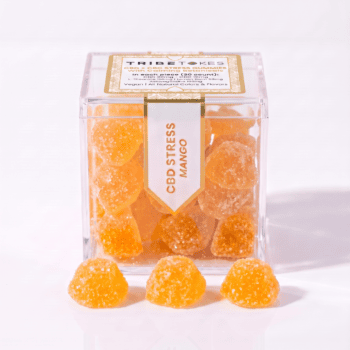
 CBD Gummies for Stress: 30mg CBD + ...Starting from: $45.00 SHOP NOW This product has multiple variants. The options may be chosen on the product page
-
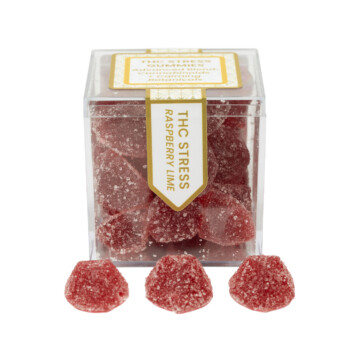
THC Stress Gummies | THC, CBD, CBC ...Starting from: $45.00 SHOP NOW This product has multiple variants. The options may be chosen on the product page
Frequently Asked Questions
CBD has well-supported anxiolytic mechanisms, including 5-HT1A serotonin receptor agonism and FAAH inhibition that raises anandamide levels. A 2015 review in Neurotherapeutics found consistent evidence across multiple anxiety types in preclinical models, with promising human clinical data. Neuroimaging research has shown CBD reduces anxiety alongside measurable changes in limbic brain activity. THC’s relationship with anxiety is more complex: it can be anxiolytic at low doses and anxiogenic at higher doses, so the answer depends heavily on which cannabinoid, what dose, and the individual’s sensitivity.
CBD is more predictable for anxiety management. Its anxiolytic mechanism doesn’t involve CB1 receptor activation; there’s no dose-dependent anxiety risk at standard doses. THC (including Delta-8) can help with stress at low doses but may worsen anxiety at higher doses (particularly in people who are already anxiety-prone). For anyone new to cannabinoids for anxiety, CBD-first is the lower-risk approach. THC-containing products are better suited to experienced users managing evening stress rather than clinical anxiety.
Research suggests CBD’s anxiolytic effects follow a bell-shaped dose-response curve: benefits increase up to a moderate range, then may plateau or decline at very high doses. Clinical studies showing benefit have used doses between 25mg and 400mg depending on the anxiety type and research context. For daily use, start at 15 to 25mg sublingually or as a gummy, taken consistently for at least two to four weeks before evaluating effect. For acute situational anxiety, a higher dose of 40 to 60mg taken 30 minutes before the stressor is more common among users who report benefit.
Sublingual CBD tincture: 15 to 45 minutes. CBD vape: 2 to 10 minutes. CBD gummies: 45 to 90 minutes. For acute anxiety events, sublingual or vape formats are the only options with fast enough onset. Gummies are better suited for chronic or anticipatory anxiety where you know a stressful period is coming and can dose in advance. Daily CBD use for anxiety builds endocannabinoid tone over weeks; the cumulative effect on baseline anxiety reactivity differs from the acute effect of a single dose.
At higher doses, yes. THC activates CB1 receptors in the amygdala, which at low levels may reduce anxiety but at higher levels can amplify it. This dose-dependent inversion is well-documented and is more pronounced in people who are anxiety-prone, new to cannabis, or using high-THC Delta-9 products. Delta-8 THC carries lower anxiogenic risk than Delta-9 because it’s a partial CB1 agonist, but the relationship still holds: start low, go slow, and do not redose before the full onset window closes. Users who experience anxiety from THC should switch to CBD-only products.
CBD-isolate products carry essentially no drug test risk. Full-spectrum CBD products (including TribeTokes CBD Live Resin Gummies and CBG Tincture) contain trace amounts of Delta-9 THC from the full-spectrum extraction and carry low but real drug test risk with daily ingested use. Delta-8 THC gummies and vapes will produce a positive result on standard drug tests. Anyone subject to workplace drug testing should review COA levels at tribetokes.com/certificates-of-analysis before choosing a product.
Discuss with your prescriber before combining cannabinoids with any prescription anxiety medication. CBD inhibits CYP3A4 and CYP2D6 liver enzymes, which metabolize many psychiatric medications including SSRIs, SNRIs, benzodiazepines, and buspirone. CBD co-administration could raise blood levels of these medications, which changes both efficacy and side effect risk. Do not discontinue prescription anxiety treatment in favor of cannabinoids without medical guidance. Topical cannabinoids carry the lowest interaction risk since they stay local.
CBD is well tolerated even at high doses, so “too much” usually means side effects rather than anything dangerous. The most common signs are an upset stomach, loose stools or diarrhea, and drowsiness when you meant to feel calm and clear. If any of that shows up, it’s your cue to come down, not push through.
Here’s the part that trips people up, and it’s especially common with anxiety: when a dose doesn’t feel like it’s working, the instinct is to take more. With CBD, that instinct works against you. The dose-response curve is bell-shaped, so past a moderate range the calming effect plateaus and can even taper off while the side effects climb. More isn’t stronger. It’s just more side effects with less of the benefit you were after.
If you think you’ve overshot, drop back to the last dose that felt good and hold there for a couple of weeks before changing anything. Anxiety makes “more is better” feel true. Your body is telling you the opposite.Discuss with your prescriber before combining cannabinoids with any prescription anxiety medication. CBD inhibits CYP3A4 and CYP2D6 liver enzymes, which metabolize many psychiatric medications including SSRIs, SNRIs, benzodiazepines, and buspirone. CBD co-administration could raise blood levels of these medications, which changes both efficacy and side effect risk. Do not discontinue prescription anxiety treatment in favor of cannabinoids without medical guidance. Topical cannabinoids carry the lowest interaction risk since they stay local.
CBD’s anxiolytic effects operate primarily through 5-HT1A serotonin receptor agonism and endocannabinoid tone elevation via FAAH inhibition. CBG’s anxiolytic pathway is different: it acts as an alpha-2 adrenoceptor agonist, which reduces norepinephrine release and directly dampens the physical fight-or-flight symptoms of anxiety. Products that combine CBD and CBG (like the TribeTokes CBG Tincture) may address anxiety through more receptor pathways simultaneously than either cannabinoid alone.
Non-Psychoactive for Daytime. Low-Dose THC for the Evening.
Lab-tested. COA on every batch. Woman-owned since 2017.