

THCa is federally legal right now under the 2018 Farm Bill, but that changes on November 12, 2026 when Section 781 redefines hemp to include total THC. Seven states have already banned THCa outright, eight restrict it to dispensaries, and another nine operate in legal gray areas with inconsistent enforcement. This guide covers the federal timeline, every state’s current status, shipping rules, travel considerations, and what the upcoming deadline means for THCa products you can buy today.
🧪 Lab Tested | 👩💼 Woman-Owned | 🏆 Est. 2017
THCa Legal Status at a Glance
| Federal status (now) | Legal under the 2018 Farm Bill when hemp-derived and below 0.3% delta-9 THC |
| Federal deadline | November 12, 2026: Section 781 redefines hemp to include total THC (THCa counts) |
| States where legal | 26 states follow federal Farm Bill definition |
| States restricted | 8 states (dispensary-only or potency limits): CO, MN, MT, NV, OR, TN, TX, VT |
| States banned | 7 states: AK, AR, DE, HI, ID, IA, RI |
| Gray area states | 9 states: CT, KS, MA, NE, NY, SD, UT, WA, WY |
| Drug test risk | High. THCa produces the same metabolites as marijuana on standard drug screens. |
| Pending legislation | H.R. 7024 would push Section 781 deadline to November 2029 (36 co-sponsors, not yet advanced) |
Short Answer: Yes, THCa Is Federally Legal Right Now. But That Changes in November 2026.
THCa (tetrahydrocannabinolic acid) is legal at the federal level under the 2018 Farm Bill, which defines hemp as cannabis containing less than 0.3% delta-9 THC on a dry weight basis. Because THCa is not delta-9 THC, hemp-derived THCa products that meet that threshold are federally permitted. But there’s a hard deadline coming. Section 781 of the Continuing Appropriations Act redefines hemp to include total THC (which includes THCa), and it takes effect November 12, 2026. That gives you roughly seven months to understand where things stand, stock up on what you want, and pay attention to your state’s specific rules.
Here’s the problem: federal legality doesn’t mean your state agrees. Some states have already banned THCa flower or restricted THCa products to licensed dispensaries. Others operate in a gray area where enforcement is inconsistent and laws haven’t caught up to the science. This guide breaks down the legal status of THCa in all 50 states, explains the upcoming federal changes, and covers what you need to know about shipping, travel, and compliance as of April 2026.
How THCa Stays Legal (For Now): The Farm Bill Loophole
The 2018 Farm Bill created a legal distinction between hemp and marijuana based on one number: 0.3% delta-9 THC. Cannabis plants below that line are hemp. Above it, marijuana. Simple enough on paper.
THCa sits in a gray area because it’s technically not delta-9 THC. It’s the acidic precursor, the raw form of THC found in living cannabis plants. Under current federal law, testing for hemp compliance measures delta-9 THC specifically, not THCa. So a hemp flower could contain 20% THCa and still test below 0.3% delta-9 THC, making it federally legal.
This is the loophole that built an entire THCa market. And it’s also the loophole that Congress is closing.
If you’re confused about the difference between these two cannabinoids, our THCa vs THC guide breaks down the chemistry, effects, and legal distinctions in plain language.
The November 2026 Deadline: What Section 781 Actually Changes
Section 781 of the Continuing Appropriations Act rewrites the definition of hemp to include total THC, not just delta-9 THC. That means THCa will count toward the 0.3% threshold starting November 12, 2026.
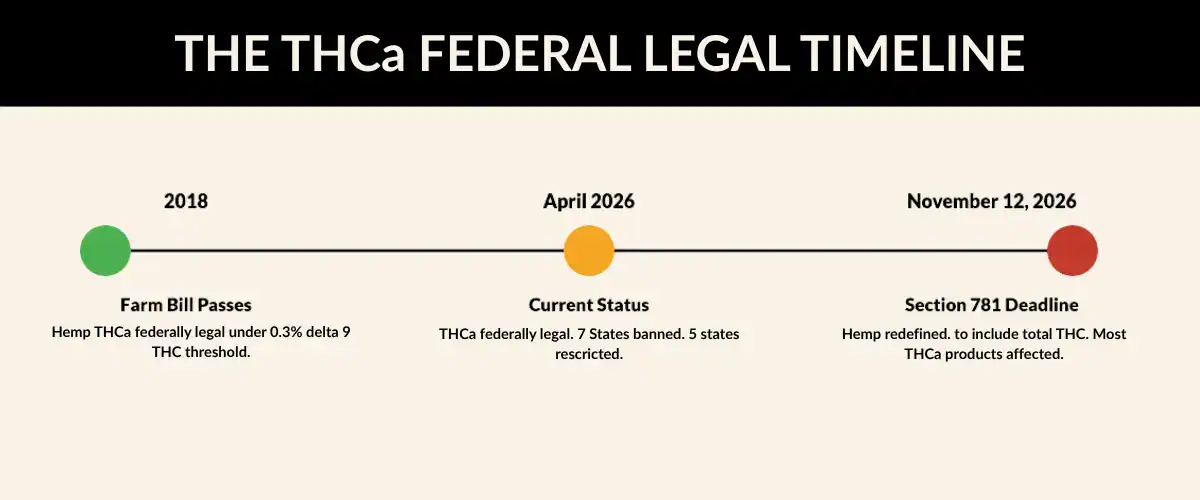
Here’s what that means in practice:
- Finished products face a new cap of 0.4 mg total THC per container. That’s milligrams, not percentage. A single gummy with 5 mg of THCa would exceed this limit.
- Raw hemp flower high in THCa will almost certainly exceed the total THC threshold, making most current THCa flower products illegal at the federal level.
- Synthetic and converted cannabinoids are explicitly banned under Section 781. This targets delta-8 THC created through chemical conversion of CBD, not naturally occurring cannabinoids.
According to an Arnold & Porter legal advisory, the new rules fundamentally restructure how hemp products are regulated and could eliminate the majority of current THCa products from legal commerce.
There is one bill attempting to push back the deadline. H.R. 7024, the Hemp Planting Predictability Act, was introduced on January 13, 2026 by Rep. Baird (R-IN). It would extend the Section 781 effective date to November 2029, giving the industry three more years. The bill has gained 36 bipartisan co-sponsors but has not yet advanced out of committee as of April 2026.
THCa Legal Status: All 50 States (April 2026)
State laws on THCa range from fully legal to completely banned, with a large gray area in between. Some states follow federal hemp law closely. Others have passed their own restrictions on THCa flower, THCa products, or intoxicating hemp cannabinoids in general.
This table reflects the legal landscape as of April 2026. Laws change frequently, so check your state’s hemp program or cannabis regulatory agency for the latest updates before purchasing or traveling with THCa products.
| State | Status | Key Notes |
| Alabama | Legal | Follows federal Farm Bill definition |
| Alaska | Banned | Classifies THCa as a controlled substance |
| Arizona | Legal | Hemp-derived cannabinoids permitted under state law |
| Arkansas | Banned | Banned intoxicating hemp products including THCa |
| California | Legal | AB 45 regulates hemp CBD products; THCa flower sold openly |
| Colorado | Restricted | THCa products only legal through licensed dispensaries |
| Connecticut | Gray Area | Regulations pending; limited enforcement on hemp THCa |
| Delaware | Banned | HB 1 restricts intoxicating hemp cannabinoids |
| Florida | Legal | SB 1698 regulates hemp products; THCa flower available |
| Georgia | Legal | Follows federal hemp definition; active retail market |
| Hawaii | Banned | Prohibits intoxicating hemp-derived cannabinoids |
| Idaho | Banned | Zero THC tolerance; any detectable THC or THCa is illegal |
| Illinois | Legal | Regulated hemp market; THCa products available at retail |
| Indiana | Legal | Follows federal Farm Bill; active hemp product market |
| Iowa | Banned | Considers THCa a controlled substance analog |
| Kansas | Gray Area | No explicit THCa regulation; enforcement varies by county |
| Kentucky | Legal | Strong hemp program; THCa products sold at retail |
| Louisiana | Legal | Age-gated (21+) hemp products permitted |
| Maine | Legal | Follows federal definition; retail sales active |
| Maryland | Legal | Hemp-derived products regulated but available |
| Massachusetts | Gray Area | Cannabis Control Commission considering hemp THCa rules |
| Michigan | Legal | Hemp products legal; separate regulated cannabis market |
| Minnesota | Restricted | Heavy restrictions on THCa potency and serving sizes |
| Mississippi | Legal | Follows federal definition with limited state oversight |
| Missouri | Legal | Hemp products widely available at retail |
| Montana | Restricted | THCa products only through licensed dispensaries |
| Nebraska | Gray Area | Limited hemp program; THCa legality unclear |
| Nevada | Restricted | THCa products only through regulated cannabis market |
| New Hampshire | Legal | Follows federal hemp definition |
| New Jersey | Legal | Hemp-derived THCa sold at retail; separate adult-use market |
| New Mexico | Legal | Hemp products legal under state law |
| New York | Gray Area | OCM regulating cannabinoid hemp products; enforcement inconsistent |
| North Carolina | Legal | Large hemp market; THCa flower widely available |
| North Dakota | Legal | Follows federal definition with age restrictions |
| Ohio | Legal | Hemp-derived cannabinoids permitted; adult-use cannabis now active |
| Oklahoma | Legal | Strong hemp market; minimal THCa-specific restrictions |
| Oregon | Restricted | THCa products restricted to licensed dispensaries |
| Pennsylvania | Legal | Follows federal definition; retail sales active |
| Rhode Island | Banned | Prohibits intoxicating hemp-derived products |
| South Carolina | Legal | Follows federal hemp definition |
| South Dakota | Gray Area | Strict hemp program; THCa enforcement uncertain |
| Tennessee | Restricted | Total THC regulations effective January 1, 2026; limits THCa products |
| Texas | Restricted | DSHS banned retail sale of THCa flower effective March 31, 2026 |
| Utah | Gray Area | Hemp products regulated; THCa-specific rules evolving |
| Vermont | Restricted | THCa products only through licensed dispensaries |
| Virginia | Legal | Hemp-derived THCa products legal at retail |
| Washington | Gray Area | LCB considering hemp cannabinoid regulations |
| West Virginia | Legal | Follows federal definition; hemp products at retail |
| Wisconsin | Legal | Follows federal hemp definition |
| Wyoming | Gray Area | Limited hemp regulation; THCa not explicitly addressed |
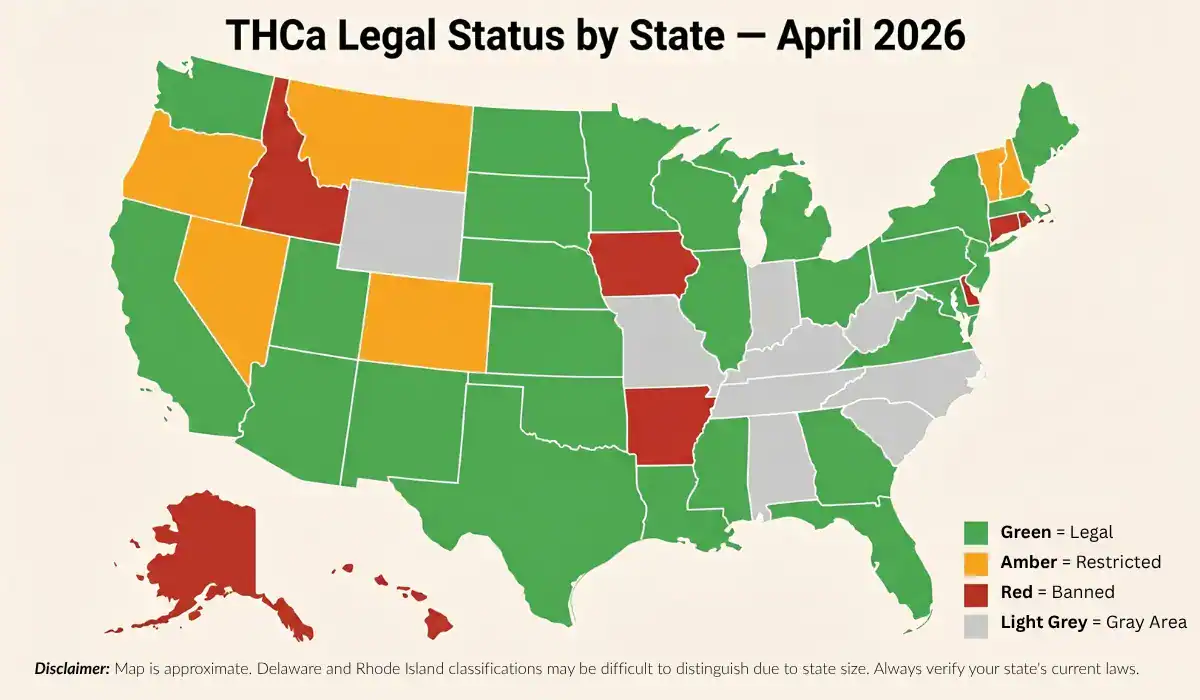
Last updated: April 2026. This table is for informational purposes only and should not be taken as legal advice. Contact a licensed attorney in your state for guidance specific to your situation.
States Where THCa Is Legal
The majority of U.S. states currently allow hemp-derived THCa products because they follow the federal Farm Bill definition. In these states, you can purchase THCa flower, THCa vapes, and other THCa products from licensed retailers and online shops without a medical card or dispensary visit.
States with the most active THCa markets include Florida, Georgia, North Carolina, Texas (before the March 2026 ban on flower), and Virginia. These states have large populations, limited or no recreational cannabis programs, and hemp laws that closely mirror federal standards. That combination created the conditions for a booming THCa retail market.
If you live in a legal state, the main things to watch for are product testing and compliance. Legitimate THCa products should come with third-party lab results (called Certificates of Analysis, or COAs) showing cannabinoid content, terpene profiles, and contaminant screening. You can see what proper testing looks like on our Certificates of Analysis page.
One thing worth flagging: “legal” doesn’t mean “unregulated.” Many of these states have age restrictions (usually 21+), packaging requirements, and testing standards that legitimate brands follow. If a THCa product doesn’t have a COA or the retailer can’t tell you where the hemp was grown, that’s a red flag regardless of your state’s legal status.
States Where THCa Is Restricted
Restricted states allow THCa products but only through specific channels, usually licensed dispensaries or the regulated cannabis market. This means you can’t buy THCa flower at a gas station or order it online for delivery to these states.
Colorado
Colorado has a mature recreational cannabis market and moved early to close the hemp THCa loophole. THCa products containing intoxicating levels of cannabinoids must be sold through licensed dispensaries. Hemp CBD products with minimal THC are still available at retail.
Texas
Texas was one of the biggest THCa markets in the country until March 2026. The Texas Department of State Health Services (DSHS) adopted new hemp regulations effective March 31, 2026, banning the retail sale of THCa flower specifically. Other THCa products (like vapes and edibles) exist in a gray area where enforcement varies by jurisdiction. This is a state to watch closely.
Tennessee
Governor Bill Lee signed HB1376 in May 2025, and the law took effect January 1, 2026. It adopts total THC testing (THCa + delta-9 THC), bans online sales and delivery of hemp cannabinoid products, and restricts retail to licensed, age-verified locations only. THCa was estimated at 60% of revenue for some Tennessee hemp businesses before the ban. The state’s Alcoholic Beverage Commission now oversees hemp product regulation instead of the Department of Agriculture.
Minnesota
Minnesota legalized recreational cannabis in 2023 and has since placed heavy restrictions on hemp-derived intoxicating cannabinoids, including THCa. Products are subject to potency limits and serving size restrictions that rule out most high-THCa products sold in other states.
Montana, Nevada, Oregon, Vermont
All four states funnel THCa products through their licensed dispensary systems. If you have access to a dispensary (either medical or recreational, depending on the state), you can purchase THCa products. Hemp-derived THCa products sold outside the regulated market are not permitted.
States Where THCa Is Banned
A smaller group of states has outright banned THCa or classified it alongside delta-9 THC as a controlled substance. In these states, possessing THCa products can carry the same penalties as possessing marijuana.
- Alaska: Classifies THCa as a controlled substance. No exemption for hemp-derived products.
- Arkansas: Banned all intoxicating hemp products, including THCa, in 2023.
- Delaware: HB 1 restricted intoxicating hemp-derived cannabinoids.
- Hawaii: Prohibits the sale of intoxicating hemp-derived cannabinoids.
- Idaho: Has a zero-tolerance policy for all THC, including THCa. Any detectable amount is illegal.
- Iowa: Treats THCa as a controlled substance analog.
- Rhode Island: Banned intoxicating hemp-derived products.
Idaho is the strictest by far. Most other states on this list still allow low-THC hemp CBD products. But if you’re looking for THCa flower or high-concentration THCa vapes, these states are off-limits.
The Gray Area States
Several states haven’t passed specific laws addressing THCa, which creates genuine uncertainty. In Connecticut, Kansas, Massachusetts, Nebraska, New York, South Dakota, Utah, Washington, and Wyoming, the legal status of THCa products falls somewhere between “probably legal” and “nobody’s tested it in court yet.”
Gray area states tend to share a few characteristics. They usually have a hemp program that follows the federal definition but haven’t explicitly addressed intoxicating hemp cannabinoids through legislation. Enforcement is inconsistent, sometimes varying by county or city within the same state. And regulators may be in the process of drafting rules that could tip the state toward “legal” or “restricted” at any point.
If you’re in a gray area state, the safest approach is to buy from reputable brands that provide full lab testing, keep your products in their original packaging, and stay current on any pending legislation. A product that’s fine to buy today could become restricted next month.
Shipping THCa Products: What You Need to Know
Can you order THCa products online and have them shipped to your door? In most legal states, yes. But the rules around shipping are more complicated than you’d think.
Federal law governs interstate commerce, and under the current Farm Bill, hemp-derived THCa products that contain less than 0.3% delta-9 THC can be shipped across state lines. That’s the legal basis for online THCa sales. But here’s the catch: the product has to be legal in both the origin state and the destination state. A legitimate retailer won’t ship THCa flower to Idaho, for example, even though the shipment itself is federally legal.
Shipping carriers have their own policies too. USPS follows federal law and generally permits hemp-derived products with proper documentation. Private carriers like UPS and FedEx have stricter internal policies and may refuse hemp shipments regardless of legality.
Quality matters here. The best THCa products come with COAs that travel with the product (or are accessible via QR code on the packaging). If a shipment is ever questioned during transit, those lab results are the documentation that proves the product meets the Farm Bill’s delta-9 THC threshold.
Traveling with THCa: Air Travel, Road Trips, and the TSA
The TSA’s official position is that they follow federal law. Since hemp-derived THCa products meeting the Farm Bill definition (less than 0.3% delta-9 THC) are federally legal, the TSA does not specifically prohibit them from carry-on or checked bags. According to the Department of Transportation, enforcement focuses on marijuana, not hemp products with proper documentation.
That said, the TSA isn’t testing your cannabinoids at the checkpoint. If a TSA agent finds something they believe to be marijuana, they’ll refer the matter to local law enforcement. Local law enforcement follows state law. So if you’re flying out of Idaho with THCa flower, you have a problem, even though the TSA technically wouldn’t care about a legal hemp product.
Practical tips for traveling with THCa products:
- Keep products in original packaging with clear labeling
- Carry a copy of the COA (digital or printed)
- Check laws at your destination and any layover states
- Avoid flower when possible (it looks and smells identical to marijuana, which creates unnecessary complications)
- THCa vape cartridges are generally easier to travel with than flower because they’re more discreet and clearly labeled
One more thing: even in states where THCa is legal, driving under the influence of any intoxicating substance is illegal. And drug tests don’t distinguish between THCa, delta-9 THC, or any other THC metabolite. If you’re subject to drug testing, check out our guides on THCa and drug testing and whether CBD shows up on a drug test before making any decisions.
How THCa Laws Affect Product Testing and Compliance
Testing requirements are where the rubber meets the road for THCa legality. The difference between a legal hemp product and an illegal marijuana product often comes down to how and when the testing happens.
Under current federal rules, hemp is tested for delta-9 THC on a dry weight basis. Most states follow this standard, which is why high-THCa flower can test as legal hemp. The plant hasn’t been heated, so the THCa hasn’t converted to delta-9 THC, and the product passes compliance testing.
States that have adopted total THC testing (like Tennessee as of January 2026) change the math entirely. Total THC testing uses a formula that accounts for the potential conversion of THCa to delta-9 THC: Total THC = delta-9 THC + (THCa x 0.877). Under this method, flower with 15% THCa would have a total THC content of about 13.2%, far exceeding the 0.3% threshold.
This is exactly the approach the federal government is adopting with Section 781 in November 2026. When that happens, the testing standard shifts nationwide, and the entire THCa market as it currently exists will need to adapt or shut down.
For consumers, the testing question is also about safety. Third-party testing should verify not just cannabinoid content but also screen for pesticides, heavy metals, residual solvents, and microbial contamination. Brands that skip testing, or provide incomplete results, aren’t just cutting corners on compliance. They’re cutting corners on your health.
Why Product Quality Matters More Than Ever
With regulations tightening across the country and a major federal deadline looming, the THCa products that will survive are the ones built on genuine quality and compliance. The gray market brands selling untested flower out of gas stations? They’re the reason legislators are cracking down in the first place.
At TribeTokes, every product starts with organically grown hemp and goes through third-party lab testing before it reaches you. Our COAs are publicly available, and we test for the full panel: cannabinoid potency, terpene profiles, pesticides, heavy metals, and microbial contaminants. (Yes, we actually want you to look at the results. That’s kind of the point.)
We’ve been in the cannabis wellness space since 2017, long before the THCa market exploded. As a women-owned brand, we’ve always prioritized transparency and clean formulations over cutting corners for margin. That matters now more than ever, because when November 2026 hits, the brands that invested in compliance and quality are the ones that will still be here.
If you’re curious about how different THCa products feel and which format might work for you, our guide to THCa vape effects is a good starting point. And if you want to understand how long cannabinoids stay in your system (relevant for both legal and testing reasons), check out our delta-8 duration guide.
Frequently Asked Questions
No. As of April 2026, THCa is legal in the majority of states under the federal Farm Bill, but at least seven states (Alaska, Arkansas, Delaware, Hawaii, Idaho, Iowa, and Rhode Island) have banned it. Another group of states restricts THCa to dispensaries only (Colorado, Montana, Nevada, Oregon, Vermont). And several states have unclear or evolving regulations. Always check your specific state’s current hemp laws before purchasing.
Section 781 of the Continuing Appropriations Act takes effect November 12, 2026, and redefines hemp to include total THC. This means most current THCa products, especially flower and high-potency concentrates, will likely exceed the new federal threshold. Low-dose THCa products might still be possible under the 0.4 mg per container cap, but the market will look very different. H.R. 7024 could push the deadline to 2029 if it passes, but as of April 2026, it hasn’t advanced.
The TSA follows federal law, so hemp-derived THCa products under 0.3% delta-9 THC are not prohibited from flights. However, TSA agents who find what looks like marijuana will refer it to local law enforcement, who follow state law. Carry your product in original packaging with the COA, and research laws at your destination and any layover cities.
Yes. Standard drug tests detect THC metabolites, and THCa can produce those same metabolites in your body. A positive result from THCa use is indistinguishable from one caused by marijuana use. If you’re subject to workplace or legal drug testing, this is a real concern. Read our full THCa drug test guide for specifics.
THCa is the raw, acidic form of THC found naturally in the cannabis plant. THC (specifically delta-9 THC) is the cannabinoid associated with psychoactive effects. In its raw form, THCa is non-intoxicating. The legal distinction under the Farm Bill is based on delta-9 THC content, not THCa content, which is why hemp-derived THCa products are currently federally legal. Our THCa vs THC breakdown covers the full science.
In states where THCa is legal, yes. Hemp-derived products meeting the Farm Bill’s delta-9 THC threshold can be shipped interstate. The product must be legal in both the shipping origin and your state. Reputable brands will not ship to states where THCa products are banned or restricted. Look for retailers that include COAs with every shipment and use compliant packaging.
Penalties vary by state. In states like Idaho, any detectable THC (including THCa) can result in misdemeanor or felony charges depending on quantity. In other banned states, penalties may be less severe but still include fines and potential criminal charges. The fact that you purchased the product legally in another state is not a defense. If you’re traveling through or to a banned state, do not bring THCa products with you.
Shop THCa Products Before November 2026
Lab-tested THCa flower and vapes from a women-owned brand. Full-panel COAs on every batch. Est. 2017.