If THC ever sent you spiraling into paranoia when you expected to relax, you weren’t having a freak reaction. You were having a completely predictable pharmacological outcome from a dose that exceeded your personal CB1 threshold. THC works directly on the amygdala’s threat-detection circuit. At low levels of CB1 activation, it quiets that circuit. At high levels, it amplifies it. The same receptor, the same compound, opposite results depending on how much you took, what form you took it in, and what your nervous system was doing before you started. Understanding why this happens is the most useful thing you can know before picking up any THC product.
🧪 Lab Tested | 👩💼 Woman-Owned | 🏆 Est. 2017
IN THIS GUIDE
- How THC Connects to the Anxiety Circuit
- The Biphasic Dose Curve: Why the Same Compound Calms and Terrifies
- Why the Threshold Is Different for Everyone
- How CBD Changes the Equation
- Why Delta-8 Carries Lower Anxiogenic Risk Than Delta-9
- What the Research Shows
- How to Avoid THC Anxiety
- TribeTokes Products for Anxiety-Prone Users
- Frequently Asked Questions
How THC Connects to the Anxiety Circuit
The amygdala is the brain’s threat-detection hub. It receives sensory information, evaluates potential danger, and sends alarm signals to the rest of the brain. CB1 receptors are distributed throughout the amygdala at high density. The endocannabinoid system uses these receptors to regulate the amygdala’s alarm volume, quieting activity when the system is calm and allowing it to respond when a real threat appears.
THC is a full CB1 agonist. When it binds to CB1 receptors in the amygdala, it modifies how the amygdala processes threat signals. At low occupancy (a small dose, low tolerance), CB1 activation suppresses amygdala firing. That’s the calming, stress-relieving effect most people associate with low-dose cannabis. At high occupancy (a large dose, low tolerance, or a dose that overwhelms the receptor system), the picture inverts. Excessive CB1 activation in the amygdala begins to disrupt normal inhibitory signaling, and the amygdala responds by increasing threat sensitivity rather than decreasing it.
This is not a paradox. It’s the same pattern seen with many compounds that modulate neurological systems at a receptor level: the dose determines the direction.
The Biphasic Dose Curve: Why the Same Compound Calms and Terrifies
THC’s anxiety dose-response curve is biphasic, meaning it produces opposite effects at different dose levels. This is documented consistently across the clinical literature and is the primary reason that “I’ve used cannabis before and it was fine” is not reliable protection against a bad experience. The dose, form, and context all shift where you land on the curve.
THC Dose vs Anxiety Effect (illustrative — individual thresholds vary)
Trace-low
Calming, stress relief
Low-moderate
Mild euphoria, relaxation
Moderate
Varies by individual
High
Elevated anxiety risk
Very high
Paranoia, acute anxiety
The most dangerous part of this curve is the edibles onset window. Inhalation (vape, smoke) delivers THC to the bloodstream within 2 to 5 minutes, so the effect is felt before someone takes a second dose. Edibles take 45 to 90 minutes to hit peak effect. Users who don’t feel much at 30 minutes frequently redose, then find themselves at 2x or 3x their intended dose an hour later. By the time the first dose peaks, the second is already in the system. “If you are new to gummies like me, start with quarters and halves before taking one whole,” Scott M. (Delta-8 Live Resin Gummies).
Why the Threshold Is Different for Everyone
The dose at which THC crosses from calming to anxiogenic isn’t fixed. It shifts based on several variables.
Baseline anxiety level
People with pre-existing anxiety have a more reactive amygdala at baseline. A CB1 activation level that calms a low-anxiety nervous system may be enough to tip an already-heightened amygdala further into alarm mode.
Tolerance
Regular THC use downregulates CB1 receptor density over time. Chronic users have fewer CB1 receptors available for THC to occupy at a given dose, so the same milligram amount produces less receptor occupancy. Tolerance also means the anxiogenic threshold moves up. Low-tolerance or first-time users are at highest risk for anxiety at any given dose.
Set and setting
Context shapes THC’s anxiety risk more than most users realize. An anxious environment, social pressure, unfamiliar people, or being in a situation where the user doesn’t feel in control all prime the amygdala before the first dose. THC amplifies the emotional state it finds. Starting from a calm baseline in a comfortable environment lowers the anxiety risk of any given dose.
CBD content of the product
CBD modulates how the brain responds to THC at CB1 receptors. Neuroimaging research has confirmed that CBD pretreatment reduces THC-induced paranoia and hippocampal activity associated with anxiety. Full-spectrum products and 1:1 ratio formulas carry meaningfully lower anxiety risk than high-potency THC isolate products at equivalent milligram doses.
How CBD Changes the Equation
CBD modulates the brain’s response to THC at a receptor level, reducing the pattern of amygdala and hippocampal activity that underlies THC-induced paranoia. That’s a pharmacological interaction, not a separate calming effect running alongside the THC.
A 2010 fMRI study by Bhattacharyya et al. (PMID 20562093) gave participants CBD pretreatment before THC administration and measured brain activity. CBD reduced the striatal and hippocampal activity patterns associated with THC-elicited anxiety. Separately, Morgan et al. 2010 (PMID 20568000) found that cannabis users with higher habitual CBD exposure (measured via hair content) showed significantly less THC-induced memory impairment and anxiety.
For practical use, this means that product choice matters as much as dose. High-potency THC-dominant products carry higher anxiety risk than full-spectrum or CBD-ratio products at the same THC milligram count. “The 1:1 CBD:Delta-8 ratio is perfect for someone sensitive to THC products,” Misty T. (1:1 Ratio Disposable Vape). The CBD isn’t just providing a separate calming effect alongside the THC. It’s actively changing how the THC behaves at the brain circuit level.
Why Delta-8 Carries Lower Anxiogenic Risk Than Delta-9
Delta-8 THC is a partial CB1 agonist; Delta-9 THC is a full agonist. Partial agonism places a ceiling on how much CB1 receptor occupancy Delta-8 can achieve regardless of dose. Since the anxiety inversion is driven by high CB1 occupancy in the amygdala, Delta-8’s lower maximum ceiling means the anxiogenic threshold is higher and harder to reach.
Users who experience paranoia from Delta-9 THC frequently report that Delta-8 at the same or higher milligram dose does not produce the same response. “These are the perfect gummies for me, smoking and strong items make me paranoid. I don’t find that with these,” Lisa R. (Delta-8 THC Gummies). The partial agonism at CB1 is the mechanistic reason for this, not just brand quality or formulation.
Delta-8 still produces psychoactive effects. The dose-dependent anxiety inversion still exists; the threshold is just higher. For users with significant anxiety sensitivity, Delta-8 is a more forgiving starting point than Delta-9, but CBD-only products remain the lowest-anxiety-risk entry into cannabis. Delta-8 THC products will produce a positive result on standard drug tests.
What the Research Shows
CBD blocks THC anxiety via fMRI
Bhattacharyya et al. 2010 (PMID 20562093) administered CBD pretreatment before THC in healthy volunteers and measured brain activity with fMRI. CBD reduced striatal and hippocampal activity patterns associated with THC-induced paranoia.
Habitual CBD exposure protects against THC anxiety
Morgan et al. 2010 (PMID 20568000) measured CBD concentration in the hair of regular cannabis users as a proxy for habitual CBD intake, then tested THC-induced memory and anxiety effects. Higher CBD exposure was associated with significantly less THC-induced impairment. Regular users who smoked higher-CBD cannabis experienced less paranoia and cognitive disruption from THC than users with low CBD intake.
CBD anxiolytic mechanisms across anxiety types
Blessing et al. 2015 (PMID 26341731) reviewed the preclinical and human evidence for CBD across generalized anxiety disorder, social anxiety disorder, PTSD, and panic disorder. The review identified 5-HT1A serotonin receptor agonism and endocannabinoid modulation as the primary anxiolytic mechanisms. Notably, CBD’s lack of CB1 agonism means it does not carry the dose-dependent anxiety inversion that characterizes THC.
How to Avoid THC Anxiety
- Start at a quarter dose and wait the full window. For edibles, the onset window is 45 to 90 minutes. Do not redose before that window closes. The most common cause of THC-induced anxiety is the second dose landing on top of the first.
- Choose full-spectrum or CBD-ratio products over high-potency THC isolate. The CBD content in full-spectrum formulas actively buffers the anxiogenic potential of the THC. A 1:1 CBD:Delta-8 or CBD-boosted Delta-8 gummy carries meaningfully lower anxiety risk than a pure Delta-9 concentrate at the same THC milligram count.
- Choose Delta-8 over Delta-9 if you are anxiety-prone. Delta-8’s partial CB1 agonism places a ceiling on receptor occupancy that Delta-9 doesn’t have. The anxiety inversion threshold is higher and takes more to reach.
- Control your environment. THC amplifies the emotional state it finds on arrival. A tense environment, unfamiliar people, or any situation that primes the amygdala before dosing lowers your anxiety threshold substantially. The same dose in a calm, familiar environment lands differently.
- Have CBD on hand. If THC anxiety starts, CBD administered sublingually can reduce the amygdala activation pattern within 15 to 30 minutes. Neuroimaging evidence confirms CBD modulates the THC-activated brain activity signature specifically in the striatum and hippocampus.
- Reserve THC for evenings if you have daytime anxiety. Using THC when the amygdala is already activated from daily stressors compounds the anxiogenic risk. Evening use, when baseline anxiety is lower and cognitive demands are done, sits in a more forgiving part of the dose curve.
- Consider skipping THC entirely if your anxiety is severe. CBD and CBG address anxiety through 5-HT1A and alpha-2 receptor pathways that carry no dose-dependent anxiety risk. For people with generalized anxiety disorder or panic disorder, non-psychoactive cannabinoids are a lower-risk starting point than any THC isomer.
TribeTokes Products for Anxiety-Prone Users
Non-Psychoactive: Zero CB1 Anxiety Risk
CBG Tincture (Full Spectrum)
★★★★★ 4.85 from 13 reviews
CBG + CBD
Full Spectrum
Sublingual
Non-Psychoactive
CBD’s 5-HT1A serotonin activity and CBG’s alpha-2 adrenoceptor mechanism both reduce anxiety without activating CB1 receptors at all. No biphasic dose curve. No anxiogenic threshold to worry about. The CBG Tincture is the appropriate starting cannabinoid for anyone with significant anxiety who hasn’t established tolerance with THC first. Sublingual delivery provides onset in 15 to 45 minutes. Full-spectrum trace D9: low but real drug test risk; review COA at tribetokes.com/certificates-of-analysis. “It’s a great boost and is so helpful for my anxiety. I’m able to get more done,” Megan M.
Lower-Risk THC: Partial CB1 Agonist + CBD Buffer
Buzzed Delta-8 THC Gummies
★★★★★ 4.77 from 77 reviews
Delta-8 THC
CBD-Boosted
Vegan
Positive Drug Test
Delta-8’s partial CB1 agonism gives it a higher anxiogenic threshold than Delta-9. The CBD boost in the formula buffers CB1 receptor activity further. Start at a quarter gummy — this is not a suggestion, it is the protocol for anyone who has experienced THC anxiety before. Wait the full 45 to 90 minute onset window. Best for evening use. Will produce a positive result on standard drug tests. “Smoking and strong items make me paranoid. I don’t find that with these,” Lisa R. COAs at tribetokes.com/certificates-of-analysis.
Daily Baseline: No THC, No Threshold to Manage
CBD Live Resin Gummies (CBG-Boosted)
★★★★★ 4.65 from 37 reviews
Full Spectrum CBD
CBG-Boosted
Live Resin
Vegan
For users who want daily anxiety support without managing any THC dose curve. Full-spectrum CBD with CBG boost for cumulative endocannabinoid tone building. No psychoactive effect. No biphasic anxiety risk. Best taken at a consistent time daily for two to four weeks to evaluate baseline anxiety reduction. Full-spectrum trace D9: low but real drug test risk. “I have always suffered with severe anxiety. This vape is fast-acting and helps a lot,” Nicole D. (CBD Vape).
-
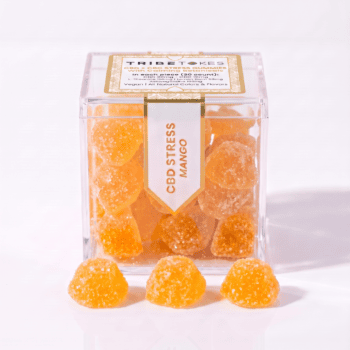
 CBD Gummies for Stress: 30mg CBD + ...Starting from: $45.00 SHOP NOW This product has multiple variants. The options may be chosen on the product page
Frequently Asked Questions
The difference comes down to where each person’s CB1 threshold sits and what dose they took relative to that threshold. THC activates CB1 receptors in the amygdala; at low occupancy it calms the threat-detection circuit, and at high occupancy it amplifies it. Individual thresholds vary based on baseline anxiety level, CB1 receptor density (which shifts with tolerance), CBD content of the product, and the emotional state at the time of use. Two people taking the same product at the same dose can have very different outcomes if their baseline anxiety and tolerance differ.
THC-induced anxiety is intensely unpleasant but not medically dangerous for otherwise healthy people. It passes as the THC clears the system, typically within 1 to 4 hours for inhaled THC and 3 to 8 hours for edibles. CBD administered sublingually can reduce the experience. Moving to a calm, familiar environment and staying physically grounded (a walk, cold water, slow breathing) are the standard management approaches. If THC anxiety is severe, frequent, or does not resolve, avoid THC products and consult a healthcare provider.
Tolerance after a single use is negligible, so the threshold hasn’t changed between experiences. More commonly, the second dose involved more THC (edible timing misread, a stronger product, or unintentional redosing), a more anxious emotional state, or a different environment. The first experience being positive doesn’t establish immunity; the biphasic dose-response curve applies every time regardless of prior history. Dose and context matter more than prior experience.
Research suggests yes. Neuroimaging data shows CBD modulates the brain activity patterns that drive THC-induced paranoia, specifically reducing activity in the striatum and hippocampus. Sublingual CBD tincture (fastest onset, 15 to 30 minutes) is the most practical format for acute intervention. If you use THC products regularly and are prone to anxiety, having a CBD sublingual available is a practical harm-reduction approach.
At equivalent milligram doses, Delta-8 carries lower anxiogenic risk than Delta-9. Delta-8 is a partial CB1 agonist; Delta-9 is a full agonist. Partial agonism limits the maximum CB1 occupancy Delta-8 can achieve regardless of dose, placing a ceiling below the level that typically triggers the anxiety inversion. Users who have experienced paranoia from Delta-9 THC frequently report that Delta-8 does not produce the same response. Delta-8 is still psychoactive and still requires careful dosing for anxiety-prone users.
Two reasons. First, edibles have a 45 to 90 minute onset window; vapes and smoked flower deliver effects within 2 to 5 minutes. The delayed onset leads to redosing before the first dose peaks, which places users well above their intended dose and well past their anxiety threshold by the time the full effect arrives. Second, edibles are metabolized through the liver, converting Delta-9 THC partly into 11-hydroxy-THC, which crosses the blood-brain barrier more readily and produces a more potent psychoactive effect than the same milligram of inhaled Delta-9 THC.
Tolerance to THC’s anxiety effects develops through the same mechanism as tolerance to its other effects: downregulation of CB1 receptor density with regular use. Regular users have fewer available CB1 receptors per dose, which raises the anxiety threshold. Starting at very low doses and increasing slowly over weeks is the most reliable way to build tolerance while minimizing anxiety risk. Tolerance also diminishes quickly after a break (days to weeks), so returning to a previous dose after time off may reproduce anxiety that was absent before.
Not necessarily, but the risk profile is higher. People with pre-existing anxiety disorders have a more reactive amygdala baseline, which lowers the CB1 threshold at which THC turns anxiogenic. CBD and CBG address anxiety through 5-HT1A and alpha-2 receptor pathways with no dose-dependent anxiety risk. For anyone with GAD, panic disorder, or PTSD, starting with non-psychoactive cannabinoids before introducing any THC isomer reduces the risk of a counterproductive experience. Any use of cannabinoids alongside prescription anxiety medications should involve prescriber oversight.
Know the Threshold. Choose the Right Tool.
Non-psychoactive CBD and CBG for predictable daily relief. Low-dose Delta-8 for evenings. Lab-tested, COA on every batch.