

No. CBD does not get you high. This isn’t a technicality or a marketing hedge: it’s the molecular reality. CBD and THC interact with the brain’s cannabinoid receptors in fundamentally different ways.
That’s the short answer. The longer one is more interesting: CBD is non-intoxicating not because it’s a weak version of THC, but because it works through a completely different mechanism. It doesn’t activate the receptors that produce a high, and at the right dose it can actually reduce THC’s intoxicating effects. This article covers why, what CBD actually does feel like, whether full-spectrum products with trace THC are a concern, and what happens if you get drug tested. 4.79/5 from 909 CBD product reviews.
🧪 Lab Tested | 👩💼 Woman-Owned | 🏆 Est. 2017
Why CBD Doesn’t Get You High
THC’s intoxicating effect comes from its direct activation of CB1 receptors: cannabinoid receptors concentrated in the brain and central nervous system. When THC binds to CB1, it triggers a cascade of effects including dopamine release, altered sensory perception, and the subjective experience of being high.
CBD binds to CB1 receptors too, but it doesn’t activate them the same way. CBD is what pharmacologists call a negative allosteric modulator at CB1. This means CBD binds at a different site on the receptor (not the primary binding site where THC attaches) and changes the receptor’s shape in a way that reduces its activity. It doesn’t turn the receptor on. It actually makes the receptor less responsive.
The practical consequence of this: CBD cannot produce the intoxicating effects associated with CB1 activation, no matter how much you take. The mechanism simply isn’t there. You cannot get high from CBD in the way you can from THC or Delta 8.
CBD can also reduce THC’s intoxicating effects. When CBD and THC are present together (as they are in full-spectrum products, or when someone uses both), CBD’s negative allosteric modulation at CB1 competes with THC’s activation of the same receptor. Some users deliberately combine CBD with THC to take the edge off a high that’s become too intense.
CBD also interacts with other receptor systems: serotonin receptors (5-HT1A), TRPV1 channels involved in pain and inflammation, FAAH (an enzyme that breaks down the body’s own endocannabinoids), and GPR55 receptors. These interactions are responsible for the effects CBD does produce: relaxation, anxiety modulation, pain relief, and sleep support. None of them produce intoxication.
Sources: Laprairie, R.B. et al. (2015). “Cannabidiol is a negative allosteric modulator of the cannabinoid CB1 receptor.” British Journal of Pharmacology, 172(20), 4790-4805. PubMed: 26218949. | Russo, E.B. (2011). “Taming THC: Potential cannabis synergies and phytocannabinoid-terpenoid entourage effects.” British Journal of Pharmacology, 163(7), 1344-1364. PubMed: 21749363.
What CBD Actually Feels Like
Users consistently report effects. They’re just not psychoactive ones:
- Relaxation without cognitive fog or sedation at typical daytime doses
- Reduced anxiety background noise (the mental static of a stressful day turning down)
- Physical relief from tension, soreness, and inflammation
- Easier sleep onset at higher doses or with indica-strain CBD products
- Mental clarity and focus at lower doses, particularly with sativa-strain profiles
“It’s the relaxation without the buzz, which is just what my mind and body were looking for,” wrote Hannah S. Lori J.: “I’m not interested in getting a ‘high’ feeling so I choose the CBD.” Challan R.: “Help with no head high.”
The daytime-use picture is consistent too. Robert C.: “My go-to when I want an uplift but remain clear-headed.” June L.: “I find these products really grant me some ease and mental clarity when daytime anxiety is present.” Victoria G.: “I use the CBD vapes when I’m taking a break from THC and it helps calm me down so much.”
Something is clearly happening, but it’s not intoxication. No distortion of perception. No impaired cognition. No couch-lock. What users describe is CBD working through serotonin, TRPV, and FAAH pathways: real effects at normal doses, without CB1 activation.
Dose matters. At low doses (5-15mg), CBD tends to produce mild calm and focus. At higher doses (25-50mg+), sedation becomes more common and sleep support more pronounced. Individual body chemistry, delivery format, and whether the product is full-spectrum or isolate all affect the experience.
CBD vs. THC: Side by Side
| CBD | THC (Delta 8 or Delta 9) | |
| CB1 receptor action | Negative allosteric modulator; changes receptor shape, reduces activation | Direct agonist; activates the receptor and produces psychoactive effects |
| Psychoactive? | No | Yes |
| Primary effects | Relaxation, anxiety reduction, pain modulation, sleep support at higher doses | Euphoria, altered perception, appetite stimulation, intoxication |
| Effect on each other | CBD can reduce THC’s intoxicating effects when taken together | THC’s effects can be modulated (reduced in intensity) by CBD |
| Federal legal status | Legal when hemp-derived (the Agricultural Improvement Act of 2018) | Delta 8: legal when hemp-derived; Delta 9: federally Schedule I (legal in many states) |
| Drug test risk | Low with broad-spectrum or isolate; low but non-zero with full-spectrum | High; will produce positive result on standard drug test |
| Impairs driving? | No evidence of impairment at typical doses | Yes; impairs reaction time and cognitive function |
THC turns the receptor on. CBD changes the receptor’s shape in a way that makes it harder to turn on.
What About Full-Spectrum CBD?
Full-spectrum CBD products contain the full range of cannabinoids and terpenes from the hemp plant, including trace amounts of Delta-9 THC (at or below the legal limit of 0.3% by dry weight). This raises a reasonable question: is that enough THC to produce any psychoactive effect?
At 0.3% or below, the answer is no for the vast majority of users at typical doses. A full-spectrum CBD tincture or gummy at a standard serving contains such a small absolute amount of Delta-9 THC that intoxication is not a realistic outcome. The CBD present in the same product is also actively modulating CB1 receptors in a way that would further reduce any effect from trace THC.
The more relevant concern with full-spectrum products is drug testing, not intoxication. Even trace THC can accumulate in the body with regular use, producing THC-COOH metabolites detectable on a standard urine screen.
Broad-spectrum CBD (THC removed post-extraction) and CBD isolate (pure CBD only) are the alternatives for anyone who wants to completely avoid THC exposure. TribeTokes CBD gummies are available in THC-free formulations for exactly this reason.
CBD and Drug Testing
CBD itself is not what drug tests detect. Standard immunoassay urine screens target THC-COOH, a metabolite of Delta-9 THC metabolism. CBD metabolizes through a different pathway and does not produce THC-COOH.
CBD isolate and broad-spectrum CBD with verified non-detectable THC on a batch COA carry very low drug test risk. If the product contains no THC, there is no THC to metabolize into THC-COOH.
Full-spectrum CBD carries a low but non-zero risk. The trace THC present in legal full-spectrum products is unlikely to trigger a positive result from a single dose, but regular daily use can cause THC-COOH to accumulate to detectable levels over time, particularly in people with lower body fat turnover or slower THC metabolism. A 2020 study in the Journal of Analytical Toxicology documented positive THC urine screens in participants using full-spectrum CBD products at typical commercial doses.
If you are subject to drug testing and want to use CBD:
- Choose a THC-free (broad-spectrum or isolate) CBD product
- Verify the batch COA shows non-detectable Delta-9 THC
- Know your test type: urine screens are most common and detect THC-COOH; hair tests have much longer detection windows
TribeTokes’ THC-free CBD gummies are verified non-detectable THC by batch. COAs are published at tribetokes.com/certificates-of-analysis.
Source: Spindle, T.R. et al. (2020). “Urinary pharmacokinetic profile of cannabinoids following administration of vaporized and oral cannabidiol and vaporized CBD-dominant cannabis.” Journal of Analytical Toxicology, 44(2), 109-125. PubMed: 31722388.
Who CBD Is For
You want the effects without the high. If what you’re after is relaxation, anxiety relief, or physical comfort and you need to stay functional, clear-headed, and not impaired: CBD is the category. You can use it during the day, at work, before driving. THC products require none of those conditions.
You’re new to cannabinoids. CBD is the lower-stakes starting point. There’s no intoxication risk, no chance of an overwhelming experience, and no next-day concern about cognitive clarity. It lets people develop a sense of how their body responds to cannabinoids before deciding whether to add THC products.
You want to manage THC’s intensity. Regular THC users often keep CBD on hand to balance sessions that go further than intended. The negative allosteric modulation mechanism means CBD can genuinely take the edge off: not a placebo effect, not wishful thinking.
You’re taking a break from THC. “I use the CBD vapes when I’m taking a break from THC and it helps calm me down so much,” wrote Victoria G. CBD covers some of the same relaxation territory without the psychoactive component, which makes it a workable substitute during tolerance breaks or while navigating drug testing requirements.
Drug testing is a concern. With the right product (THC-free formulation, verified COA), CBD can be used with very low drug testing risk, something no THC-containing cannabinoid product can offer.
TribeTokes CBD Products
TribeTokes offers CBD across every format: vape carts, disposable vape pens, gummies, tinctures, pain creams, and skincare. The full-spectrum CBD vape lineup is CBG-boosted (real CBG in every cart), which adds the focus and clarity notes of CBG to CBD’s calming profile. Every product is third-party tested at ISO 17025-accredited labs with batch-specific COAs at tribetokes.com/certificates-of-analysis. THC-free options are available across gummies and tinctures. 4.79/5 from 909 CBD product reviews. Woman-owned since 2017.
Shop: CBD vape carts | CBD gummies | CBD tinctures | CBD pain cream | all CBD products
-
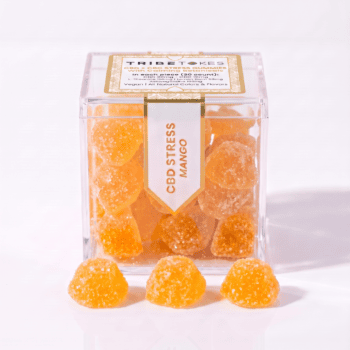
 CBD Gummies for Stress: 30mg CBD + ...Starting from: $45.00 SHOP NOW This product has multiple variants. The options may be chosen on the product page
Frequently Asked Questions
No. CBD does not produce a high, regardless of dose. THC gets you high by directly activating CB1 receptors in the brain. CBD works differently at those same receptors. It acts as a negative allosteric modulator: it binds to the receptor at a different site and reduces activation rather than triggering it. The mechanism that produces intoxication is simply not present in CBD’s pharmacology.
Users consistently report relaxation without sedation at lower doses, reduced anxiety, physical relief from tension and soreness, and at higher doses, easier sleep. The experience is grounded: calm and functional rather than altered or impaired. Many people describe it as the feeling of stress or physical discomfort stepping back without anything replacing it in the foreground. No distorted perception, no cognitive fog, no euphoria.
Yes. CBD is a negative allosteric modulator at CB1 receptors: it binds at a different site and changes the receptor’s shape in a way that reduces THC’s ability to activate it. When CBD and THC are present together, CBD competes with THC at CB1 and blunts the intoxicating effect. Some users deliberately take CBD when a THC session gets too intense for exactly this reason.
No. Full-spectrum CBD contains trace Delta-9 THC at or below the legal limit of 0.3% by dry weight. At that concentration, the absolute amount of THC in a standard serving is too small to produce intoxicating effects. The CBD present also actively modulates CB1 receptors in a way that further reduces any effect from trace THC. Full-spectrum CBD will not get you high.
CBD itself is not what drug tests detect. Standard urine screens target THC-COOH, a metabolite specific to Delta-9 THC metabolism. CBD doesn’t produce this metabolite. However, full-spectrum CBD products contain trace THC that can accumulate with regular use and produce detectable THC-COOH levels over time. If drug testing is a concern, choose broad-spectrum or isolate CBD with a COA confirming non-detectable Delta-9 THC.
No. Hemp oil (also called hemp seed oil) is pressed from hemp seeds and contains no meaningful CBD content; seeds don’t produce cannabinoids. CBD oil is extracted from the flowers, leaves, and stalks of hemp plants, where cannabinoids are produced. Both are hemp-derived, but chemically and functionally unrelated. Hemp seed oil is a food product; CBD oil is a cannabinoid product.
CBD isolate is pure CBD with all other plant compounds removed. Broad-spectrum CBD retains the plant’s terpenes and minor cannabinoids but has THC removed post-extraction. Full-spectrum CBD includes everything in the plant, including trace THC at or below 0.3%. Most users find full-spectrum and broad-spectrum products more effective than isolate because of the entourage effect: cannabinoids and terpenes working in combination tend to produce better results than CBD alone.
For most new users, 10-25mg is a reasonable starting range. Start at the lower end, give it a few days to calibrate, and adjust from there. CBD is non-intoxicating, so there’s no risk of “taking too much” in the impairment sense, but higher doses don’t always mean better effects. For sleep support, higher doses (25-50mg) tend to work better than low doses. For daytime anxiety and focus, lower doses (10-20mg) are often sufficient and less likely to cause drowsiness.
Hemp-derived CBD is within the federal hemp definition, which legalized hemp and all hemp-derived cannabinoids, provided the final product contains 0.3% or less Delta-9 THC. The vast majority of states align with federal law on hemp-derived CBD. TribeTokes CBD products are hemp-derived and third-party tested to confirm legal compliance.
Onset depends on delivery format. Vaping CBD produces effects in 5-15 minutes: the fastest of all formats. Cannabinoids absorb directly through lung tissue into the bloodstream. Sublingual tinctures (held under the tongue) take 15-45 minutes. Gummies are the slowest: 45-90 minutes, because they have to be digested first. Gummies also produce longer-lasting effects than vaping. That makes them better for sustained overnight sleep support.
Shop TribeTokes CBD
4.79/5 from 909 reviews. CBG-boosted vape carts, THC-free gummies, full-spectrum tinctures. Batch-tested. Woman-owned since 2017.
Sources
- Laprairie, R.B. et al. (2015). “Cannabidiol is a negative allosteric modulator of the cannabinoid CB1 receptor.” British Journal of Pharmacology, 172(20), 4790-4805. PubMed: 26218949.
- Russo, E.B. (2011). “Taming THC: Potential cannabis synergies and phytocannabinoid-terpenoid entourage effects.” British Journal of Pharmacology, 163(7), 1344-1364. PubMed: 21749363.
- Spindle, T.R. et al. (2020). “Urinary pharmacokinetic profile of cannabinoids following administration of vaporized and oral cannabidiol and vaporized CBD-dominant cannabis.” Journal of Analytical Toxicology, 44(2), 109-125. PubMed: 31722388.