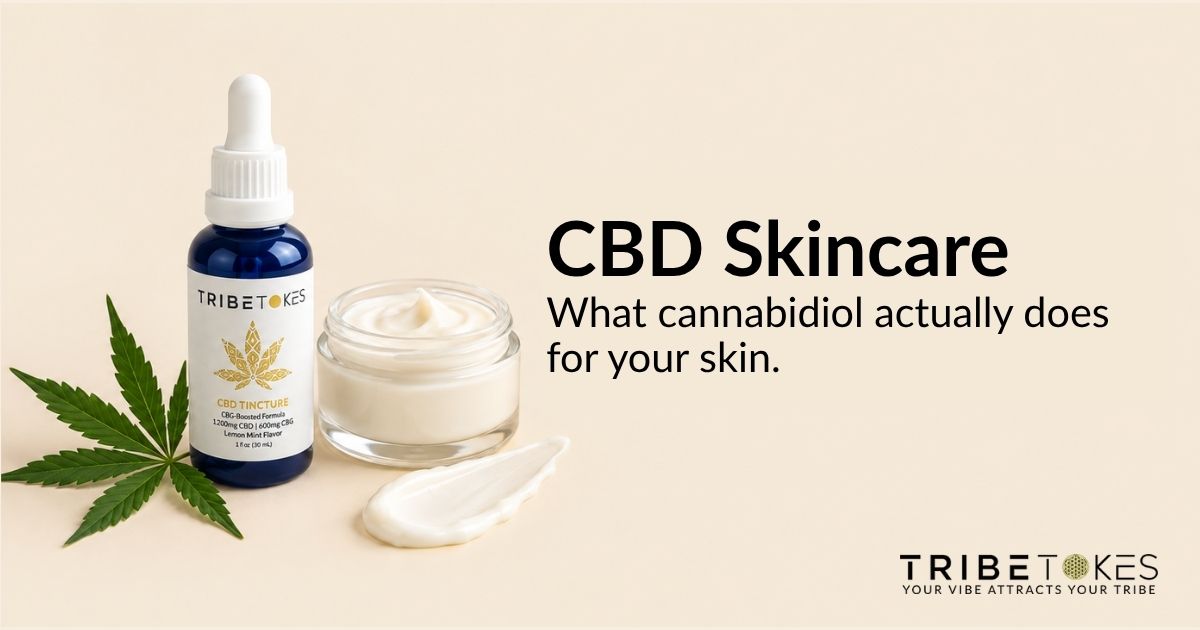
Most people meet CBD through gummies, tinctures, or vape pens, so the idea of putting it on your face sounds like a stretch. But CBD skin care has been a serious category since around 2017, and it earned its spot honestly. CBD is a calming, antioxidant ingredient that offers anti-inflammatory, antioxidant, and oil-balancing benefits for reactive, oil-prone, and easily irritated skin. It is not a miracle cream.
🧪 Lab Tested | 👩💼 Woman-Owned | 🏆 Est. 2017
What CBD Actually Does for Skin
CBD works on skin as a calming antioxidant, not a miracle cream. Cannabidiol comes from the hemp plant, and the qualities that made it interesting for skin are the same ones people notice elsewhere: it calms, it balances, and it defends. Set the expectation there and the ingredient makes sense. Promise more than that and you are reading marketing.
It calms the look of stressed skin
Redness and reactivity are where CBD built its reputation in skincare. Researchers have studied cannabidiol for its soothing properties, which is why it showed up in products aimed at sensitive skin that flushes or reacts to everything. Customers describe skin that looks calmer and less angry, not numbed. Think of it as taking the edge off, quietly, the way a good moisturizer does.
It helps balance oil
Combination and oily skin tend to respond to CBD better than you would guess. Some research suggests cannabidiol plays a role in how skin manages its own oil, so shine reads as less of a problem through the day. That balance is also why CBD found its way into products for skin that feels greasy by noon but tight by night.
It defends like other antioxidants
CBD is an antioxidant, in the same family of job description as vitamin C and vitamin E. Skin takes daily hits from pollution, light, and general environmental stress, and antioxidants help defend against that wear. CBD adds to that defense rather than replacing your other actives.
A note on claims: CBD is a cosmetic ingredient that supports the look and feel of skin. It is not a medicine, and no honest brand will tell you it treats a skin condition. Anyone promising a cure is selling you the promise, not the science.
What Clean Beauty Really Means
Clean beauty means formulating without the ingredients most people would rather keep off their face, and being able to prove it. The phrase gets slapped on everything, so it has lost most of its meaning. Here is the version worth holding a brand to.
The ingredient side
Clean, in practice, means no parabens, no sulfates, no phthalates, and no synthetic fragrance. Those are the four most people are trying to avoid, and a clean formula leaves them out without hiding the swap behind a vague natural label. You should be able to read the ingredient list and actually recognize what you are putting on.
The CBD side
With CBD specifically, clean also means you know exactly how much cannabidiol is in the bottle and where the hemp came from. A product can call itself CBD skincare with barely any CBD in it, or with hemp grown somewhere with no oversight. Clean means the dose is real and the source is traceable. That last part matters more than any label buzzword, which brings us to the one habit worth carrying into every CBD purchase.
How to Judge a CBD Skincare Product
The fastest way to judge any CBD product is its certificate of analysis, and it takes thirty seconds to check. A COA is a third-party lab report confirming the CBD content is what the label claims and screening for the things you do not want on your skin. Skincare, tinctures, topicals, the rule holds across all of them. If a brand will not show you one, you have your answer.
What a lab report actually tells you
A real COA confirms two things: the cannabinoid content is accurate, and the product is free of contaminants. That means the CBD milligrams match the label, and the batch tested clean for pesticides, heavy metals, and residual solvents. Everything TribeTokes sells is lab tested with results published, a standard that came straight out of building skincare, where what sits in the bottle is the entire point. You can browse our current lab reports on the certificates of analysis page.
Spectrum types, in plain terms
The label will say full-spectrum, broad-spectrum, or isolate, and the difference comes down to what rides along with the CBD. Here is the short version.
| Type | What is in it | Best for |
| Full-spectrum | CBD plus other compounds, trace THC under 0.3% | People who want the whole plant, no drug testing concerns |
| Broad-spectrum | Plant compounds, THC removed | People wanting more than isolate, zero THC |
| Isolate | Pure CBD only | Lightest formula, THC-sensitive users |
Match the format to your skin
Pick the format for the job, not the hype on the front of the jar. Lightweight serums and toners suit oily and combination skin that hates heavy layers, while richer creams suit dry or mature skin that wants more cushion. The CBD does similar work across formats, so the texture is what you are really choosing.
Before you buy any CBD skincare: check for a published COA, read the full ingredient list, and confirm the CBD amount is stated in milligrams. Two minutes of checking separates real CBD skincare from a moisturizer with a hemp leaf on the box.
Where TribeTokes Fits Now
We built TRIBEAUTY, our clean CBD skincare line, back when few brands took cannabis seriously as a beauty ingredient, and we have since retired it. The plant-first standard behind it did not go anywhere. We focused the brand on the products our community reaches for most, all held to the same lab-tested, woman-owned, clean-formula bar we set in 2017.
If you came for the serums and masks
The closest fit today is our CBD body and topical care, made for targeted, on-the-skin use. Our CBD topicals carry that same clean, hemp-derived approach onto the body, and our CBD tinctures are the flexible way to work hemp into a daily routine. If you would rather just see what people rate highest, start with our best sellers.
Why the clean standard still holds
Every product we make is third-party lab tested, and we have kept that promise since day one. The brand has been woman-owned since 2017 and featured in Allure, Rolling Stone, and Forbes, and it ships to most states. You can read how that started on our story page, or learn the fundamentals in our guide to what CBD is.
Frequently Asked Questions
CBD is valued in skincare as a calming, antioxidant-rich ingredient rather than a treatment. As a powerful antioxidant, it adds to your skin’s defense against everyday environmental stress from pollution and light. It supports the look and feel of healthy skin, and consistency over weeks matters more than any single application.
Topical CBD is generally well-tolerated, especially in clean formulas free of synthetic fragrance and harsh additives. Quality and lab testing matter more than the CBD itself. Patch test any new product for 24 to 48 hours before full use. Look for published COAs and avoid products with undisclosed ingredients that could cause irritation.
Research suggests CBD plays a role in regulating sebum, which is relevant for acne-prone skin. It has anti-inflammatory properties that may reduce inflammation and visible redness. That said, it is a cosmetic ingredient, not a prescription treatment for acne, eczema, or psoriasis. See a dermatologist for persistent skin conditions.
Topical CBD products work locally and are not absorbed into the bloodstream in meaningful amounts. Drug tests screen for THC metabolites, not CBD. Anyone facing strict testing should lean toward broad-spectrum or CBD isolate over full-spectrum as an extra precaution, and avoid transdermal patches entirely.
Lighter serums and gels suit oily or combination skin. Richer creams suit dry or mature skin. Fragrance-free, lab-tested options work best for sensitive skin. Start with one CBD step at a time, check the COA, read the full ingredient list, and let the results over a few weeks tell you whether to keep going.
Shop Lab-Tested CBD
The TRIBEAUTY face line is retired, but the standard behind it carried over. Every TribeTokes CBD product is hemp-derived, third-party lab tested, and published with a full COA.