
🔬 Lab Testing Guide · 2026
The honest, science-backed answer — plus the exact COA checklist that separates clean vapes from sketchy ones.
6
Lab Tests to Look For
5
Ingredients to Avoid
94%
EVALI cases linked to 1 ingredient
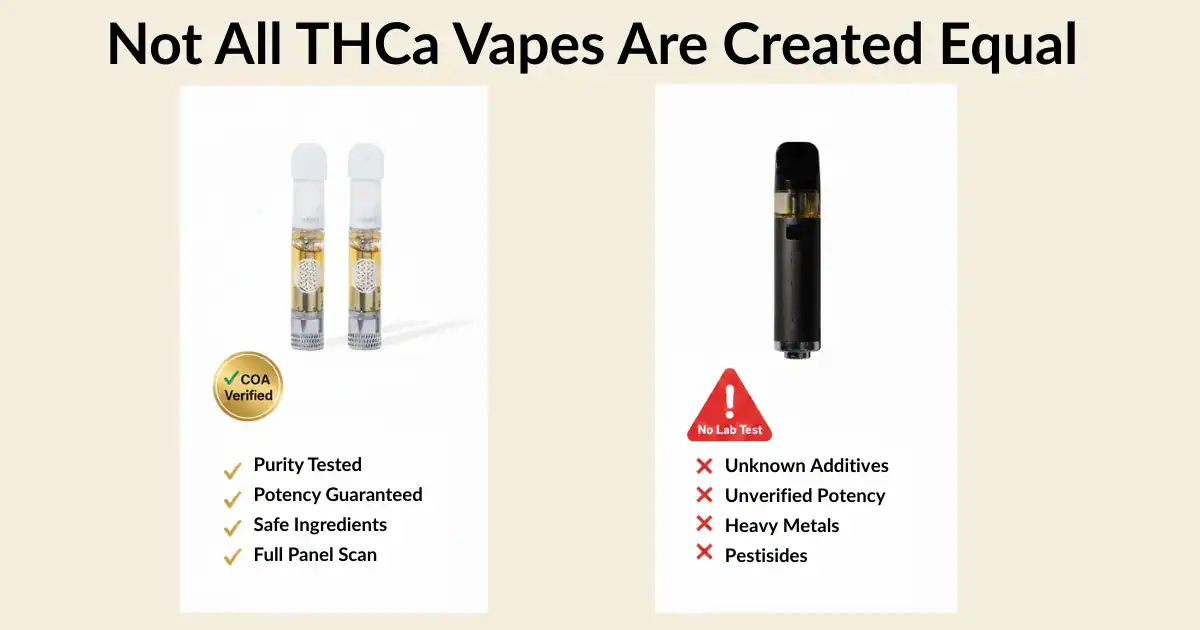
Short answer: it depends entirely on what’s inside the cartridge.
There are clean, properly tested THCa vapes that are perfectly reasonable for adult use. And there are untested, additive-laden products floating around the hemp market that deserve a hard pass — like, throw-it-across-the-room-level no.
The 2019 EVALI outbreak (E-cigarette or Vaping Product Use-Associated Lung Injury) that hospitalized nearly 3,000 people and killed 68 was traced primarily to a single adulterant — vitamin E acetate — found in illicit vape cartridges. The CDC detected it in 94% of patient lung fluid samples. That’s not a cannabis problem. That’s a “buy-your-vapes-from-a-shady-gas-station” problem.
The good news? If you know what to look for on a lab report — and what to run screaming from on an ingredient list — you can shop THCa vapes with genuine confidence. This guide breaks it all down.
1. What Is a THCa Vape, Exactly?
THCa (tetrahydrocannabinolic acid) is the raw, acidic precursor to delta-9 THC found in the cannabis plant. In its natural form — before heat is applied — THCa is non-psychoactive. It will not get you high sitting in a jar.
The moment you take a hit, though? Heat triggers decarboxylation — a chemical reaction that removes a carboxyl group from the molecule and releases CO₂. THCa instantly converts to delta-9 THC. You’re now getting a traditional cannabis high, courtesy of chemistry.
This is why THCa products occupy a legal gray area under federal hemp law: the raw compound tests below the 0.3% delta-9 THC threshold. Once you use the product, it converts. This nuance matters enormously for both safety discussions and legal status — different states are actively evolving their positions on hemp-derived THCa.
THCa vapes come in two main formats:
| Format | Description | Best For |
| Cartridge (Cart) | Refillable-style glass cartridge with 510-thread attachment, requires separate battery | Regular users who want battery flexibility and cost efficiency |
| Disposable | All-in-one device, pre-charged and pre-filled, no battery needed, draw-activated | Beginners, travel, convenience, no-fuss sessions |
2. The EVALI Story: What Really Caused Vaping-Related Illness
If you’ve Googled “are vapes safe” in the last few years, you’ve run into EVALI. Let’s set the record straight, because the nuance here actually matters for your purchasing decisions.
The 2019–2020 EVALI outbreak hospitalized 2,807 people and caused 68 deaths in the U.S. It made international headlines, scared a lot of people away from vaping entirely, and served as a legitimate wake-up call for the industry.
But here’s what the CDC data actually showed:
- The outbreak was disproportionately linked to illicit THC cartridges purchased off the street or through informal channels — not regulated cannabis dispensaries or licensed hemp brands.
- Vitamin E acetate — a cheap, oil-like additive used to dilute and thicken cheap cannabis oil — was found in 94% of BAL (bronchoalveolar lavage) fluid samples taken from EVALI patients.
- Vitamin E acetate is harmless when applied to skin. When inhaled, it coats lung tissue in ways that create severe inflammatory responses.
- By 2020, as illicit cartridge use declined and regulatory pressure increased, EVALI cases dropped sharply.
⚡ The Takeaway
EVALI was primarily an adulteration problem, not a cannabis problem. The risk is real, but it is concentrated in untested, unregulated products containing cutting agents — not in properly lab-tested hemp vapes from transparent brands. Knowing this distinction is the difference between panicking and shopping smart.
3. The 5 Ingredients to Avoid in Any THCa Vape
This is the most important section in this article. Print it out. Laminate it. Tape it to your forehead.
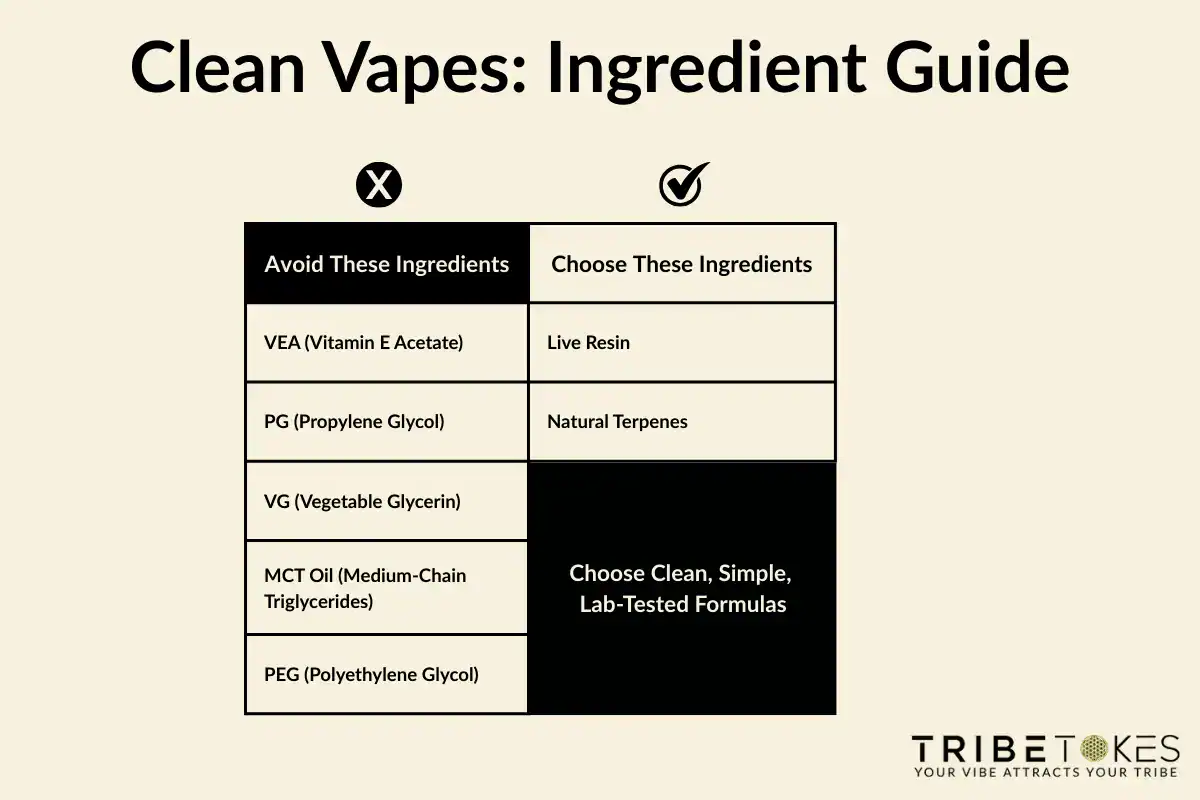
These are the ingredients that have no business being in a THCa vape cartridge — and the fact that some brands still use them is deeply alarming:
| Ingredient | Why It’s Used | Why to Avoid It |
| Vitamin E Acetate | Cheap oil to dilute and thicken extract | Linked to EVALI lung injury; found in 94% of EVALI patient samples (CDC) |
| Propylene Glycol (PG) | Common e-cigarette thinning agent | Breaks down into formaldehyde and acrolein at high temps; associated with throat irritation and inflammation |
| Polyethylene Glycol (PEG) | Thinner to improve oil viscosity | Decomposes into acetaldehyde and formaldehyde when heated; potential carcinogenic byproducts |
| Vegetable Glycerin (VG) | Thinning agent, creates vapor clouds | Can cause lung inflammation; associated with respiratory discomfort in heavy users |
| MCT Oil (Medium-Chain Triglycerides) | Coconut-derived oil used to dilute extract | Linked to lipoid pneumonia when inhaled; oils are simply not meant to go into lungs |
🌿 What Should Be in a THCa Vape?
For a vape cartridge or a THCa disposable vape pen, the ingredient list should be extremely short: cannabis-derived hemp extract (live resin or distillate) + natural plant-based terpenes. That’s it. If the ingredient list is longer than that, ask why.
4. The 6 Lab Tests a Safe THCa Vape Should Have
Not all “lab tested” claims are created equal. Some brands run only a potency test — which tells you how much THCa is in the product, but nothing about whether it’s contaminated. That’s like a restaurant telling you the calorie count but not whether the kitchen passed a health inspection.
A reputable THCa vape brand should provide a full-panel Certificate of Analysis (COA) from an independent, ISO-accredited third-party laboratory covering all six of the following:
- Cannabinoid Potency Panel
Verifies the THCa percentage (should be 85–95% of total formula for a vape), confirms delta-9 THC is below 0.3% for federal hemp law compliance, and identifies the complete cannabinoid profile. A potency test that shows 90% THCa with 0.2% delta-9 THC is a green light. - Residual Solvents Panel
Live resin extraction uses solvents like butane, propane, or ethanol to pull cannabinoids from the plant. These must be completely removed post-extraction. The lab test should show residual levels below safe action limits — ideally “ND” (non-detected) for harsh solvents like butane. - Pesticides Panel
Hemp is an absorptive plant — it pulls contaminants from soil readily. Pesticide residues can concentrate in extract. Look for “ND” or values below action limits for the full list of regulated pesticides. A pass on this test is non-negotiable for any product you’re inhaling. - Heavy Metals Panel
Tests for lead, arsenic, cadmium, and mercury — the “Big Four” heavy metal contaminants. Cannabis plants can bioaccumulate heavy metals from contaminated soil, and cheap metal coil hardware can also leach heavy metals into vapor at high temperatures. Results should show ND or below action limits for all four. - Mycotoxins Panel
Mycotoxins are toxic compounds produced by molds and fungi. If cannabis is improperly stored or processed, mycotoxin contamination becomes a real risk. Inhaling mycotoxins is significantly more dangerous than ingesting them. Look for ND on aflatoxins B1, B2, G1, G2, and ochratoxin A. - Microbials Panel
Tests for harmful bacteria (e.g., E. coli, Salmonella) and yeast/mold counts. While less of an inhaled-vapor concern than the other categories, microbial contamination indicates poor manufacturing conditions overall. Passing this test signals clean production practices.
✅ Pro Tip: Only Potency Testing = Red Flag
If a brand’s COA only shows cannabinoid percentages and nothing else, they are not doing full-panel testing. This is a significant quality shortcut. Full-panel testing costs more — which is exactly why brands that invest in it are worth the premium. You’re worth the premium too.
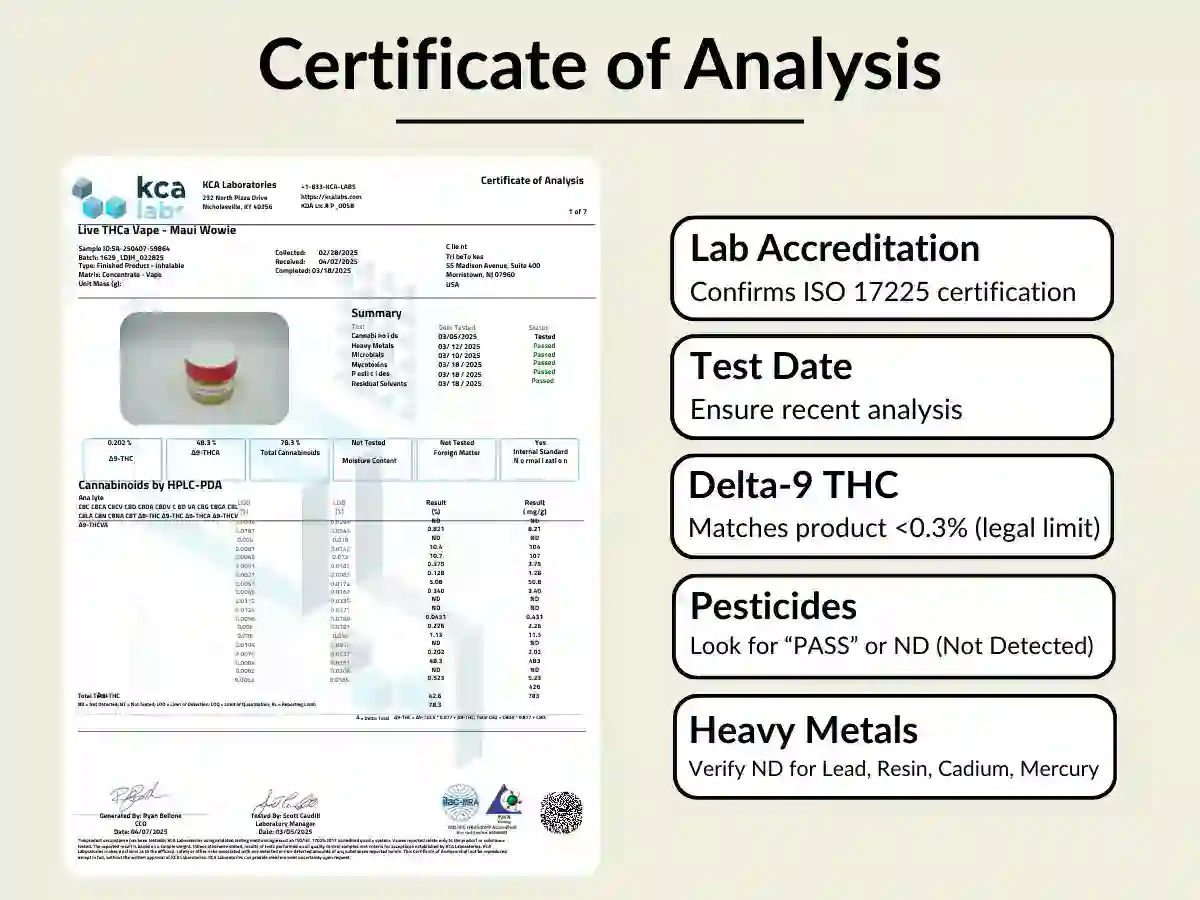
5. How to Read a THCa COA in 60 Seconds
COAs can look intimidating — lots of numbers, acronyms, and small print. Here’s the 60-second checklist for reading any THCa vape lab report:
| What to Check | Where to Find It | What’s Acceptable |
| Lab Name & Accreditation | Header of the COA document | ISO 17025 accredited, real independent lab (not brand’s own facility) |
| Test Date | Header or bottom of document | Within the past 12 months; current batch |
| THCa Percentage | Cannabinoid panel table | 85–95% for pure vape extract; anything dramatically lower or higher warrants a question |
| Delta-9 THC | Cannabinoid panel table | Below 0.3% (federal hemp law compliance) |
| Residual Solvents | Solvents panel | “ND” (non-detected) for major solvents like butane, propane |
| Pesticides | Pesticides panel | “Pass” status or “ND” on all tested compounds |
| Heavy Metals | Heavy metals panel | “ND” or below action limits for Pb, As, Cd, Hg |
| Microbials / Mycotoxins | Microbials panel | “Pass” or “ND” — no detected contaminants |
How to Verify a COA is Real (Not Faked)
Sadly, some bad actors in the hemp market fabricate or alter COAs. Here’s how to verify authenticity:
- Find the lab name on the COA and look it up independently — Google them, check their official website, and confirm they’re accredited.
- Look for a unique report number — most labs assign a batch number or case ID you can cross-reference with them directly.
- Check the lab’s website — some labs like Cannalysis, SC Labs, and ProVerde publish results on their own portals that you can search by sample ID.
- Look for a QR code on the product label that links directly to the COA — brands committed to transparency often include these.
At TribeTokes, it was vitally important to us to create premium products that do not contain harmful chemicals, fillers, artificial colors, or artificial flavors. Our proprietary vape formulations have no PG, PEG, VG, MCT, or Vitamin E Acetate — with plant-based terpenes to achieve the therapeutic effects of our best-selling strain profiles.
— TribeTokes Founders, from the brand’s Lab Testing Philosophy
6. Why Hardware Matters: Ceramic vs. Metal Coils
The extract inside the cartridge isn’t the only safety variable. The hardware — specifically the heating element — plays a significant role in what you’re actually inhaling.
Ceramic Core Cartridges
Ceramic coils are the current gold standard for cannabis vape hardware. Here’s why:
- Ceramic heats oil evenly, eliminating hot spots that can scorch the extract and create combustion byproducts.
- Ceramic does not leach heavy metals into vapor — unlike low-quality metal coils, which can introduce lead and other contaminants especially at higher voltages.
- Even heating means better flavor, more consistent dosing, and less wasted oil.
- High-quality ceramic coils (like CCELL) are designed specifically for thick cannabis oil and deliver smooth, clog-resistant performance.
What to Watch Out For
- Unknown metal alloy coils — cheap import cartridges with unspecified metal heating elements have been found to contain nickel, chromium, and lead.
- Cotton wicks — designed for nicotine e-liquid, not viscous cannabis oil. Cotton wicks struggle with thick live resin, burn unevenly, and can create acrolein when scorched.
- Plastic components — mouthpieces and bodies made from cheap plastic can off-gas when heated. Look for glass or high-grade polymer construction.
🔧 TribeTokes Hardware Spec
All TribeTokes vape cartridges use ceramic core technology — no metal coil hardware, no cotton wicks. Combined with leak-resistant glass cartridge bodies and high-grade mouthpieces, this is the hardware setup that makes clean vaping actually work.
7. Live Resin vs. Distillate: Does the Extraction Method Affect Safety?
There’s a common misconception that live resin is inherently safer than distillate. The truth is more nuanced — and interesting.
| Factor | Live Resin THCa | THCa Distillate |
| Extraction Source | Flash-frozen fresh cannabis — preserves full terpene and cannabinoid spectrum | Dried/cured cannabis — refined through distillation to isolate cannabinoids |
| Terpene Profile | Natural, complex, strain-authentic — no added terpenes needed | Pure extract but flavor-stripped — terpenes usually added back post-extraction |
| Additive Risk | Lower — rich flavor profile means less need for synthetic additives | Higher — distillate’s neutral flavor tempts manufacturers to add flavoring agents, some synthetic |
| Residual Solvent Risk | Requires thorough solvent removal (butane/propane) — must be lab verified | Distillation process removes most solvents — but lab testing still required |
| Safety Verdict | Both safe if properly tested and free of adulterants | Both safe if properly tested and free of adulterants |
The bottom line: testing matters more than extraction method. A distillate product with a full clean COA is safer than a live resin product with no lab test. That said, live resin’s natural flavor complexity reduces the commercial incentive to add potentially harmful flavoring agents — which is a real-world safety advantage worth noting.
8. Red Flags vs. Green Flags: The Brand Safety Checklist
Before you add any THCa vape to your cart, run this quick mental checklist on the brand:
🚨 Red Flags — Walk Away
🚫
No COA or Hidden COA
If you can’t find a COA easily on their website, assume they have something to hide. Full stop.
🚫
Potency-Only Testing
Testing only for cannabinoid percentages skips the safety checks entirely — solvents, pesticides, metals, microbials all absent.
🚫
PG, VG, VEA, or MCT on Label
These cutting agents are the main culprits behind vaping-related lung injuries. Non-negotiable avoidance.
🚫
Prices That Seem Too Good
Full-panel testing, quality extract, and ceramic hardware cost money. Suspiciously cheap carts are cheap for a reason.
🚫
No Company Info / Anonymous Brand
Reputable brands have a real website, real contact information, and real people behind them. Ghost brands are a hard no.
🚫
Artificial Flavors Listed
“Natural and artificial flavors” on a vape label suggests synthetic terpene blends or flavoring compounds not meant for inhalation.
✅ Green Flags — Shop With Confidence
✅
Full-Panel COA Publicly Posted
All 6 test categories, accessible on their website without having to request them.
✅
Independent ISO-Accredited Lab
Third-party testing, not an in-house facility — with a verifiable lab name and accreditation.
✅
Short, Clean Ingredient List
Hemp extract + natural terpenes = done. No mystery additives, no thinning agents.
✅
Ceramic Core Hardware
Stated clearly in product specs — not just implied. Ceramic means no metal leach risk.
✅
Real Verified Customer Reviews
Third-party review platforms (Yotpo, Trustpilot, Google) with detailed, verified purchaser reviews are a trust signal.
✅
QR Code on Packaging to COA
Linking directly from the physical product to the lab result — that’s next-level transparency.
9. How TribeTokes Tests Its THCa Vapes
We’ll be real — we’re biased about our own products. That’s why we let the lab reports do the talking.
Every batch of TribeTokes THCa vapes is tested by an independent third-party laboratory for all six safety panels: potency, residual solvents, pesticides, heavy metals, mycotoxins, and microbials. The results are posted publicly and updated with each new batch.
✅ TribeTokes Full Testing Protocol
- Potency: Cannabinoid percentages verified, delta-9 THC federal hemp law compliance confirmed
- Residual Solvents: Complete removal of extraction solvents verified post-production
- Pesticides: Full pesticide panel — ND required for all regulated compounds
- Heavy Metals: Lead, arsenic, cadmium, mercury — all tested to action limits
- Mycotoxins: Tested for aflatoxins and ochratoxin A
- Microbials: E. coli, Salmonella, yeast/mold — full microbial panel
Our vapes, including the THCa live resin disposable, contain zero PG, VG, PEG, MCT, or vitamin E acetate. The formulation is pure live resin extract plus strain-specific plant-based terpenes. Every THCa live resin cartridge ships with a COA sticker, and all batch results are accessible on our lab testing page.
🔬 Verify Our Lab Results
Every TribeTokes THCa vape has a corresponding COA. View our current batch results — full-panel testing, nothing hidden.
Responsible Use: What Even Clean THCa Vapes Won’t Change
Let’s be honest about what lab testing does — and doesn’t — address.
A clean COA means your product is free of contaminants and accurately labeled. It doesn’t mean vaping is risk-free for everyone. Here’s what responsible consumers should still keep in mind:
- Drug testing: THCa converts to delta-9 THC when heated. You will almost certainly test positive. Do not use THCa vapes if you’re subject to drug testing of any kind.
- Start low: THCa vapes can be potent. First-timers should start with 1–2 puffs and wait 10 minutes before continuing.
- Respiratory considerations: Anyone with asthma, COPD, or existing lung conditions should consult a healthcare provider before vaping any substance — cannabis or otherwise.
- Pregnancy and nursing: Do not use any cannabis products while pregnant or nursing.
- Long-term data: There are limited long-term studies specifically on hemp-derived THCa vaping. This is a relatively new product category. Informed adult decision-making applies.
- Legal status: THCa legality varies by state and evolves rapidly. Check your local laws before purchasing.
⚠️ DISCLAIMER: The information in this article is for educational purposes only and does not constitute medical advice. TribeTokes THCa vapes do not diagnose, treat, cure, or prevent any disease or condition. Always consult a qualified healthcare provider before using cannabis products. These statements have not been evaluated by the FDA.
Frequently Asked Questions
THCa vapes from reputable, lab-tested brands are generally considered safe for adult consumers when used responsibly. Safety depends almost entirely on what’s inside the cartridge. Products with verified third-party lab testing, no cutting agents like vitamin E acetate or PG/VG, and ceramic hardware are significantly lower risk than untested alternatives. Always look for a Certificate of Analysis (COA) before purchasing.
A comprehensive THCa vape COA should cover six panels: cannabinoid potency, residual solvents, pesticides, heavy metals (lead, arsenic, cadmium, mercury), mycotoxins, and microbial contaminants. If a product is only potency-tested, that’s a significant red flag — full-panel testing is the standard for trustworthy brands.
Avoid THCa vapes that contain vitamin E acetate (linked to EVALI lung disease), propylene glycol (PG), polyethylene glycol (PEG), vegetable glycerin (VG), MCT oil, artificial flavors, or synthetic terpenes. Clean THCa vapes should contain only hemp-derived extract and natural plant terpenes — nothing else.
EVALI (E-cigarette or Vaping Product Use-Associated Lung Injury) was a 2019–2020 outbreak that hospitalized nearly 3,000 people. The CDC traced 94% of cases to vitamin E acetate in illicit THC cartridges. Cases dropped sharply once this additive was identified and illicit market use declined. The risk is real but largely avoidable by buying only from brands with transparent, full-panel COAs that confirm the absence of harmful additives.
Check the lab name and confirm it’s ISO-accredited and independent. Verify the test date (should be current). Confirm THCa is 85–95% of total formula. Check delta-9 THC is below 0.3%. Look for “ND” (non-detected) or “Pass” on pesticides, heavy metals, residual solvents, and microbials. If any of these panels are missing, the product hasn’t been fully safety-tested.
Yes. Ceramic coils heat cannabis oil evenly without creating hot spots and are far less likely to leach heavy metals into vapor compared to low-quality metal coils. Ceramic core cartridges are the hardware gold standard for cannabis vaping.
Both can be equally safe when properly tested and additive-free. Live resin’s naturally rich flavor profile means manufacturers have less reason to add synthetic flavoring agents — which is a practical safety advantage. Distillate is highly refined but often has terpenes added back post-extraction; the safety of those terpenes depends on whether they’re natural or synthetic and whether they’ve been tested for inhalation safety.
Check for publicly posted COAs on their website. Look up the lab named on the COA to confirm it’s real and independent. Confirm they run full-panel testing — not just potency. Search for verified third-party customer reviews. Check that all ingredients are disclosed. Brands that can’t tell you who made their extract or who tested it are brands to avoid.
Yes, almost certainly. When you vape THCa, heat converts it to delta-9 THC. Your body metabolizes it as THC, producing the same urine metabolites standard drug tests detect. Do not use THCa vapes if you are subject to any workplace, legal, or athletic drug testing.
Lung damage from vaping has been primarily associated with contaminated products containing harmful additives like vitamin E acetate — not clean, additive-free cannabis vapes. Research from the 2019 EVALI outbreak confirmed this. For a closer look at whether can you get popcorn lung from weed vapes is a real risk with clean, third-party-tested products, see our dedicated breakdown. Clean THCa vapes with no cutting agents and ceramic hardware represent a fundamentally different product than illicit, unregulated cartridges. That said, inhaling any substance carries some respiratory risk, and those with existing lung conditions should consult a healthcare provider.