
The science-backed breakdown of what’s actually different, what the labels really mean, and how to stop guessing and start choosing correctly.
⚡ Quick Answer
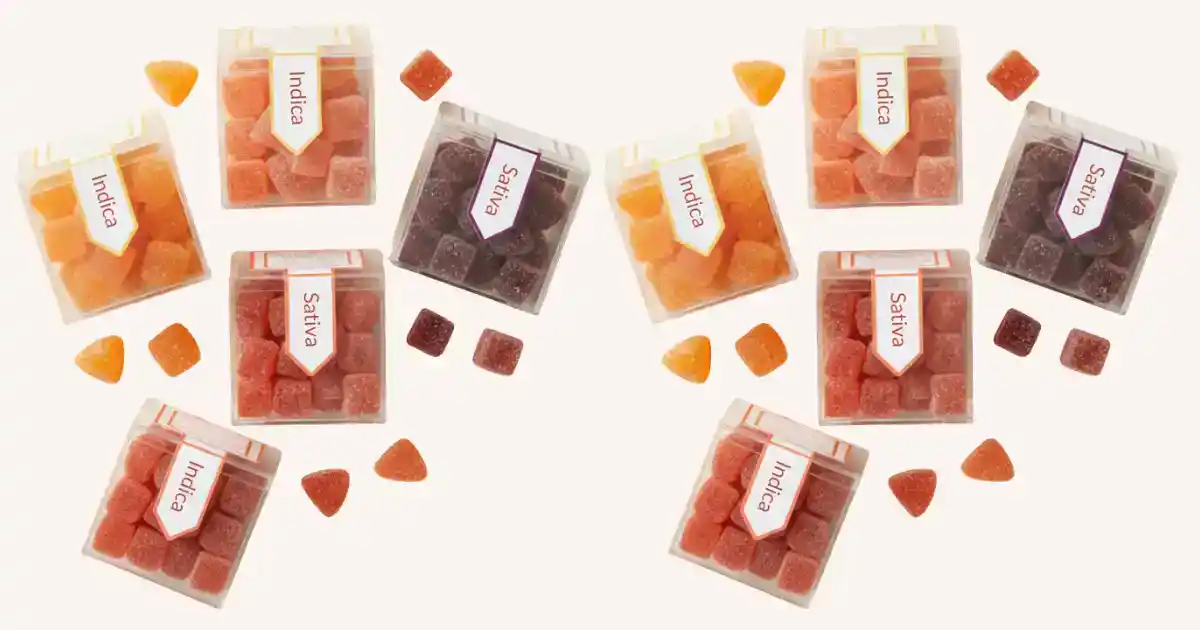
Sativa gummies are formulated for uplifting, energizing, focused effects, best for daytime use, creative projects, social situations, and staying functional.
Indica gummies are formulated for relaxation, body calm, and sleep, best for evenings, winding down, managing tension, and getting to sleep.
The key difference isn’t just sativa vs indica plant genetics. It’s the terpene profile and cannabinoid ratio that drives how each gummy feels. Here’s exactly how to choose correctly.
What Actually Makes Sativa and Indica Gummies Different?
Let’s start with the elephant in the room: gummies aren’t made from raw flower. They’re made from hemp or cannabis extract. So the classic “sativa plant is tall and lanky, indica is short and bushy” visual you learned from the internet? Basically irrelevant here.
What does matter for gummies:
- Terpene profile: The aromatic compounds added to the formulation that directly influence mood, energy, and relaxation. If mood is the deciding factor, compare our gummies picked for mood. This is the real driver of the sativa vs indica experience in gummy form.
- Cannabinoid ratio: The THC:CBD ratio and inclusion of minor cannabinoids like CBG (uplifting) or CBN (sedating) significantly shape the effect profile.
- THC type and source: Whether the gummy uses Delta-9, Delta-8, or THCa hemp extract affects potency, legality, and the character of the high.
- Dose: A low-dose sativa gummy at 5mg and a high-dose sativa at 25mg will feel very different. Dose is often the most important variable of all.
The honest truth? The sativa/indica label on a gummy is useful shorthand, but only as reliable as the brand using it. The best brands back up those labels with disclosed terpene profiles and third-party lab testing. If a brand can’t tell you which terpenes are in their “sativa” gummy, that label means nothing. For what the research says about indica vs sativa effects, see our breakdown.
🔬 Science Note
A widely cited 2011 review by Dr. Ethan Russo laid out how terpenes and cannabinoids may work together, what researchers call the “entourage effect” (Russo, British Journal of Pharmacology, 2011). This means the combination of compounds in a gummy’s formulation may matter more than any single ingredient in isolation.
The Terpene Science Behind the Effects
Terpenes are the aromatic compounds found naturally in cannabis (and thousands of other plants) that interact with your endocannabinoid system, your nervous system, and even your neurotransmitters. They’re why lavender chills you out and a citrus smell wakes you up: same principle, just in cannabis form.
Sativa Terpenes: What Creates That Uplifting Effect
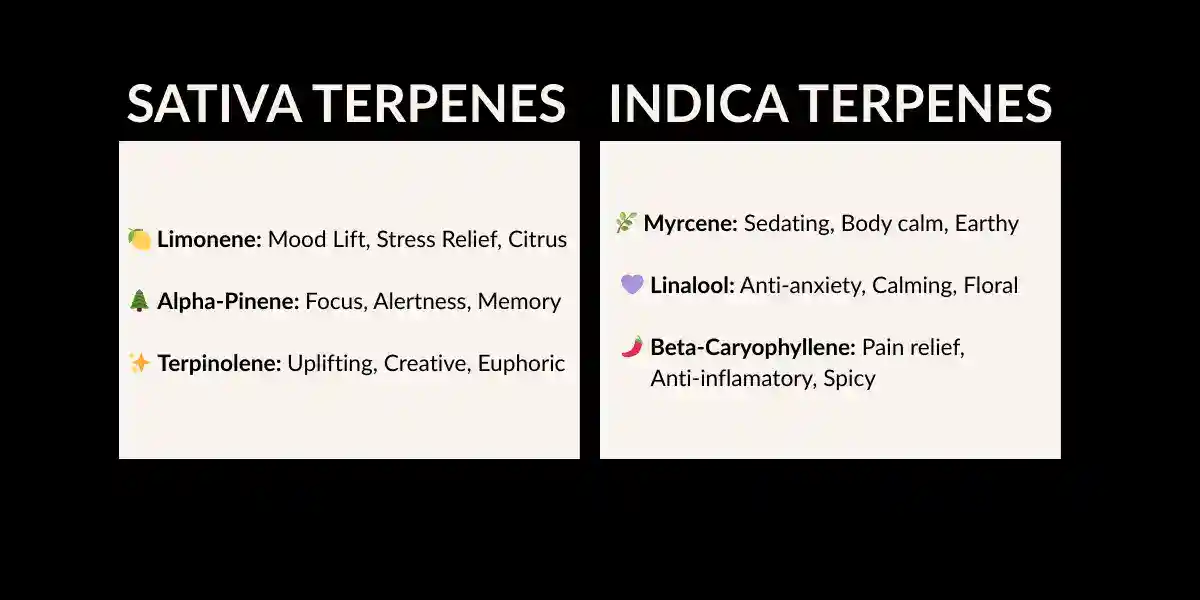
The terpenes most commonly found in sativa-formulated gummies, and what they do:
| Terpene | Aroma | Effect Profile | Research Notes |
| Limonene | Citrus, lemon | Mood elevation, stress reduction, mental uplift | A mouse study found limonene-rich lemon oil eased stress (Komiya et al., Behavioural Brain Research, 2006) |
| Alpha-Pinene | Pine, forest | Mental alertness, memory support, focus | A 2011 review proposed pinene may offset THC’s memory effects (Russo, British Journal of Pharmacology, 2011), based partly on a lab-dish study (Perry et al., Journal of Pharmacy and Pharmacology, 2000) |
| Terpinolene | Floral, herbaceous | Uplifting, slightly euphoric, creative energy | High-terpinolene products were about twice as likely to carry a sativa label in a chemical analysis of commercial cannabis (Smith et al., PLoS One, 2022), though a mouse study found it sedating (Ito and Ito, Journal of Natural Medicines, 2013) |
| Beta-Ocimene | Sweet, woody | Energizing, decongestant, anti-fatigue | Little research in people; common in tropical sativa varieties |
Indica Terpenes: The Science of Winding Down
| Terpene | Aroma | Effect Profile | Research Notes |
| Myrcene | Earthy, musky, mango | Sedating, body relaxation, muscle tension relief | Most abundant terpene in cannabis; shown to have sedative effects in mice (do Vale et al., Phytomedicine, 2002) |
| Linalool | Floral, lavender | Anti-anxiety, calming, sleep-supportive | In a mouse study, linalool’s scent had calming effects that worked through GABA receptors, the brain’s brake pedal (Harada et al., Frontiers in Behavioral Neuroscience, 2018) |
| Beta-Caryophyllene | Spicy, peppery | Body-focused calm; studied for inflammation | Unique: in lab and mouse studies it binds directly to CB2 receptors, which is why researchers call it a dietary cannabinoid (Gertsch et al., Proceedings of the National Academy of Sciences, 2008). Studied extensively for pain and inflammation |
| Humulene | Earthy, hoppy | Anti-inflammatory, appetite-suppressing (unusual for cannabis) | Related to beta-caryophyllene; found in hops and common in indica-leaning profiles |
Sativa Gummies Effects vs Indica Gummies Effects
30–90
Minutes to onset (both types)
4–8
Hours average duration
2.5–5mg
Recommended starter dose
4–12%
Typical oral bioavailability of THC
What Sativa Gummies Feel Like
A well-formulated sativa gummy at the right dose feels like: your brain got a software update. Thoughts flow faster, colors are a little brighter, conversations are easier, and that creative project you’ve been procrastinating? Suddenly very interesting.
Specific effects users commonly report from sativa gummies:
- Mental clarity and heightened focus (especially at lower doses, 5–10mg)
- Mood elevation without heavy sedation
- Increased sociability and talkativeness
- Creative thinking and idea generation
- Mild energetic boost: not like coffee, more like… enthusiastic curiosity
- Appetite stimulation (less pronounced than indica)
Important caveat: At high doses (20mg+), even sativa gummies can cause anxiety, racing thoughts, or paranoia in sensitive users. Sativa doesn’t grant immunity from going too far. It just starts the trip in a different neighborhood.
What Indica Gummies Feel Like
Indica gummies are basically a weighted blanket in edible form. They start with a gentle wave of physical relaxation, then move to full-body calm, mental quieting, and often a strong case of “the couch is perfect and I need nothing.”
Specific effects users commonly report from indica gummies:
- Deep body relaxation and muscle tension relief
- Mental slowing: the “turn the volume down on your brain” effect
- Increased drowsiness, especially at higher doses
- Stronger appetite stimulation (“the munchies”; myrcene contributes here)
- Reduced pain perception and physical discomfort
- General sense of contentment and calm
Sativa vs Indica Gummies: Head-to-Head Comparison
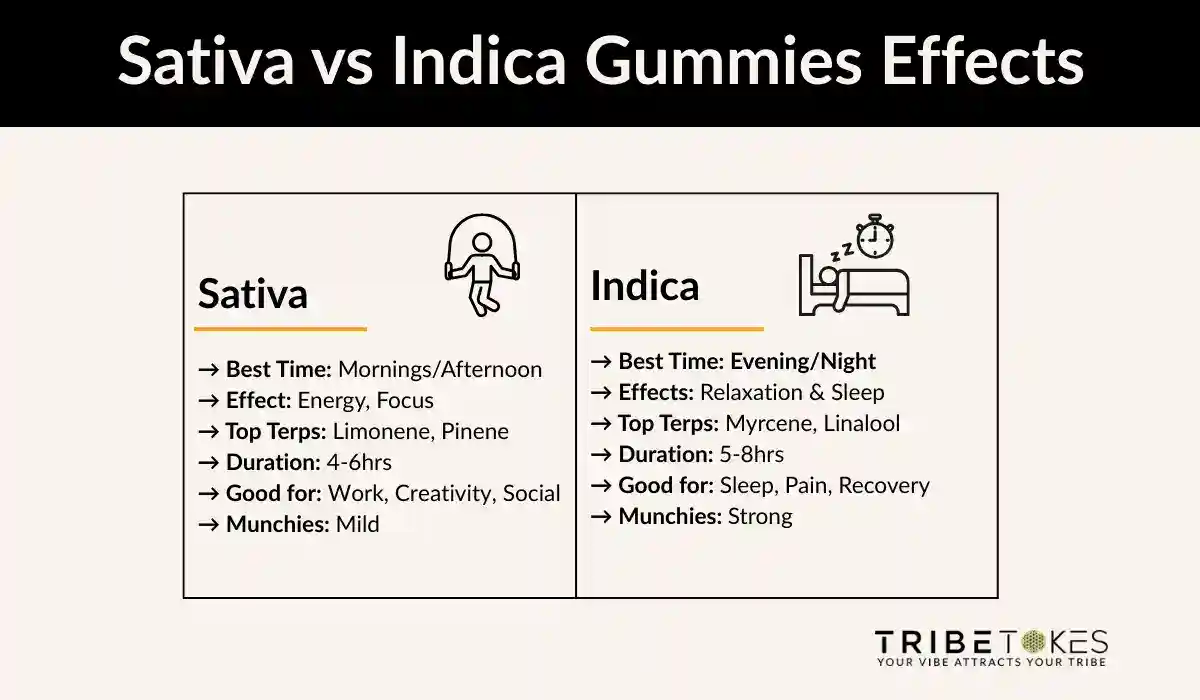
| Category | 🌞 Sativa Gummies | 🌙 Indica Gummies |
| Best Time to Take | Morning, afternoon, early evening | Evening, nighttime |
| Primary Effect | Mental uplift, energy, focus | Body relaxation, calm, sleep |
| Key Terpenes | Limonene, Pinene, Terpinolene | Myrcene, Linalool, Caryophyllene |
| Onset Time | 30–90 minutes | 30–90 minutes |
| Duration | 4–6 hours typical | 5–8 hours typical (body effects linger) |
| Ideal For | Work, creativity, socializing, exercise | Sleep, recovery, winding down |
| Munchies Intensity | Mild–moderate | Strong (myrcene amplifies appetite) |
| Anxiety Risk (high dose) | Moderate (racing thoughts possible) | Lower (calming terpenes buffer) |
| Good for Beginners? | Yes, at 2.5–5mg | Yes, at 2.5–5mg |
| CBG Addition Common? | ✓ Yes (amplifies energy) | ✗ Less common |
| CBN Addition Common? | ✗ Rarely | ✓ Yes (amplifies sleepiness) |
Best Use Cases: When to Choose Which
Choose Sativa Gummies If You Want To:
- Stay productive: The limonene + pinene combo in a quality sativa gummy can enhance focus and creative thinking without the body-lock that makes indica users one with their couch.
- Enjoy social situations: Sativa gummies at a moderate dose (5–10mg) can take the edge off social anxiety while keeping you alert, conversational, and present.
- Exercise or move: Some athletes use low-dose sativa gummies pre-workout for mood enhancement and reduced exercise-induced anxiety. In a 2019 online survey of 605 cannabis users in legal states, most who used cannabis around workouts said it made exercise more enjoyable and helped recovery (YorkWilliams et al., Frontiers in Public Health, 2019).
- Boost creativity: Anecdotally, cannabis can increase “divergent thinking”, the kind of brainstorming that breaks you out of rigid thought patterns. Sativa profiles amplify this.
- Daytime relief without sedation: If you need mild pain or anxiety management during the day but need to function, sativa gummies at a low dose are the better call over indica.
Choose Indica Gummies If You Want To:
- Sleep: This is indica’s superpower. The myrcene + linalool combination, especially paired with CBN, is one of the most effective natural approaches to sleep onset and quality. In a small chart review of 38 medical cannabis patients with sleep problems, 71% reported improvement in their sleep or a related condition, and 39% cut back on or stopped a prescription sleep medication (Vaillancourt et al., Canadian Pharmacists Journal, 2022).
- Manage physical pain or tension: In lab and mouse studies, beta-caryophyllene binds to CB2 receptors, which are involved in inflammation (Gertsch et al., Proceedings of the National Academy of Sciences, 2008).
- Wind down from stress: After a rough day, indica gummies create a psychological and physical decompression that sativa simply doesn’t replicate. It’s the difference between “let’s think through this problem” and “the problem can wait, I am fine.”
- Manage nausea or appetite issues: Indica-profile cannabinoids tend to produce stronger anti-nausea effects and appetite stimulation, relevant for those in recovery or dealing with GI issues.
- Body recovery: Post-workout recovery, muscle soreness, or general physical recovery is better served by indica’s anti-inflammatory and muscle-relaxing properties.
💡 Pro Tip
Still can’t decide? Most seasoned cannabis users keep both on hand. Sativa for the day, indica for the night. It’s not either/or. It’s a toolkit. Think of it like coffee vs chamomile tea: both are valid, just at different times.
Dosing Guide: Sativa & Indica Gummies
Here’s where most people mess up: they underestimate edibles, take another dose at the 45-minute mark, and then they’ve eaten three gummies and suddenly they’re having a full internal monologue about the concept of time. Don’t do that.
Edible bioavailability is low, roughly 4% to 12% in studies (inhaled THC runs about 10% to 35%), according to a review of how the body absorbs cannabinoids (Grotenhermen, Clinical Pharmacokinetics, 2003). Your body absorbs a smaller portion, but what it does absorb is processed through your liver into 11-hydroxy-THC, which is more potent and longer-lasting than regular THC. This is why edibles hit differently than vaping. And why patience is non-negotiable. More on bioavailability and why it changes by method.
| Experience Level | Recommended Dose | Expected Effects | Wait Time Before Redosing |
| Total Beginner | 2.5mg THC | Subtle mood lift, mild relaxation, may feel very little | At least 2 hours. Better yet, save a bigger dose for another day. |
| Occasional User | 5–10mg THC | Clear psychoactive effect, manageable for most | 2 hours minimum |
| Regular User | 10–25mg THC | Strong effects, significant euphoria or sedation | 90 minutes minimum |
| Experienced / High Tolerance | 25–50mg+ THC | Very strong effects, not recommended without tolerance | Only after first dose fully settles |
⚠️ Important
Start low, go slow, and actually mean it. The number one reason people have bad edible experiences is impatience. Both sativa and indica gummies can cause anxiety, paranoia, or discomfort at doses too high for your tolerance. Always wait at least 90–120 minutes before considering a second dose. If you’re new, 2.5–5mg is plenty. You can always take more next time.
Find Your Match: Shop TribeTokes Gummies
Lab-tested, terpene-forward, and made without fillers or artificial junk. Sativa and indica formulas available, with full COAs so you actually know what you’re getting.
What to Look for When Buying Sativa or Indica Gummies
The gummy market is crowded with brands using sativa/indica labels as marketing rather than science. Here’s how to separate the real from the ridiculous:
- Third-party COAs (Certificates of Analysis): No COA = no buy. Period. COAs from accredited labs verify THC/CBD content, confirm the absence of pesticides, heavy metals, and residual solvents, and increasingly include terpene profiles. If the brand doesn’t post them publicly, that’s your answer.
- Disclosed terpene profile: A brand that says “sativa gummies” but can’t tell you which terpenes are in the formula is just selling you vibes. Look for specific terpene disclosures: limonene, pinene, myrcene, linalool, etc.
- Accurate THC dosing: A 2015 lab analysis of 75 edibles found only 17% were accurately labeled for THC: 23% had more than the label said and 60% had less (Vandrey et al., JAMA, 2015). Brands that manufacture in compliant facilities with consistent COAs are far more reliable.
- Clean ingredient list: Avoid gummies with artificial dyes (Red 40, Yellow 5), corn syrup as the primary sweetener, or unnamed “natural flavors” as the fourth ingredient. Better gummies use pectin (vegan-friendly) or gelatin, real fruit juice for flavor, and minimal additives.
- Minor cannabinoids that match the effect: Sativa gummies with added CBG? Yes. Indica gummies with added CBN? Absolutely. These minor cannabinoids enhance the intended profile. Sativa gummies with CBN added? Red flag: that’s working against the goal.
What About Hybrid Gummies?
Hybrid gummies are formulated to deliver balanced effects: not quite “energized and focused,” not quite “couch-locked and sleepy,” but somewhere in the middle. Think of them as the “afternoon” option: functional enough for early evening, relaxed enough that you’re not grinding at the gym.
Hybrid formulas typically combine terpenes from both profiles, often limonene or terpinolene for mood lift alongside beta-caryophyllene for a calmer, body-focused edge. The result is a more well-rounded experience that works across a wider range of situations.
Hybrid gummies are a solid choice if:
- You’re newer to edibles and want a middle-ground experience
- You want relaxation without full sedation
- You’re microdosing throughout the day
- You’ve found pure sativa too stimulating and pure indica too sedating
For a deeper dive into how sativa and indica cannabis types differ across all product formats (vapes, gummies, flower), check out our guide to indica vs sativa.

Frequently Asked Questions: Sativa vs Indica Gummies
Sativa gummies are formulated with uplifting terpenes (limonene, pinene) for energizing, focused, and mentally stimulating effects, best for daytime use. Indica gummies are formulated with calming terpenes (myrcene, linalool) for relaxation, body calm, and sleep, best for evening use. The key difference is terpene profile and cannabinoid ratio, not just plant genetics.
Sativa gummies can produce a more alert, focused, and mentally stimulating experience. They lean on terpenes like limonene and pinene: in a mouse study, limonene-rich lemon oil eased stress (Komiya et al., Behavioural Brain Research, 2006), and a 2011 review proposed pinene may offset THC’s memory effects (Russo, British Journal of Pharmacology, 2011). They’re not caffeine. They create energized curiosity rather than wired stimulation. Dose matters a lot: 5mg feels very different from 25mg.
Indica gummies, hands down. They’re typically formulated with myrcene-rich terpene blends and higher relaxing cannabinoid ratios that promote drowsiness. Animal research points the same way: myrcene and linalool have both shown sedating or calming effects in mice (do Vale et al., Phytomedicine, 2002; Harada et al., Frontiers in Behavioral Neuroscience, 2018). Look for indica gummies with added CBN for maximum sleep support.
Technically yes, but it’s not ideal. Sativa gummies can cause mental stimulation, racing thoughts, and increased energy, exactly what you don’t want when trying to sleep. If you need nighttime relief, choose an indica or a hybrid-leaning formula. Reserve sativa for mornings and afternoons.
Gummies, whether sativa or indica, typically take 30–90 minutes to take effect, depending on your metabolism, food consumption, and the formulation. Nano-emulsified gummies can onset in as little as 15–30 minutes. Effects generally last 4–8 hours. Always wait the full 90 minutes before considering a second dose.
Sativa gummies: limonene (mood uplift), alpha-pinene (focus, alertness), and terpinolene (creative, euphoric energy). Indica gummies: myrcene (sedating, body relaxation), linalool (anti-anxiety, calming), and beta-caryophyllene (body-focused calm). These terpene profiles are what actually drive the sativa/indica experience in edible form. For specific picks, see our sativa gummy roundup for energy and focus.
Hemp-derived gummies are sold under federal hemp rules, but federal and state hemp laws are changing, and some states restrict Delta-8 and THCa products. Always verify your state’s current laws and buy only from brands that publish third-party Certificates of Analysis. TribeTokes publishes all of its COAs.
Beginners: start with 2.5–5mg THC regardless of type. Occasional users: 5–10mg. Experienced users: 10–25mg. Wait at least 90–120 minutes before considering a second dose. Edibles are processed differently from inhaled cannabis. They hit slower, harder, and last longer. Patience is not optional here.
Partially. Traditional plant-based sativa/indica distinctions don’t directly translate to gummies made from extract. What matters more is terpene profile, cannabinoid ratio, and formulation quality. Reputable brands use targeted terpene blends to engineer specific effects. Look for brands that disclose terpene content and back everything with third-party lab testing.
Look for sativa gummies with limonene, pinene, and terpinolene terpenes, a 1:1 or THC-dominant ratio, and under 10mg THC for daytime use. TribeTokes sativa gummies are lab-tested, terpene-forward, and formulated without fillers or artificial additives, an excellent starting point for daytime cannabis use.
Ready to Try? Start With TribeTokes Gummies.
Full COAs. Clean ingredients. Terpene-forward formulas that actually do what the label says. No guessing required.
Sources
- Russo, E.B. (2011). “Taming THC: potential cannabis synergy and phytocannabinoid-terpenoid entourage effects.” British Journal of Pharmacology, 163(7), 1344-1364. PubMed: 21749363.
- Komiya, M., Takeuchi, T. and Harada, E. (2006). “Lemon oil vapor causes an anti-stress effect via modulating the 5-HT and DA activities in mice.” Behavioural Brain Research, 172(2), 240-249. PubMed: 16780969.
- Perry, N.S., Houghton, P.J., et al. (2000). “In-vitro inhibition of human erythrocyte acetylcholinesterase by Salvia lavandulaefolia essential oil and constituent terpenes.” Journal of Pharmacy and Pharmacology, 52(7), 895-902. PubMed: 10933142.
- Harada, H., Kashiwadani, H., Kanmura, Y. and Kuwaki, T. (2018). “Linalool Odor-Induced Anxiolytic Effects in Mice.” Frontiers in Behavioral Neuroscience, 12, 241. PubMed: 30405369.
- do Vale, T.G., Furtado, E.C., Santos, J.G. Jr. and Viana, G.S. (2002). “Central effects of citral, myrcene and limonene, constituents of essential oil chemotypes from Lippia alba (Mill.) n.e. Brown.” Phytomedicine, 9(8), 709-714. PubMed: 12587690.
- Gertsch, J., Leonti, M., et al. (2008). “Beta-caryophyllene is a dietary cannabinoid.” Proceedings of the National Academy of Sciences, 105(26), 9099-9104. PubMed: 18574142.
- YorkWilliams, S.L., Gust, C.J., et al. (2019). “The New Runner’s High? Examining Relationships Between Cannabis Use and Exercise Behavior in States With Legalized Cannabis.” Frontiers in Public Health, 7, 99. PubMed: 31114776.
- Vaillancourt, R., Gallagher, S., Cameron, J.D. and Dhalla, R. (2022). “Cannabis use in patients with insomnia and sleep disorders: Retrospective chart review.” Canadian Pharmacists Journal, 155(3), 175-180. PubMed: 35519083.
- Vandrey, R., Raber, J.C., et al. (2015). “Cannabinoid Dose and Label Accuracy in Edible Medical Cannabis Products.” JAMA, 313(24), 2491-2493. PubMed: 26103034.
- Grotenhermen, F. (2003). “Pharmacokinetics and pharmacodynamics of cannabinoids.” Clinical Pharmacokinetics, 42(4), 327-360. PubMed: 12648025.
- Smith, C.J., Vergara, D., Keegan, B. and Jikomes, N. (2022). “The phytochemical diversity of commercial Cannabis in the United States.” PLoS One, 17(5), e0267498. PubMed: 35588111.
- Ito, K. and Ito, M. (2013). “The sedative effect of inhaled terpinolene in mice and its structure-activity relationships.” Journal of Natural Medicines, 67(4), 833-837. PubMed: 23339024.