

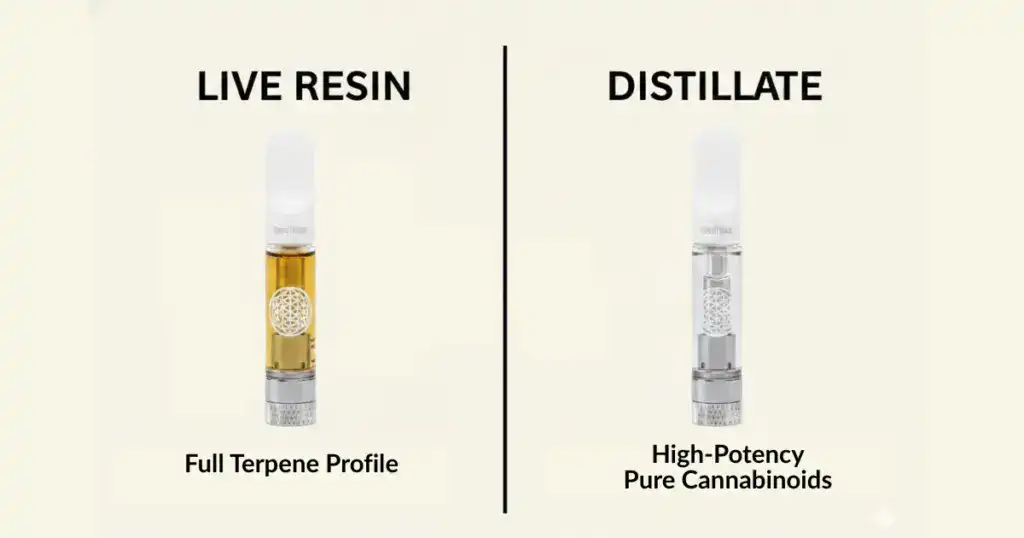
What’s the Difference Between Live Resin and Distillate?
If you’ve ever stood in a dispensary (or scrolled through an online menu) staring at two THCa carts with wildly different price tags, you’ve probably wondered: what’s actually different here?
Here’s the thing—live resin and distillate are both cannabis concentrates that’ll get you high, but they take completely different paths to get there. And those paths make all the difference in flavor, effects, and whether you’ll be reaching for that cart again tomorrow.
Live resin is made from fresh-frozen cannabis flower that’s never been dried or cured. This preserves the plant’s full terpene profile—those aromatic compounds that give each strain its unique smell, taste, and vibe. When you hit a live resin cart, you’re getting the whole plant experience: THCa plus 5-15% natural terpenes working together.
Distillate is the exact opposite approach. It’s cannabis oil that’s been refined, heated, and stripped down to almost pure THCa (85-99%). The process removes nearly all terpenes and other cannabinoids, leaving you with a clear, odorless, flavorless concentrate. Think of it as the clean, potent base: high in THCa, with flavor coming from the terpenes added back.
💡 The Bottom Line: Live resin = full-spectrum, flavorful, expensive. Distillate = pure THC, flavor from added terpenes, consistent every time.
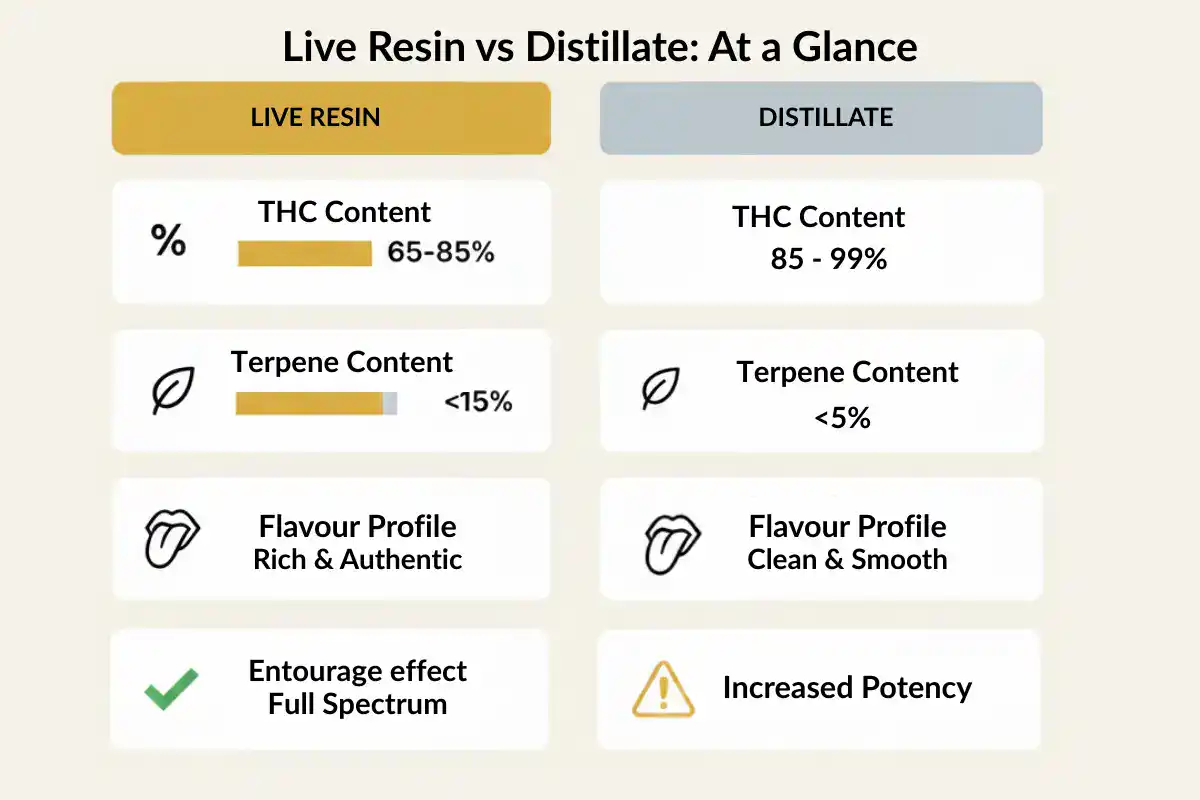
| Feature | Live Resin THCa Carts | Distillate THCa Carts |
| THC Content | 65-85% | 85-99% |
| Terpene Content | 5-15% (natural) | <1% (often added back) |
| Flavor Profile | Rich, strain-specific, authentic | Depends on the added terpenes |
| Effects | Full-spectrum, entourage effect | Potent, straightforward high |
| Price Range | $40-80 per cart | $20-50 per cart |
| Best For | Flavor lovers, connoisseurs | Consistent potency, high tolerance users |
Extraction Methods: How They’re Made
Understanding how these carts are made helps explain why they’re so different (and why one costs twice as much as the other).
Live Resin Extraction: Flash-Frozen Freshness
Live resin starts with cannabis plants that are flash-frozen within hours of harvest—we’re talking liquid nitrogen or dry ice cold, like -40°F. This locks in the terpenes and cannabinoids at their peak, before they have a chance to degrade during the typical drying and curing process.
Then, extractors use solvents like butane or propane (don’t worry, it’s all purged out later) to pull the good stuff from the frozen plant material. Because the plant was never dried, you get way more terpenes in the final product—hence that intense flavor and aroma. Prefer no solvent at all? Here’s how live resin vs rosin compares.
The result? A thick, amber-colored concentrate that smells amazing and tastes like the actual strain it came from.
Distillate Extraction: Refined to Perfection
Distillate takes a different route. It usually starts with a basic cannabis extract (often made from dried, cured plant material), which is then heated and run through a distillation process multiple times.
Each round of distillation strips away more plant compounds—terpenes, flavonoids, waxes, fats—until you’re left with nearly pure THCa. The process can hit temperatures of 250-300°F, which is why terpenes (which evaporate at lower temps) don’t survive.
What you end up with is a clear or light-gold oil that’s incredibly potent but basically flavorless. Many manufacturers add terpenes back in afterward—either cannabis-derived terpenes (CDT) or botanical terpenes (BDT) from other plants—to give the cart some taste and aroma.
🧪 Fun Fact: Live resin extraction happens at sub-zero temperatures to preserve terpenes. Distillation happens at high heat to isolate pure THC. Completely opposite approaches!
Lab Testing: What the COAs Tell Us
Here’s where things get real: the lab results. If you’re buying quality THCa carts, you should always check the Certificate of Analysis (COA)—that’s the third-party lab report that shows exactly what’s in your cart.
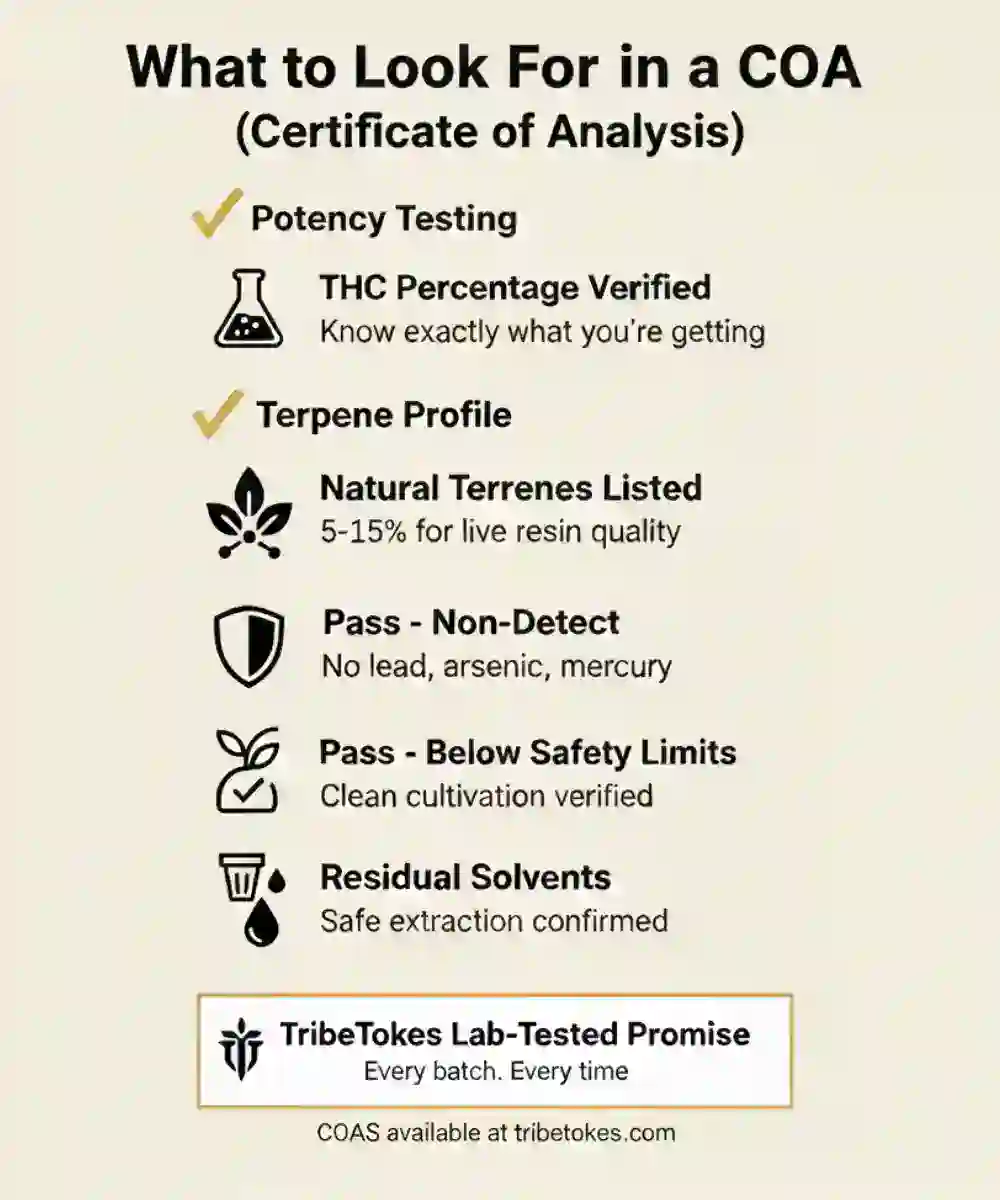
What to Look for in Live Resin COAs
- Total THC: Typically 65-85%
- Terpene Profile: Should show 5-15% total terpenes with specific names (myrcene, limonene, caryophyllene, etc.)
- Minor Cannabinoids: Look for CBG, CBC, CBN—these contribute to the entourage effect
- Residual Solvents: Should be below detection limits or pass state safety standards
- Pesticides & Heavy Metals: Must pass (non-detect or below safety thresholds)
What to Look for in Distillate COAs
- Total THC: Usually 85-99%
- Terpene Content: Often <1% unless terpenes were added back (check if they’re CDT or BDT)
- Other Cannabinoids: Minimal or none—distillation strips these out
- Residual Solvents: Should still pass safety tests
- Purity Tests: Clean on pesticides, heavy metals, microbials
At TribeTokes, we lab-test every batch of our 12-strain THCa live resin carts and make COAs publicly available. Whether you’re buying live resin or distillate, you should never have to guess what’s in your cart.
⚠️ Red Flag: If a brand doesn’t provide COAs or won’t share lab results, walk away. You deserve to know exactly what you’re inhaling.
Potency Comparison: Which Hits Harder?
Let’s talk about what everyone really wants to know: which one gets you more high?
On paper, distillate wins. With 85-99% THC, it’s objectively more potent by percentage. Take a hit of distillate, and you’re getting almost pure THCa—no filler, no extras, just straight cannabinoid.
But here’s where it gets interesting: higher THC percentage doesn’t always mean a stronger high.
The Entourage Effect (Why Live Resin Punches Above Its Weight)
Live resin typically tests at 65-85% THC—technically “weaker” than distillate. But because it contains 5-15% terpenes plus minor cannabinoids like CBG and CBC, you get what’s called the entourage effect.
This is the theory that cannabinoids and terpenes work better together than in isolation. It’s a well-known idea in cannabis science (Russo, British Journal of Pharmacology, 2011), but the research is still early: one lab study in cells found six common cannabis terpenes didn’t change how THC acts at the CB1 and CB2 receptors (Santiago et al., Cannabis and Cannabinoid Research, 2019). If the effect is real, it likely works some other way. Terpenes can enhance, modulate, or extend the effects of THC. For example:
- Myrcene (earthy, musky) may enhance THC’s sedative effects
- Limonene (citrus) may boost mood and energy
- Caryophyllene (peppery) may reduce anxiety and inflammation
So even though live resin has “less THC,” many users report it feels more potent, more rounded, and longer-lasting than distillate.
Distillate: Fast, Intense, Straightforward
Distillate gives you a clean, powerful high—no surprises, no complexity. It hits fast and hard, which is great if you have a high tolerance or you’re looking for quick relief.
With fewer natural terpenes, the high tends to feel more straightforward.
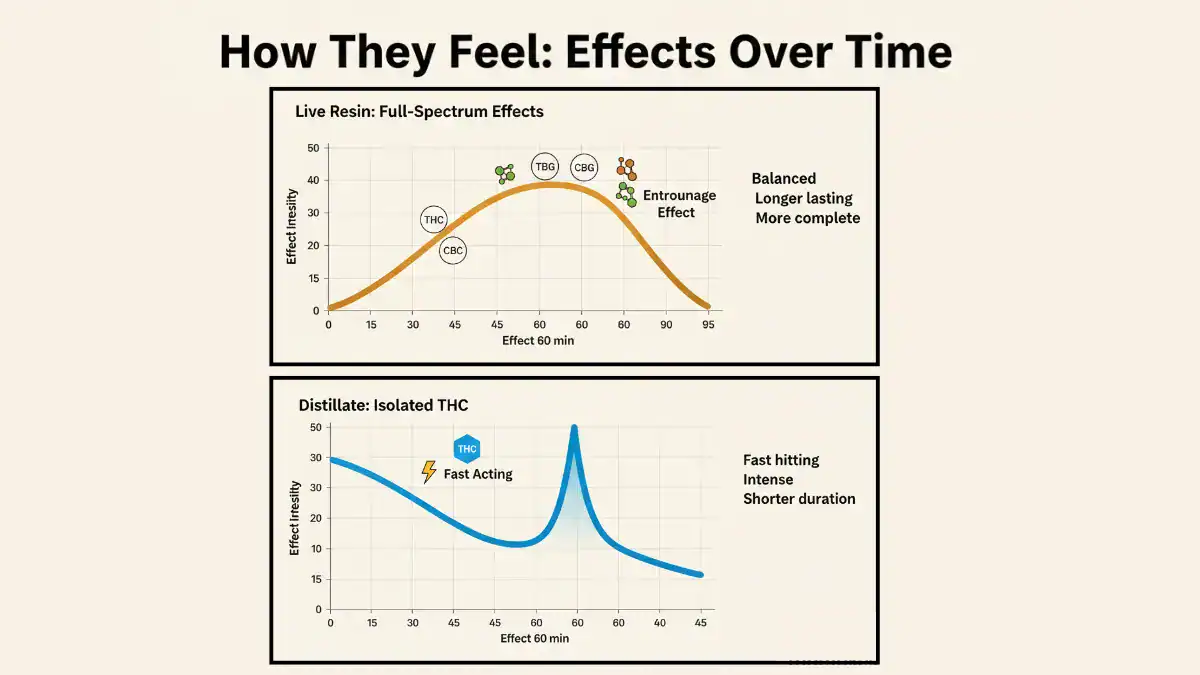
💡 User Experience: Distillate = higher THC %, faster onset, shorter duration. Live resin = lower THC % but fuller effects, longer duration, more nuanced high.
Flavor & Terpenes: The Taste Test
If you care about flavor—and honestly, who doesn’t?—this section is huge.
Live Resin: The Full Sensory Experience
Live resin carts taste like actual weed. You know that distinct, dank, strain-specific flavor you get from smoking flower? That’s what live resin captures.
With 5-15% natural terpenes, every puff is packed with flavor. You’ll notice earthy, piney, citrusy, fruity, or diesel notes depending on the strain. And because those terpenes are intact, the flavor stays consistent from the first hit to the last drop.
If you’re someone who loves exploring different strains and appreciating the nuances of cannabis, live resin is your jam.
Distillate: Minimal Flavor (Unless Terpenes Are Added)
Pure distillate has basically no flavor—it’s odorless and tasteless. That’s why most distillate carts have terpenes added back in afterward.
The catch? Those added terpenes are either:
- Cannabis-Derived Terpenes (CDT): Extracted from real cannabis plants. More expensive but taste authentic.
- Botanical Terpenes (BDT): Extracted from other plants (citrus peels, pine trees, etc.). Lower price per gram, with flavor that depends on the blend.
Live resin’s flavor comes from the plant’s own terpene profile, captured at harvest, which is why it tastes layered and strain-specific. With distillate, the flavor comes from the terpene blend added back, so the quality of that blend is what to look at.
| Flavor Factor | Live Resin | Distillate |
| Natural Terpenes | ✅ 5-15% | ❌ <1% (unless added) |
| Strain-Specific Taste | ✅ Authentic | ⚠️ Depends on added terps |
| Flavor Consistency | ✅ Strong throughout | ⚠️ Depends on the added terpenes |
| Aroma | ✅ Strong, dank | ⚠️ Depends on the added terpenes |
🍃 Terpene Tip: If you buy a distillate cart, look for ones with cannabis-derived terpenes (CDT) for better flavor. Cannabis-derived and botanical terpenes are both fine; vague “flavoring” with no terpene source listed is worth a question.
Effects Comparison: How They Feel Different
Alright, let’s get into the nitty-gritty: how do these carts actually make you feel?
Live Resin: The Full-Spectrum High
Live resin delivers what cannabis enthusiasts call a “full-spectrum” or “whole-plant” high. Because you’re getting THC, terpenes, and minor cannabinoids all working together, the effects are more layered and nuanced.
Users typically describe live resin effects as:
- More balanced: Less racy, less anxious, more grounded
- Longer-lasting: The high builds gradually and sticks around
- Strain-specific: A sativa live resin feels different from an indica live resin (thanks, terpenes!)
- More “complete”: You get the head high and the body relaxation
The entourage effect means the high is more than just “I’m stoned”—it’s “I feel creative” or “I feel relaxed but focused” or “I’m laughing at everything and my body feels amazing.” Live resin tends to hit the sweet spot between mind and body effects.
Distillate: The Potent, Predictable High
Distillate is all about that pure THC experience. It hits fast—within 1-3 minutes—and the effects are straightforward:
- Strong cerebral high: Mostly in your head, less body sensation
- Fast onset, shorter duration: Peaks quickly, fades quicker
- Consistent: Same experience every time (good for medical users who need predictability)
- More straightforward: Fewer natural terpenes, so the experience is cleaner and more predictable
If you have a high tolerance or you’re using cannabis for specific symptoms (like pain or nausea), distillate’s pure potency can be exactly what you need. If you’re a flavor chaser or love exploring different strains, live resin is where that pays off.
👤 Real User Feedback: “Live resin makes me feel like I just smoked a really good joint. Distillate makes me feel high, but it’s missing that magic.” —TribeTokes customer review
Price & Value: Is Live Resin Worth It?
Let’s talk money. Because yeah, live resin costs more—sometimes a lot more.
Typical Price Ranges (2025)
| Cart Type | Price Range (0.5g) | Price Range (1g) |
| Live Resin | $40-60 | $70-100 |
| Distillate | $20-35 | $35-60 |
Why the price gap? Live resin is more expensive to produce:
- Flash-freezing equipment isn’t cheap
- Fresher starting material (whole flower, not trim)
- Lower yields (you get less product per pound of flower)
- More labor-intensive process
Distillate costs less to make because it can start from dried plant material, and distillation is more efficient at scale.
Value Breakdown: What Are You Actually Paying For?
With Live Resin, you’re paying for:
- Rich, authentic flavor
- Full-spectrum effects (entourage effect)
- Premium starting material
- Strain-specific experience
With Distillate, you’re paying for:
- Maximum THC potency
- Consistent, predictable effects
- Easy, predictable dosing
- Versatility (works in edibles, tinctures, etc.)
Is live resin “worth it”? That depends on what you value. If flavor and full-spectrum effects matter to you, absolutely. If you want strong, predictable effects, distillate makes more sense.
💡 Try Both: Start with a distillate cart to learn your dose, then try live resin and see how much the terpenes matter to you. No wrong answer.
How to Choose: Which One Is Right for You?
Okay, decision time. Here’s how to figure out which cart matches your needs.
Choose Live Resin If You:
- Love exploring different strains and flavors
- Want the full-spectrum entourage effect
- Prefer a more balanced, nuanced high
- Are willing to pay extra for premium quality
- Use cannabis for both recreational enjoyment and therapeutic benefits
Choose Distillate If You:
- Prioritize maximum THC potency
- Want consistent, predictable effects
- Want the most THC per puff
- Have a high tolerance and need strong doses
- Want a simple, no-fuss cart for everyday use
The Hybrid Approach: Why Not Both?
Here’s a pro tip: you don’t have to pick just one. Many cannabis users keep both on hand:
- Live resin for evenings, weekends, or when you want to savor the experience
- Distillate for quick relief, microdosing, or busy days
At TribeTokes, we offer both options because we know different situations call for different tools. Use what works for you, when it works for you.
Frequently Asked Questions
Live resin preserves the full terpene profile from fresh-frozen cannabis, offering rich flavor and the entourage effect (THC: 65-85%). Distillate is highly refined, nearly pure THCa (85-99%) with minimal terpenes, delivering potent but less complex effects.
Distillate carts have higher THC percentages (85-99%) compared to live resin (65-85%). However, many users report live resin feels more potent due to the entourage effect—where cannabinoids and terpenes work together synergistically.
Yes, live resin carts typically offer superior flavor. They retain 5-15% natural terpenes from the cannabis plant, providing authentic strain-specific taste. Distillate carts contain less than 1% natural terpenes, so terpenes are usually added back, either cannabis-derived or botanical.
If you prioritize flavor, full-spectrum effects, and a more rounded high, yes. Live resin costs $10-25 more per cart but delivers a premium experience. If you want maximum THC potency, distillate is the stronger pick by percentage.
Distillate is often better for beginners due to its predictable, straightforward effects. Live resin’s complex terpene profile and entourage effect can be overwhelming if you’re not used to cannabis.
Check the label and COA. Live resin will list terpene percentages (5-15%) and may appear darker amber. Distillate is typically clear to light gold with minimal terpenes. Live resin products usually cost more and prominently advertise the extraction method.
Yes, distillate carts deliver strong psychoactive effects from pure THCa. However, without terpenes, you miss the entourage effect and strain-specific characteristics. Many distillate carts add terpenes back in for flavor and enhanced effects.
Both can be equally safe when lab-tested and from reputable brands. The extraction method doesn’t inherently make one safer. Always check for third-party COAs testing for potency, pesticides, heavy metals, and residual solvents regardless of cart type.
Yes, both work with standard 510-thread batteries. However, live resin carts perform best at lower voltages (2.5-3.3V) to preserve terpenes, while distillate can handle higher settings (3.3-4.0V). Any cart oil breaks down more as the heat goes up, though: in a lab study, THC and myrcene breakdown products rose right along with the power applied to the device (Meehan-Atrash et al., RSC Advances, 2021).
Shelf life is similar (6-12 months stored properly). However, distillate carts may provide more puffs per dollar due to lower viscosity and price. Live resin’s effects may last longer per session due to the entourage effect, potentially meaning you use less overall.